
The Art of Incense in Korea and Japan
In Korea as in Japan, incense has for centuries accompanied gestures that are both simple and deeply ingrained. It crosses the spaces of the temple and the home, connects the living to the departed, and is part of a mindful relationship with time and matter. Stemming from the same continental heritage, it has given rise to two distinct cultures that share a common foundation while developing their own unique sensibilities.
The Paths of Incense
The use of incense originated in China, nourished by exchanges with South and Southeast Asia, from which agarwood, sandalwood, and aromatic resins were sourced. With the spread of Buddhism, these materials became integrated into a set of ritual practices where smoke became an offering, purification, and mediation between the visible and invisible worlds.
Buddhism was introduced to Korea starting in the 4th century, first in the Goguryeo and Baekje kingdoms, then in Silla. Incense immediately took on an essential role in religious practices there. In Japan, the official transmission of Buddhism occurred in the 6th century through the Korean kingdom of Baekje. Ancient Japanese chronicles, notably the Nihon Shoki, a historical text compiled in the early 8th century, report this introduction to the Japanese court in the form of Buddhist images, texts, and ritual objects.
Incense was part of this transmission and became firmly established in Japan. A narrative preserved in these same chronicles also mentions the arrival of fragrant wood on the shores of Awaji Island in the 6th century. Burned by inhabitants, it released a remarkable scent and was presented to the court. This narrative is part of Japan's cultural memory of incense, alongside the religious and diplomatic history of its transmission.

Offering, Purification, and Memory
In both countries, incense remains inseparable from religious practices, family rituals, and the relationship with the deceased.
In Korea, jesa refers to a set of commemorative rites performed to honor ancestors and express filial gratitude. During these ceremonies, incense is placed before the offering table, along with food, ritual drinks, and other items prepared for the deceased. The smoke accompanies the opening of the rite and imbues the gesture with a sense of respect for ancestors. Rites can also take place at the cemetery, particularly during myoje, performed at gravesites at certain times of the year.
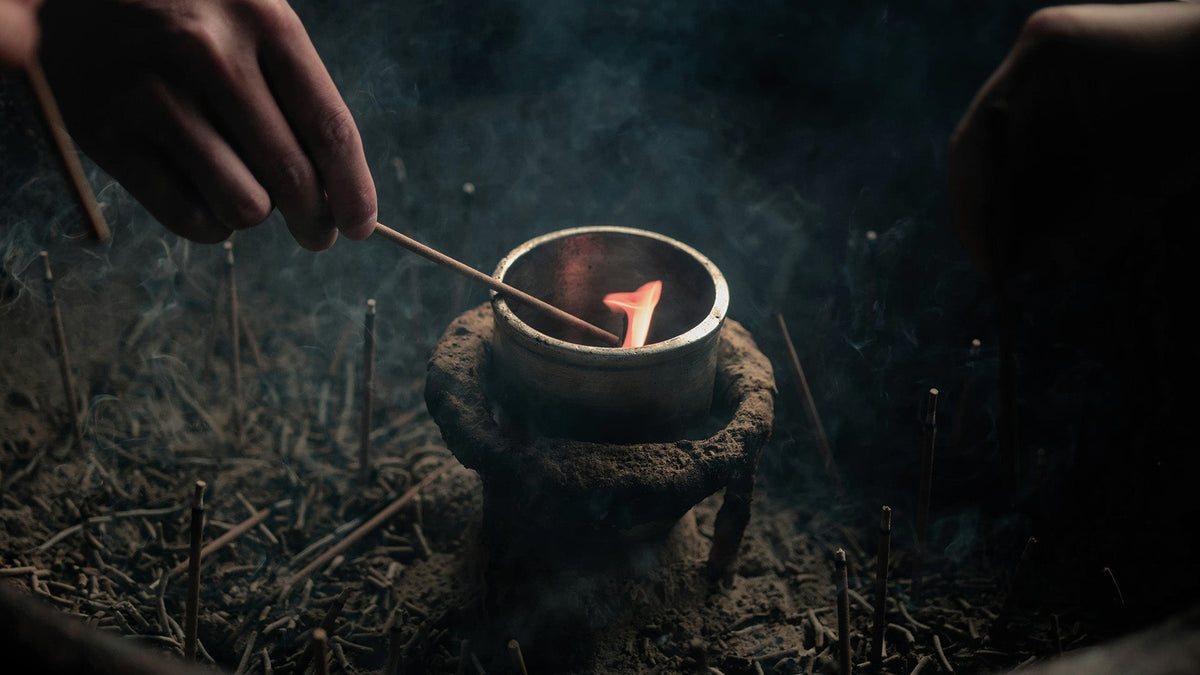
In Japan, incense is one of the fundamental Buddhist offerings, alongside flowers, light, and food. In the hondo, the temple's main hall, the censer is placed on or in front of the altar. Worshippers can place an incense stick or a pinch of incense there before joining their hands in prayer. In many temples, large communal censers hold the sticks offered by visitors, the smoke forming a space for purification and contemplation. In the home, incense is offered before the butsudan, the domestic altar. The practice involves lighting a candle and an incense stick, placing the stick in the censer, and then joining one's hands. During funerals and memorial services, incense can also be offered in powdered form, placed on glowing charcoal after being brought to the forehead. In these contexts, incense is at once an offering, purification, and memory.

Korea, an Integrated Culture of Fragrance
In Korea, incense became part of daily life very early on, beyond just religious contexts. During the Silla kingdom (57 BC to 935 AD), it was worn in the form of scented sachets, hyangnang, attached to clothing. These objects diffused a subtle fragrance upon contact with the body and reflected a direct relationship with scent.
During the Goryeo period (918 to 1392), incense held an important place in court life and social practices. It accompanied official ceremonies, receptions, and social gatherings. Clothes were perfumed by exposure to smoke, spaces were imbued with aromas, and precious materials circulated among aristocratic circles. Objects related to incense bear witness to this culture.
Goryeo celadon censers, with their animal or openwork forms, demonstrate a particular attention to the diffusion of smoke and the aesthetics of the object. The gilded bronze censer from Baekje (a kingdom active from 18 BC to 660 AD), with its composition of mountains and figures, illustrates a symbolic vision in which incense is fully integrated.
Certain practices extend this relationship over a long period. Maehyang involves burying aromatic wood in the ground with a spiritual perspective, associating incense with an extended temporality. From the Joseon period (1392 to 1897), incense remained present in rituals and domestic spaces, in continuity with family customs.

Japan, Towards a Formalization of Experience
In Japan, incense gradually evolved towards a codified form.
During the Heian period (794 to 1185), it was used by the aristocracy in the form of fragrant blends, called takimono, intended to perfume clothes, living spaces, and to create a unique and memorable olfactory signature, a culture extensively documented in The Tale of Genji.
From the Muromachi period (1336 to 1573), attention focused on the aromatic woods themselves. The practice involved heating a fragment of fragrant wood without directly burning it to perceive its nuances. This practice, called monko, gave birth to kōdō, a discipline based on "listening" to the fragrance.
Kōdō developed precise classifications and practices. Woods are distinguished by their origin and olfactory qualities, grouped into systems like rikkoku gomi. Incense became an object of attention based on perception, memory, and a ceremonial with its codes and fabulous objects.

Two Complementary Approaches
In Korea, incense accompanies the body, clothing, and spaces. It is integrated into daily gestures and maintains continuity between domestic, social, and ritual uses. In Japan, it is the object of specific attention, structured by rules and forms. It becomes an object of experience, based on perception and interpretation. These two approaches outline two ways of inhabiting fragrance, one integrated, the other formalized.

Incense in Daily Life
In a domestic setting, incense can be part of a mindful practice of gesture and space. The preparation of the censer, the arrangement of the ash, and the choice of holder all contribute to the whole. The ash can be carefully leveled to precisely receive the incense. The act of lighting, then placing the stick or wood, is done slowly. The space in which it is placed plays a role. Incense is placed in a chosen location where the smoke can unfurl unhindered. Light, materials, and surrounding objects contribute to the overall balance. The objects used extend this attention. Their form, material, and visual presence contribute to the experience. Contact with these objects introduces a tactile dimension that accompanies olfactory perception.
Incense thus engages several senses at once and structures a moment based on gesture, material, and time.
This article accompanies the exhibition "Kyunghee Shin, white porcelain and the gesture of incense" which presents the work of Korean artist Kyunghee Shin, featuring delicate porcelain incense holders. An exhibition to discover here.

Main sources used for writing this article: National Museum of Korea | National Folk Museum of Korea | Encyclopedia of Korean Culture | DBpia | Shōsōin Treasure House | Soto Zen Buddhism | Nihon Shoki | Shoyeido | Yamadamatsu | World History Encyclopedia
Photo credits: ©Atelier Ikiwa and Unsplash
© Atelier Ikiwa – Laurence Corteggiani. Photographs and texts protected. All reproduction prohibited without authorization.