
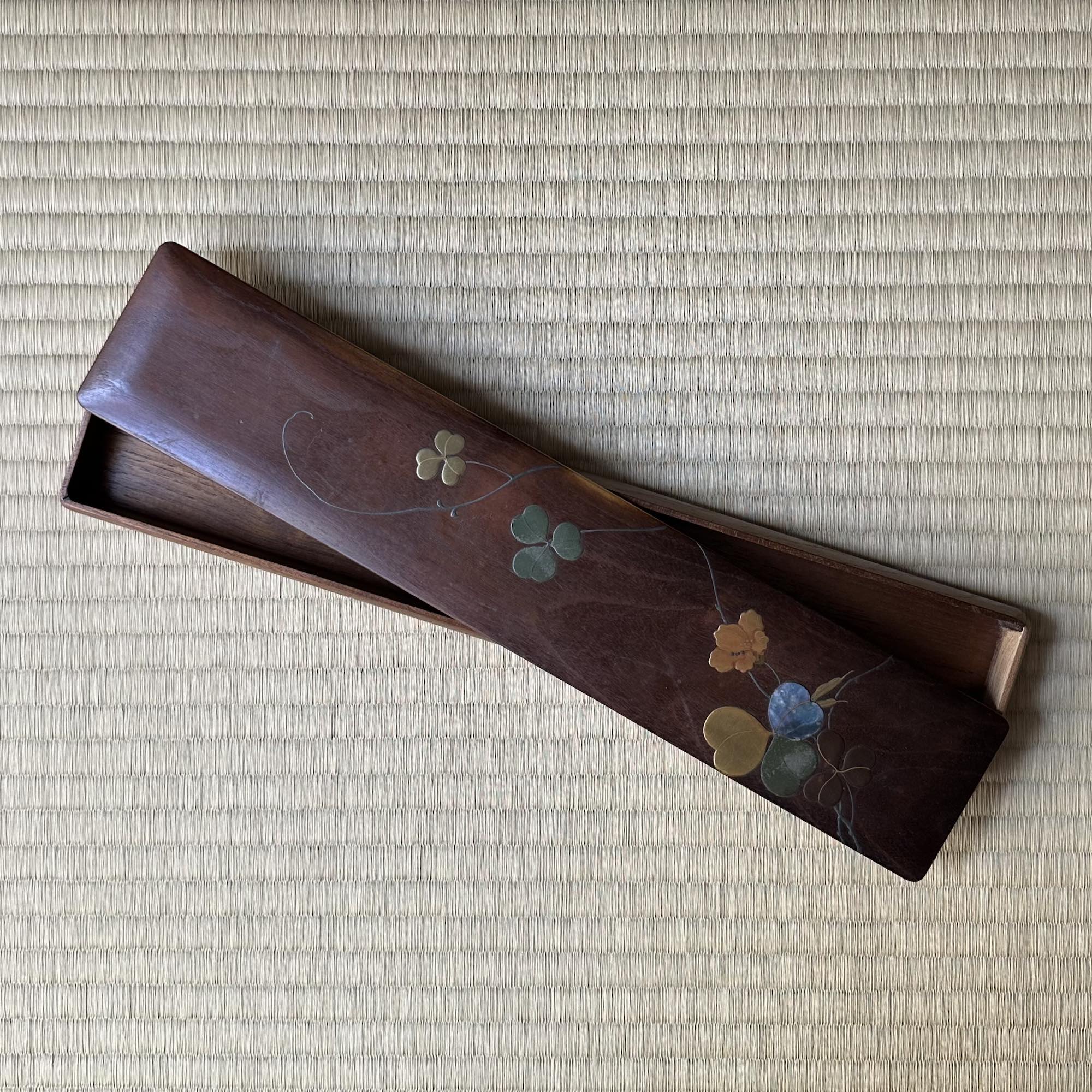
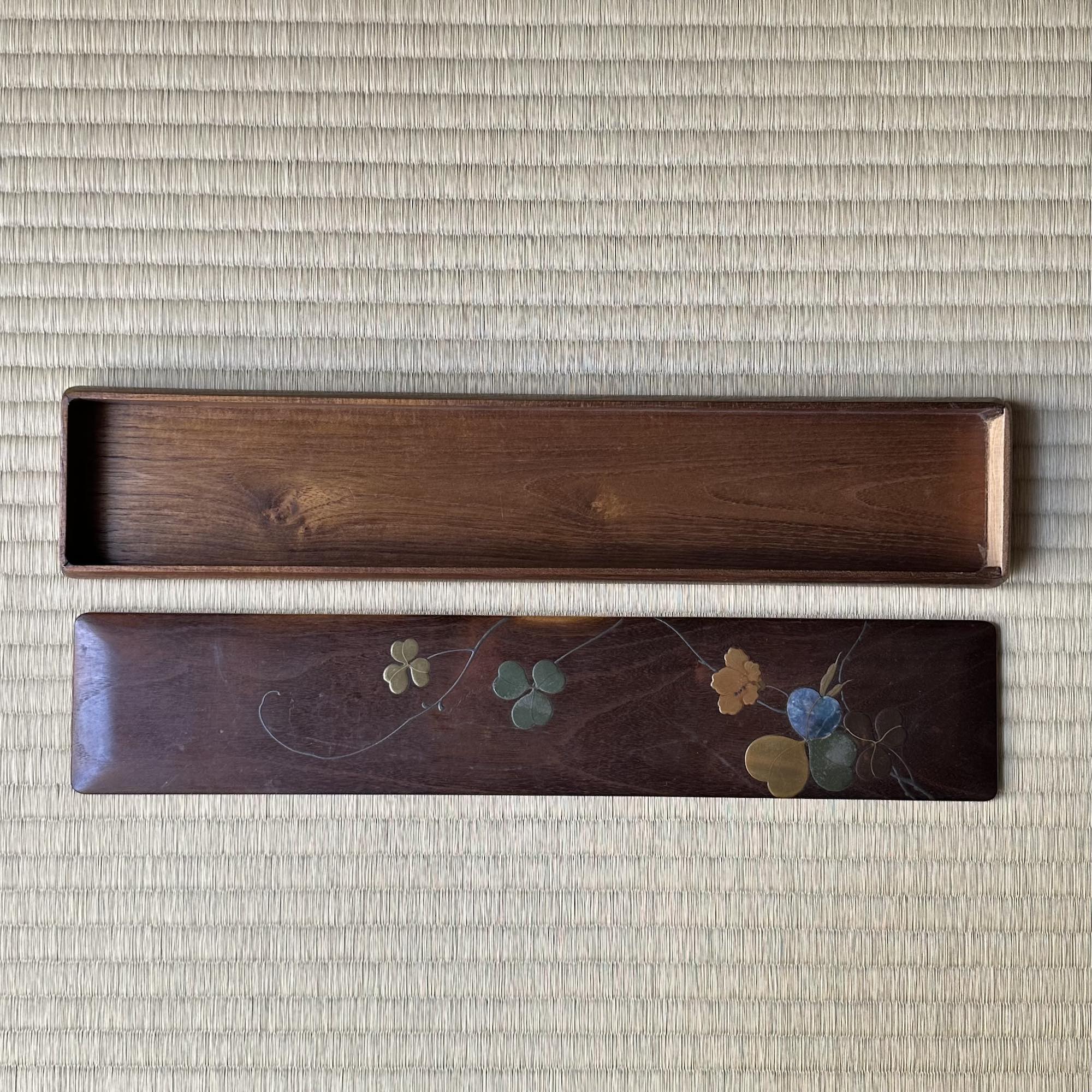
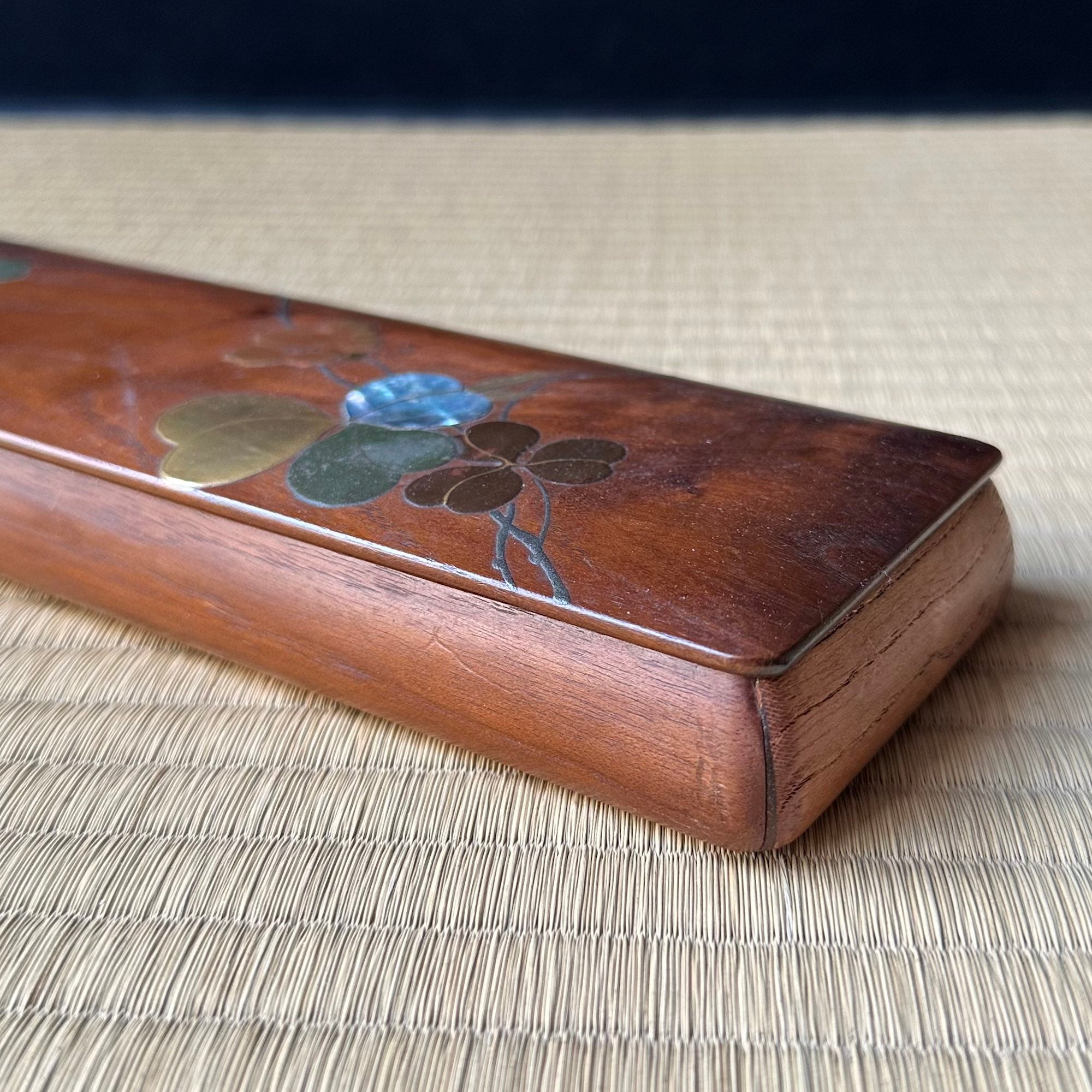
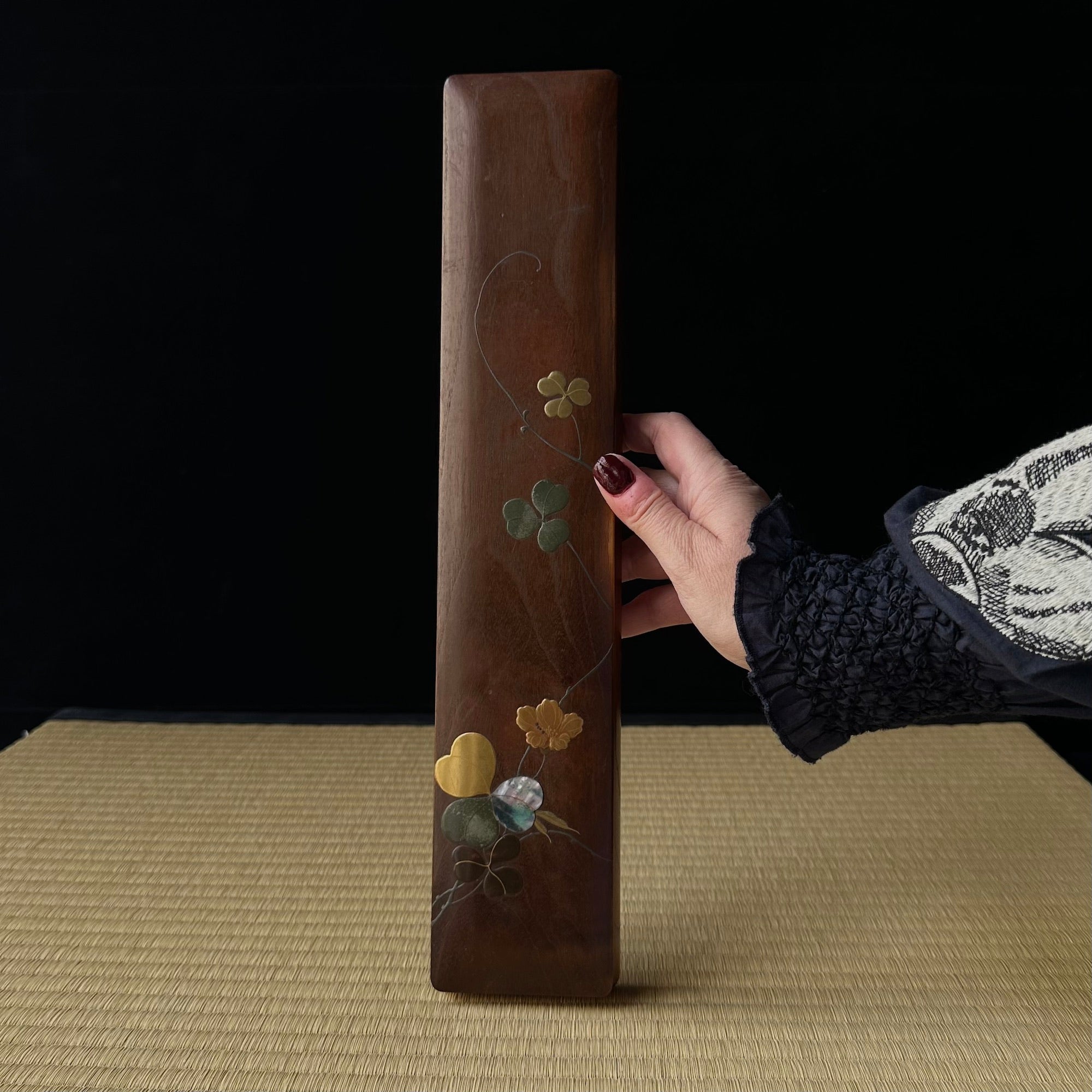
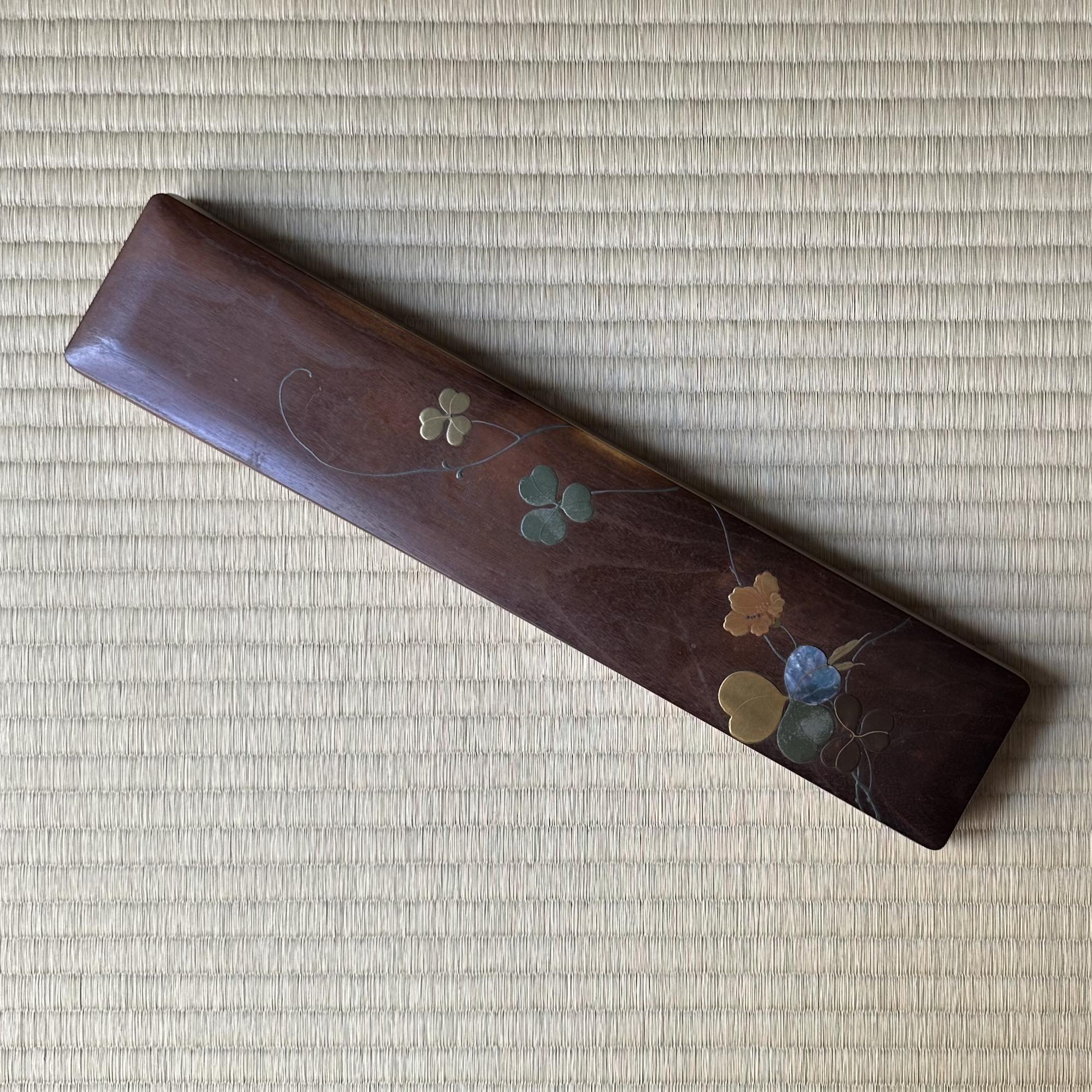
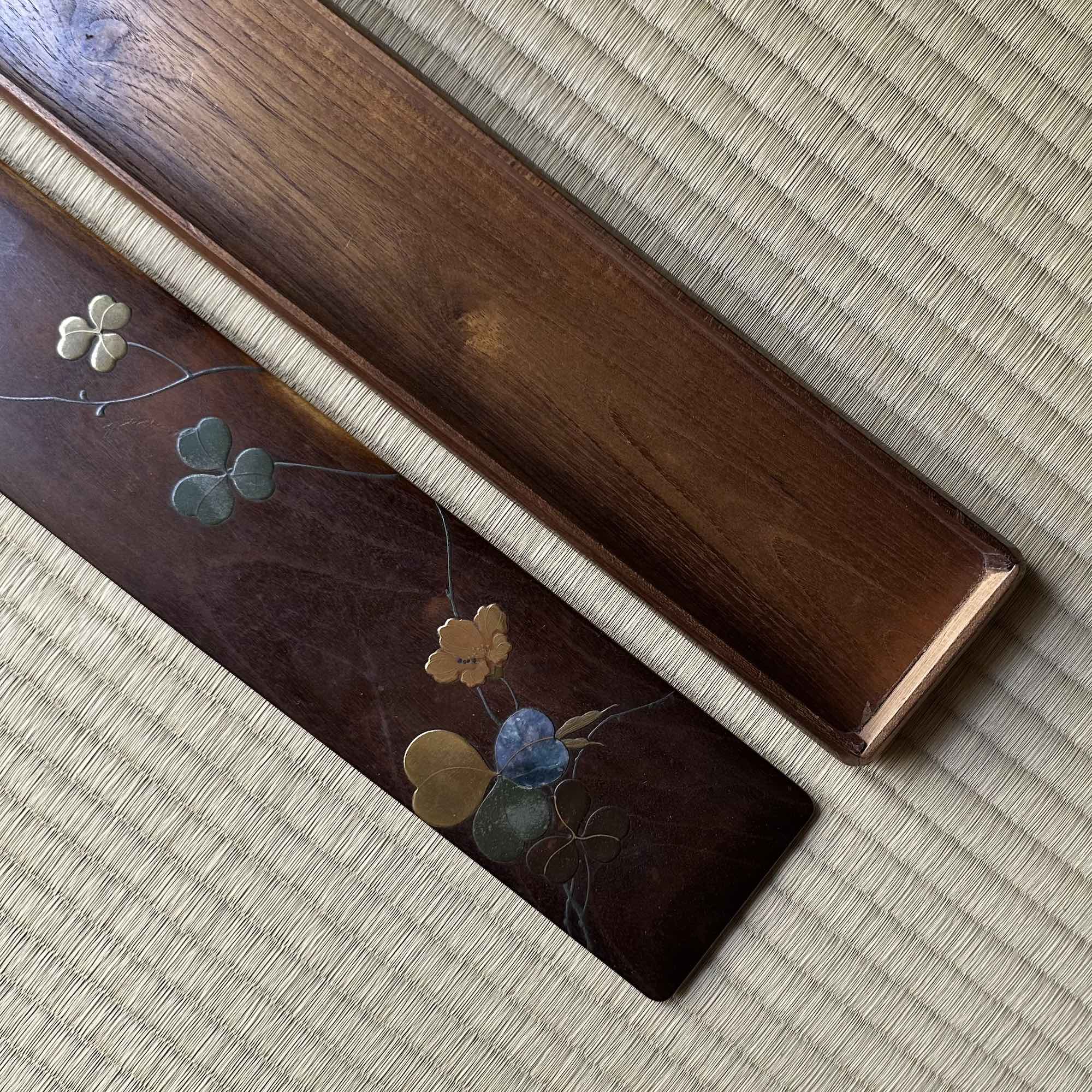
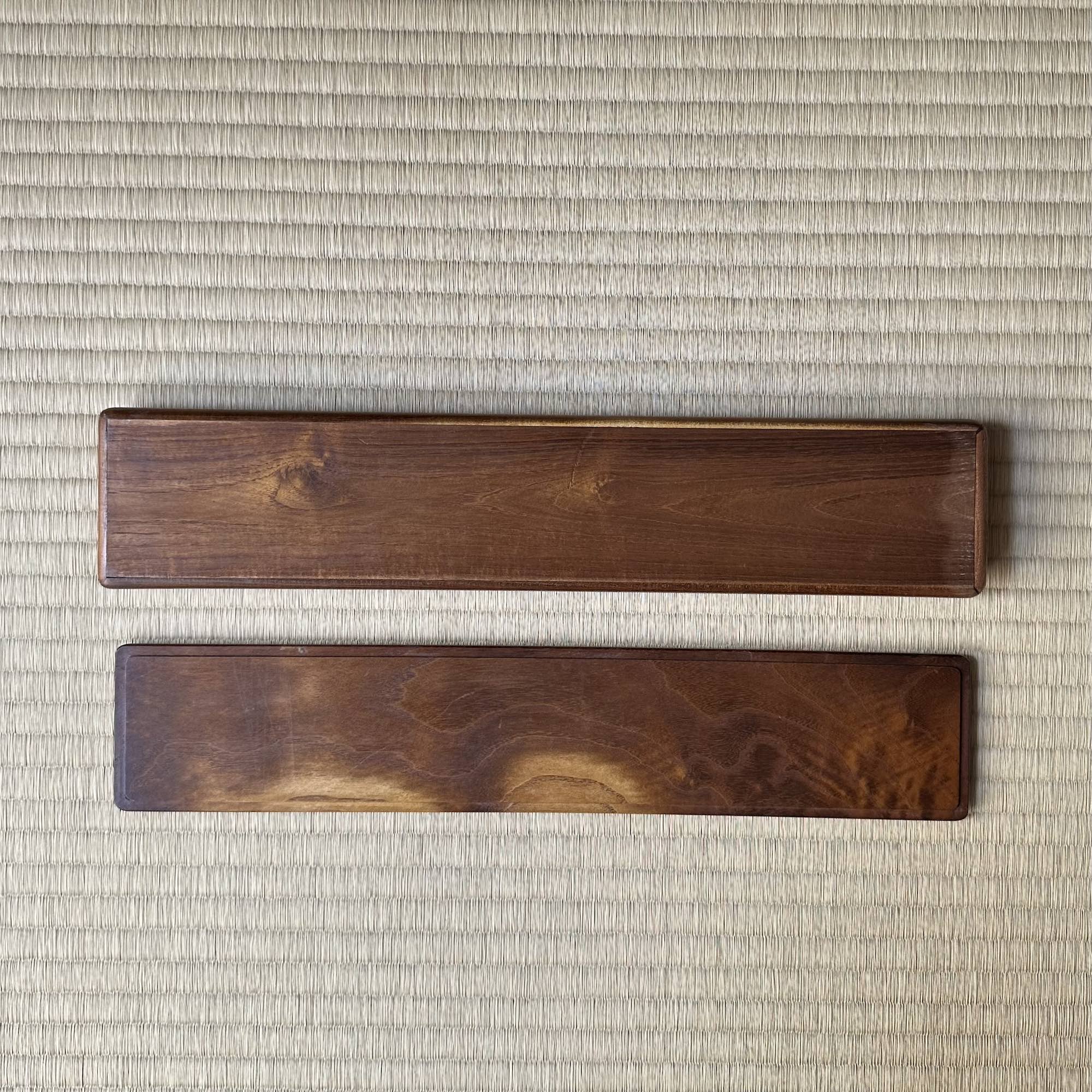
Japanese tanzaku box in keyaki wood, vine design in raden and maki-e
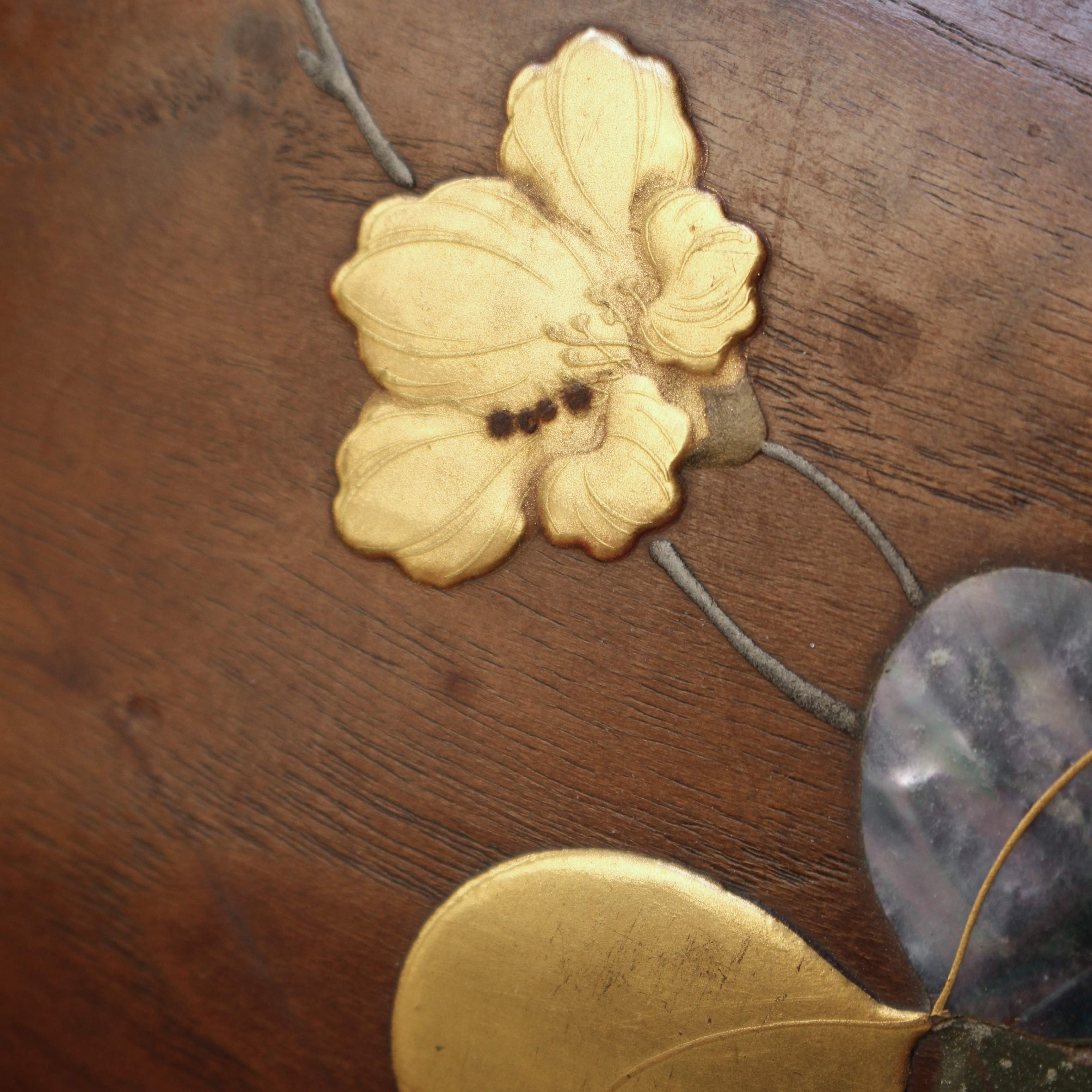
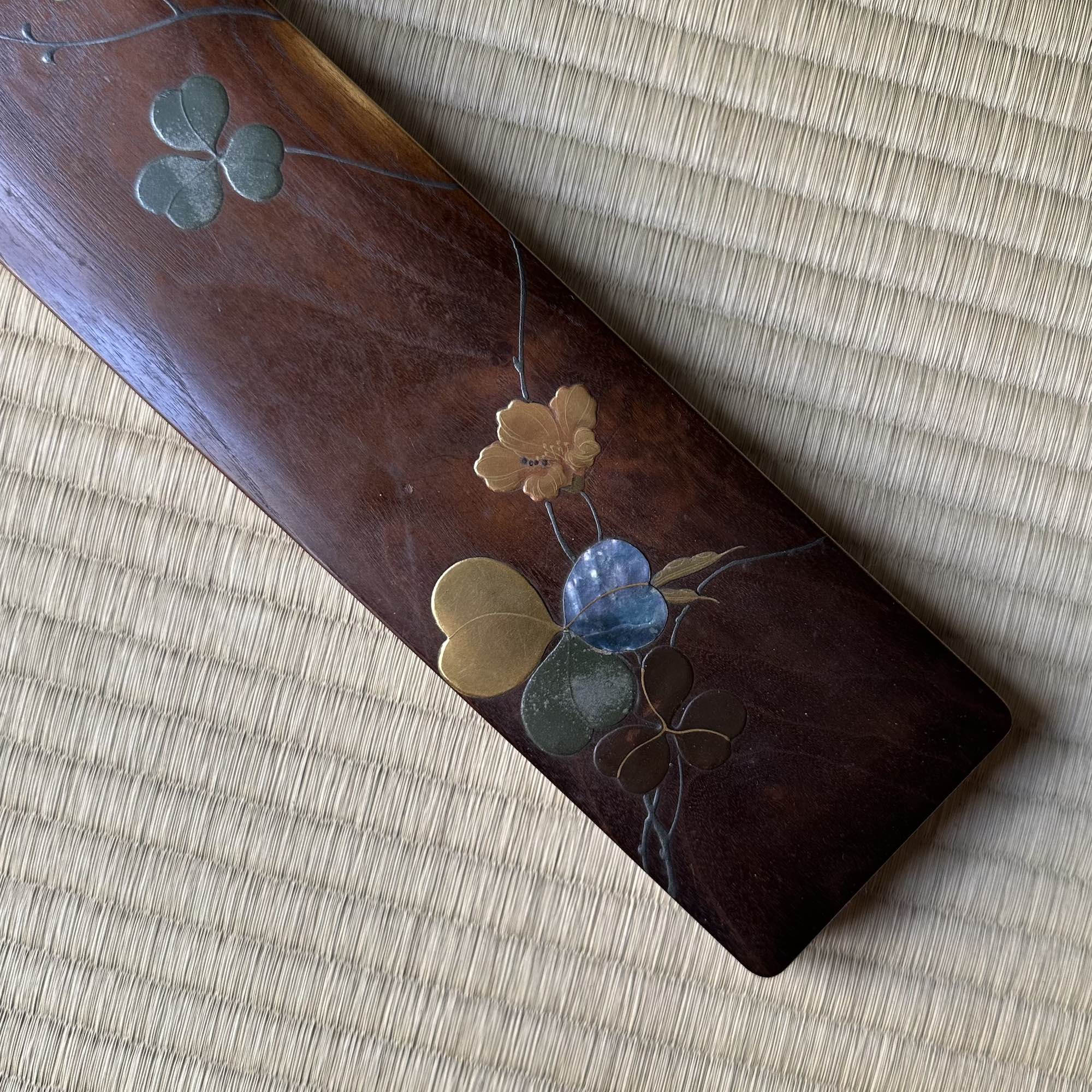
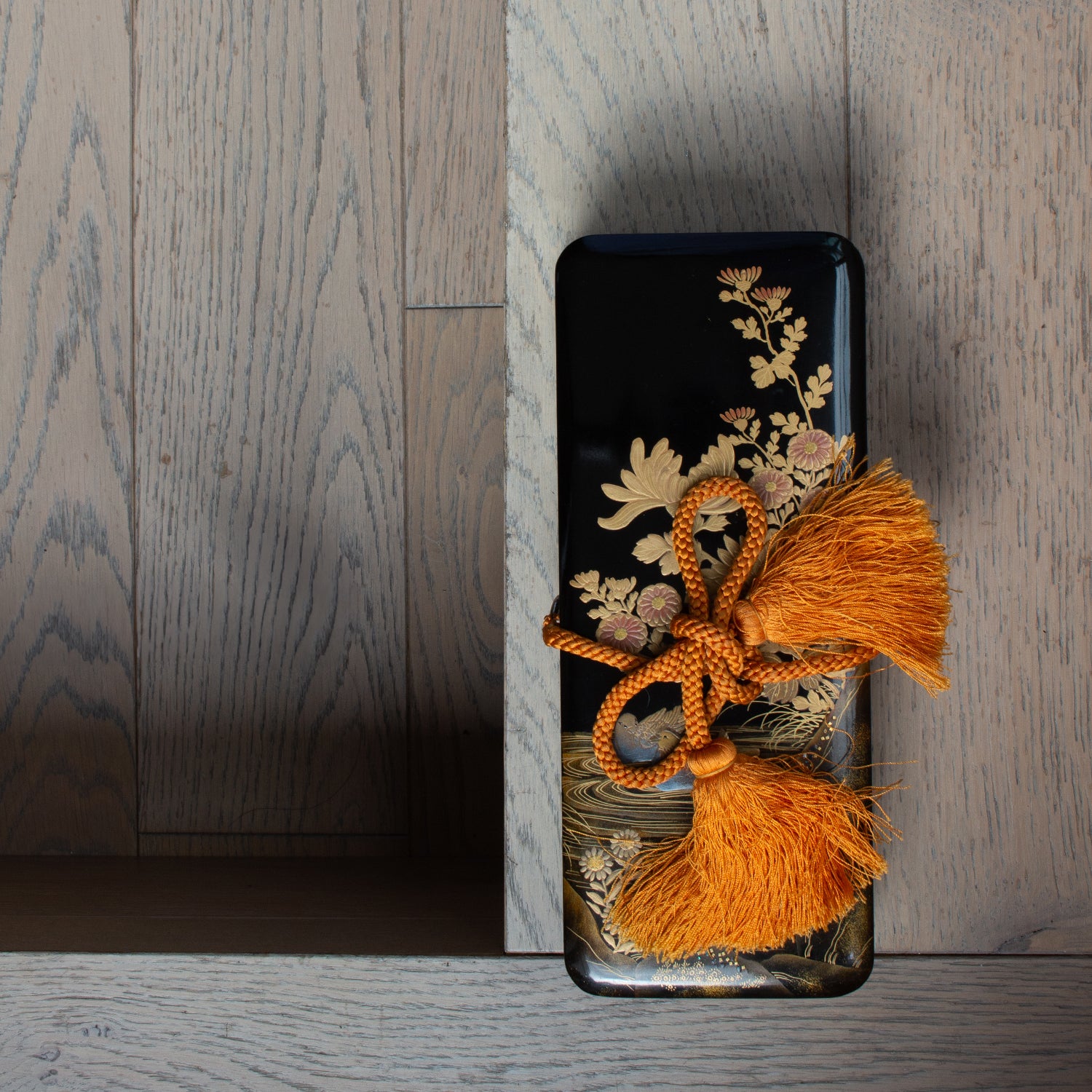
This keyaki (zelkova) wood tanzaku bako (tanzaku box, for Japanese poetry) features a typical, elongated, and highly elegant silhouette for this use, highlighted by a delicate vine decoration. On a warm brown background revealing the natural wood grain, a fluid composition unfolds where sinuous stems, leaves, and flowers intertwine lightly. The motifs alternate between raden (mother-of-pearl) inlays with iridescent reflections and maki-e (lacquer sprinkled with metallic powder, including gold powder) applications, creating a subtle interplay of materials and light. The intentionally asymmetrical balance of the decoration complements the object's length and accentuates its discreet elegance.
Technique and Decoration
The box is made of keyaki (zelkova), a dense wood highly prized in Japan for the beauty of its grain. Here, the grain is left visible and fully integrated into the object's aesthetic, following a traditional approach of enhancing the material rather than masking it.
The decoration combines two classic lacquer art techniques. Raden (mother-of-pearl) involves the inlay of polished shell fragments, visible in the elements with iridescent reflections. Maki-e (powder) is achieved by localized application of lacquer serving as a binder, onto which metallic powders, including gold powders, are deposited to form the floral motifs.
Together, they form a tsuru hana zu (vine) type decoration, characterized by fine, sinuous stems extending along the entire length of the box. The work here is done directly on the prepared wood surface, allowing the grain to remain visible while integrating the raden and maki-e applications. This approach, well-established in Japanese decorative arts, highlights both the quality of the wood and the refinement of the decoration.
Usage
The tanzaku bako (tanzaku box) is designed to store tanzaku (vertical paper strips), used for calligraphy or poetry. Its elongated shape precisely corresponds to these formats, making it both a utilitarian and refined object, often found in environments related to brush arts.
Practical Information
Place of manufacture:
Japan
Dimensions:
Length 38.5 cm - Width 7.8 cm - Height 2.7 cm
Weight:
230g
Period:
Shōwa Era (1926-1989)
Materials:
Keyaki wood (zelkova), lacquer, mother-of-pearl (raden), gold powder
Condition:
Good condition, slightwear consistent with age and use
© Atelier Ikiwa – Laurence Corteggiani. Photos and texts protected. All reproduction forbidden without authorization.
KNOW-HOW
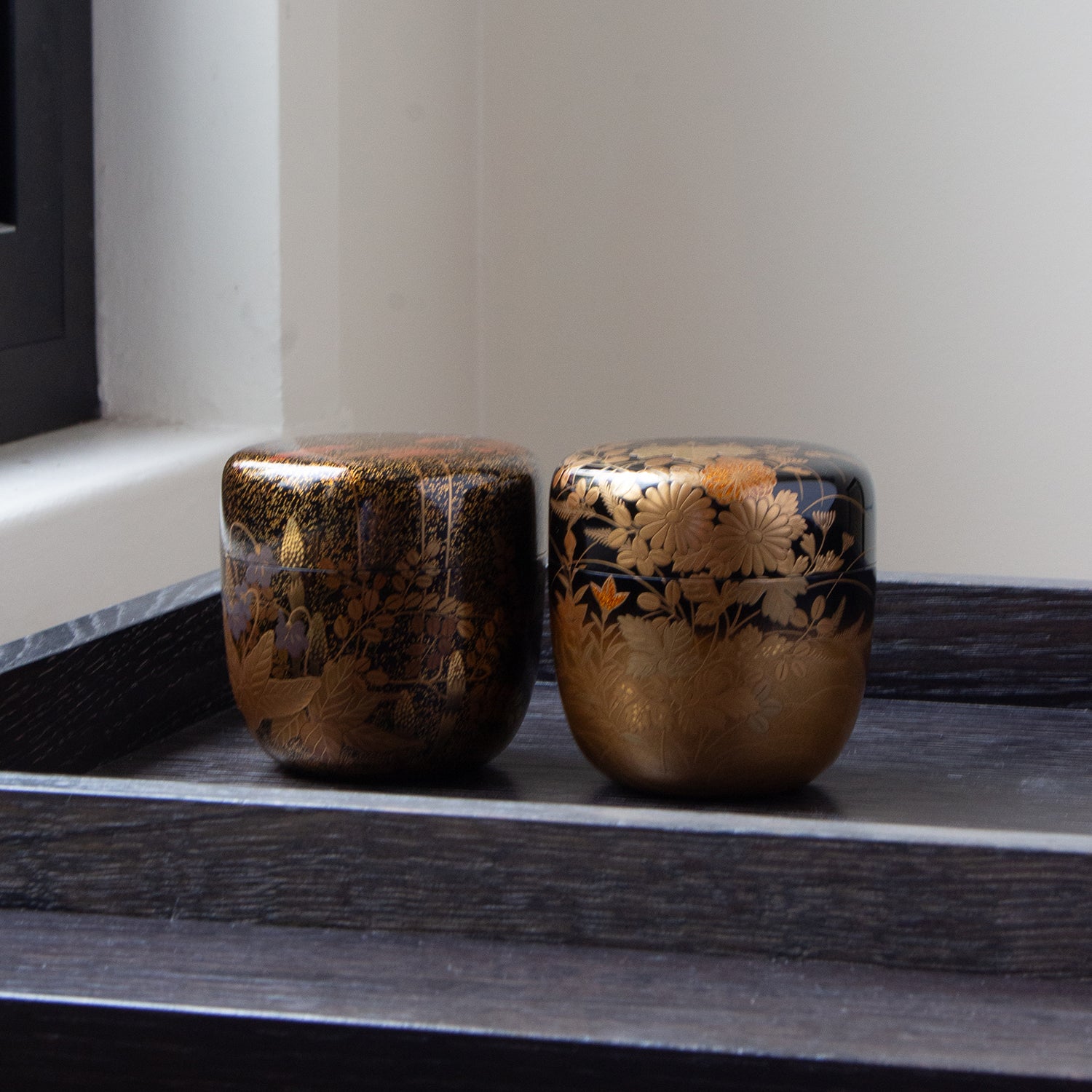
Traditional Japanese lacquer, urushi, comes from the sap of the lacquer tree (Rhus Verniciflua), which flows after incision of the bark. It is a very precious material, a tree will give a maximum of 200ml of sap in its life, which is worked by specialized craftsmen. It takes many operations, slow and meticulous, and several months of work to bring real lacquer objects to life. It is the oldest craft in Japan! Initially used to protect and waterproof objects, this immutable craft has become an art of extreme sophistication. If you want to know more about the art of Japanese lacquer, you can read our dedicated article > .
SHIPPING AND PAYMENT OPTIONS
Shipping
Free shipping in mainland France for purchases over €200. Shipping with Colissimo, delivery to your home or a pick-up point, package delivered against signature or unique code for valuable items. Orders are generally dispatched within 2 business days, except for fine art photographs, which are printed on demand, and special cases that will be announced in the banner at the top of the site (e.g., in case of absence). Learn more >
Payment options
Secure card payment with Shopify Payments and 3D Secure technology.
Visa, MasterCard, American Express, Cartes Bancaires, PayPal, Apple Pay, Shop Pay, and Klarna.
Klarna: Pay in 3 interest-free installments or within 30 days, for purchases up to €1,500, subject to Klarna's approval. You will be redirected to Klarna to log in or create an account and confirm your payment.
PayPal: You will be redirected to PayPal to log in and confirm payment. New users can create an account during checkout.
Your invoice will be sent with your order.
Returns and exchanges
14 days to change your mind. Learn more >
CARE INSTRUCTIONS
Clean with a very soft cloth to avoid scratches, soaked in a little warm water if necessary (never soak your lacquer objects). No microwave, dishwasher, dryer. Do not expose to direct sunlight for a long time (risk of discoloration). If the atmosphere is very dry and very hot, and to avoid the risk of cracking, you can place a glass filled with water next to your lacquer object.
Choose options
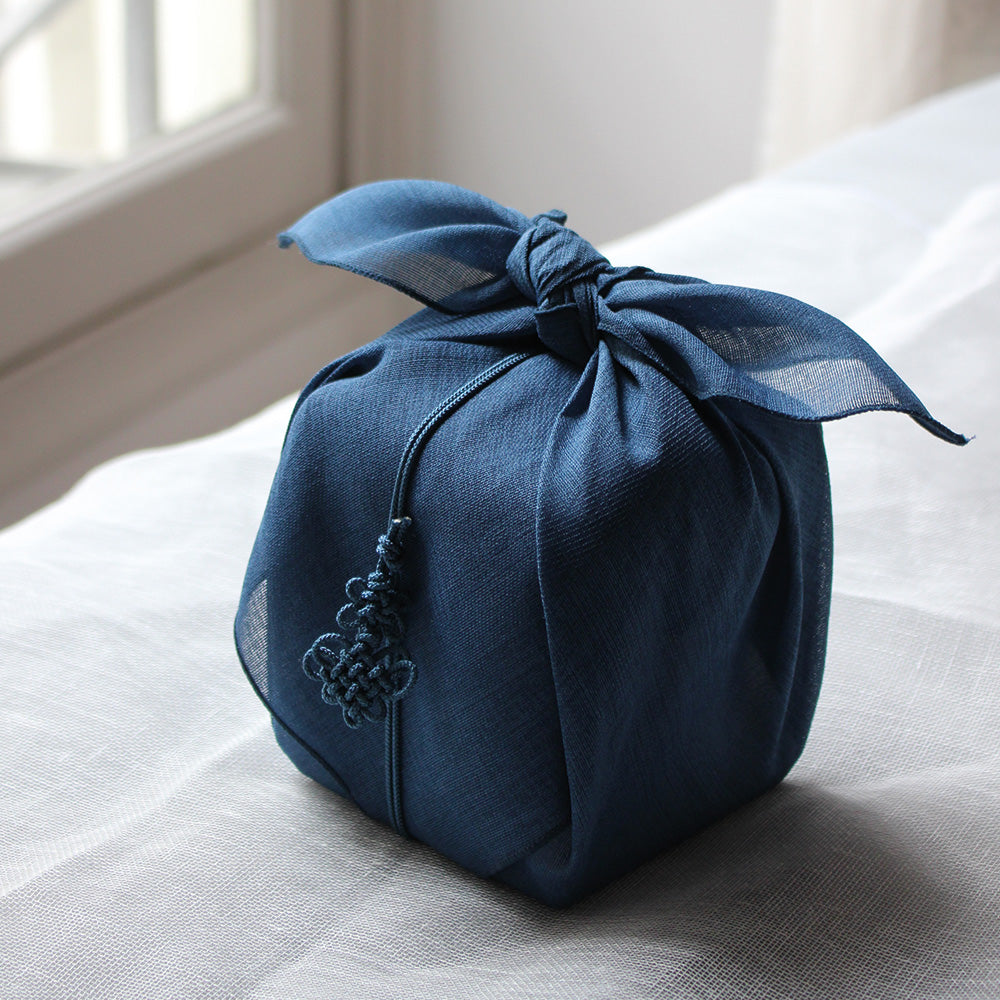
The art of wrapping
The exceptional items are wrapped in a beautiful fabric beautifully knotted using the little-known art of Korean pojagi and decorated with a delightful maedup (Korean ornamental knot). Details and conditions >
WRAPPING
Exceptional items are wrapped in textiles tied according to the Korean pojagi art