


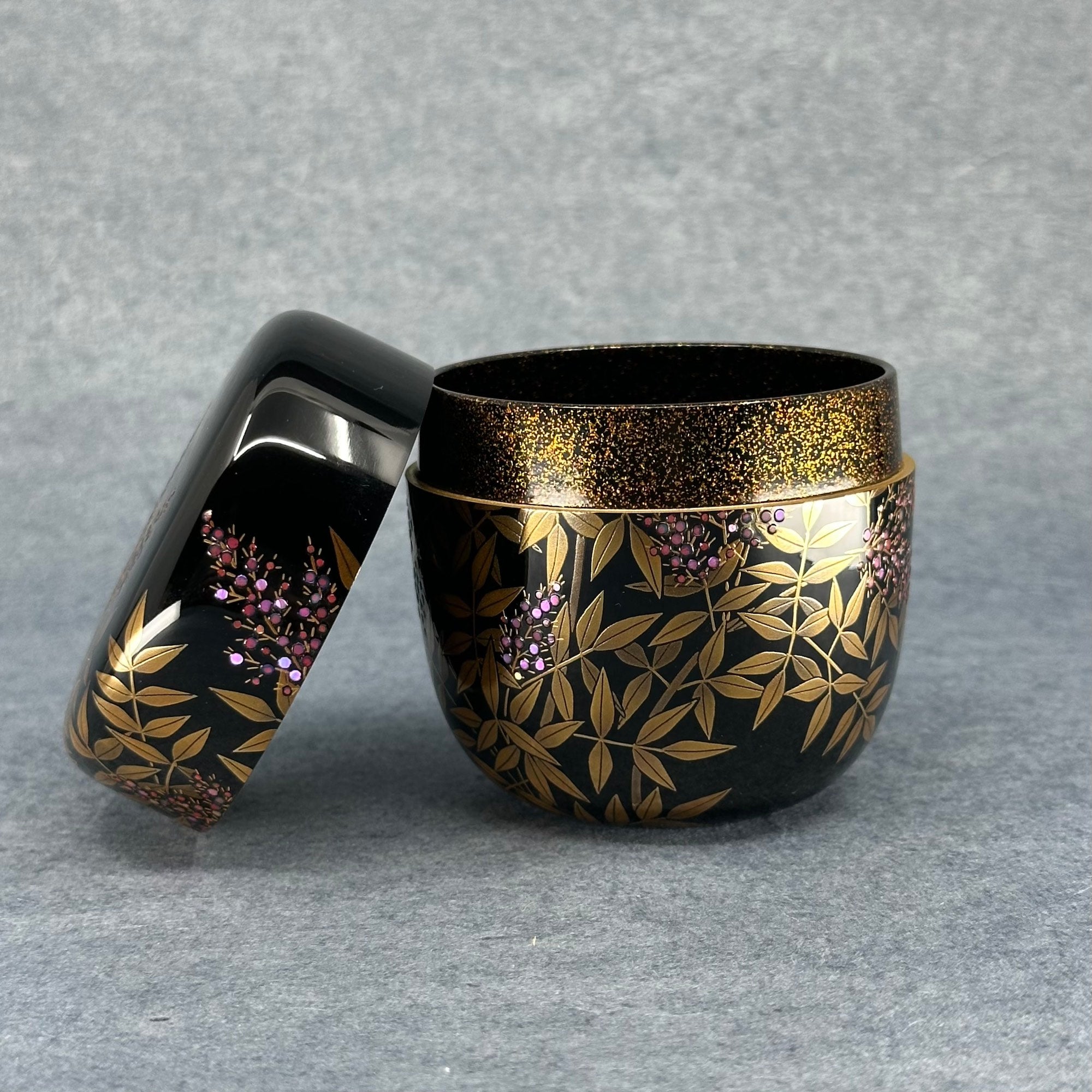
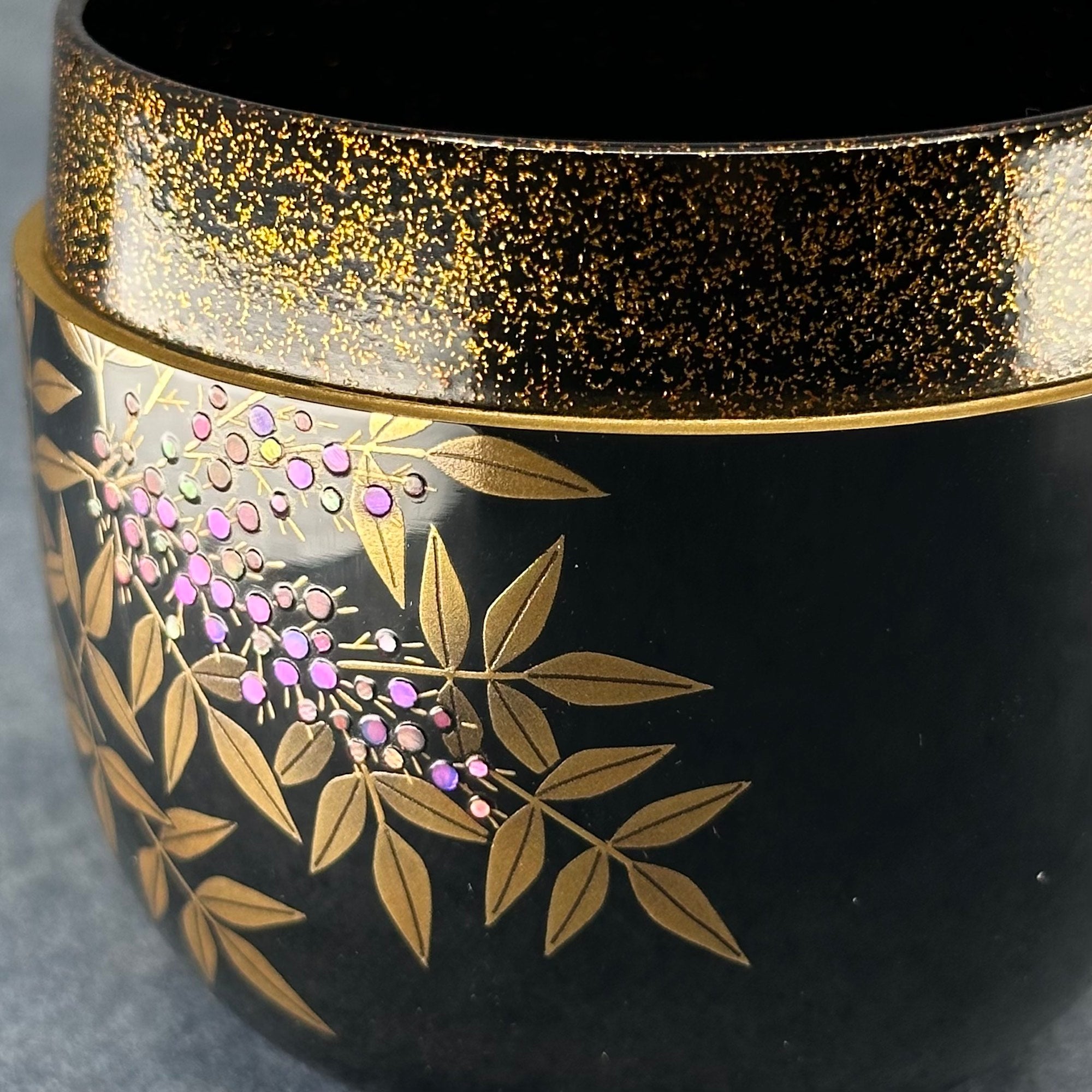
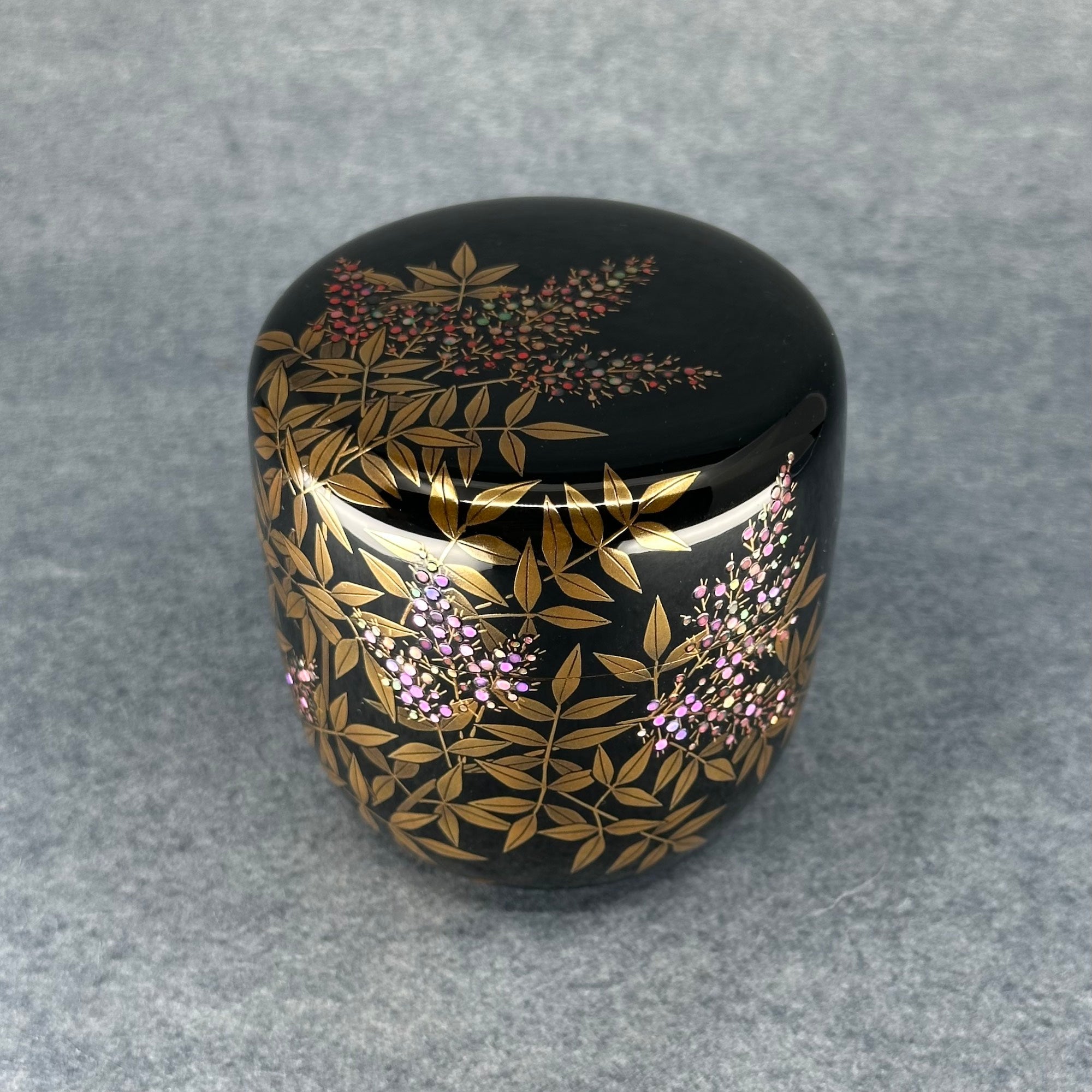
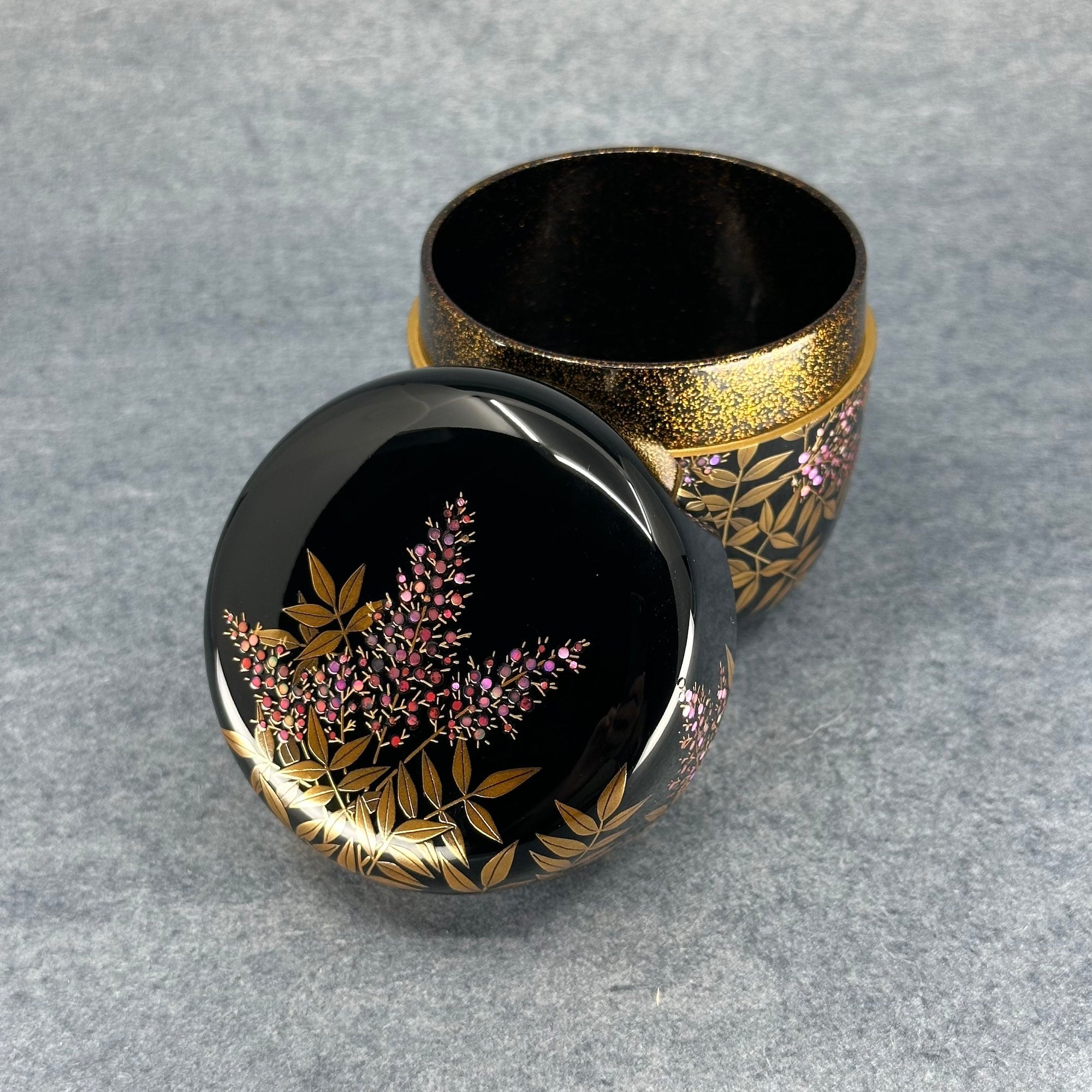
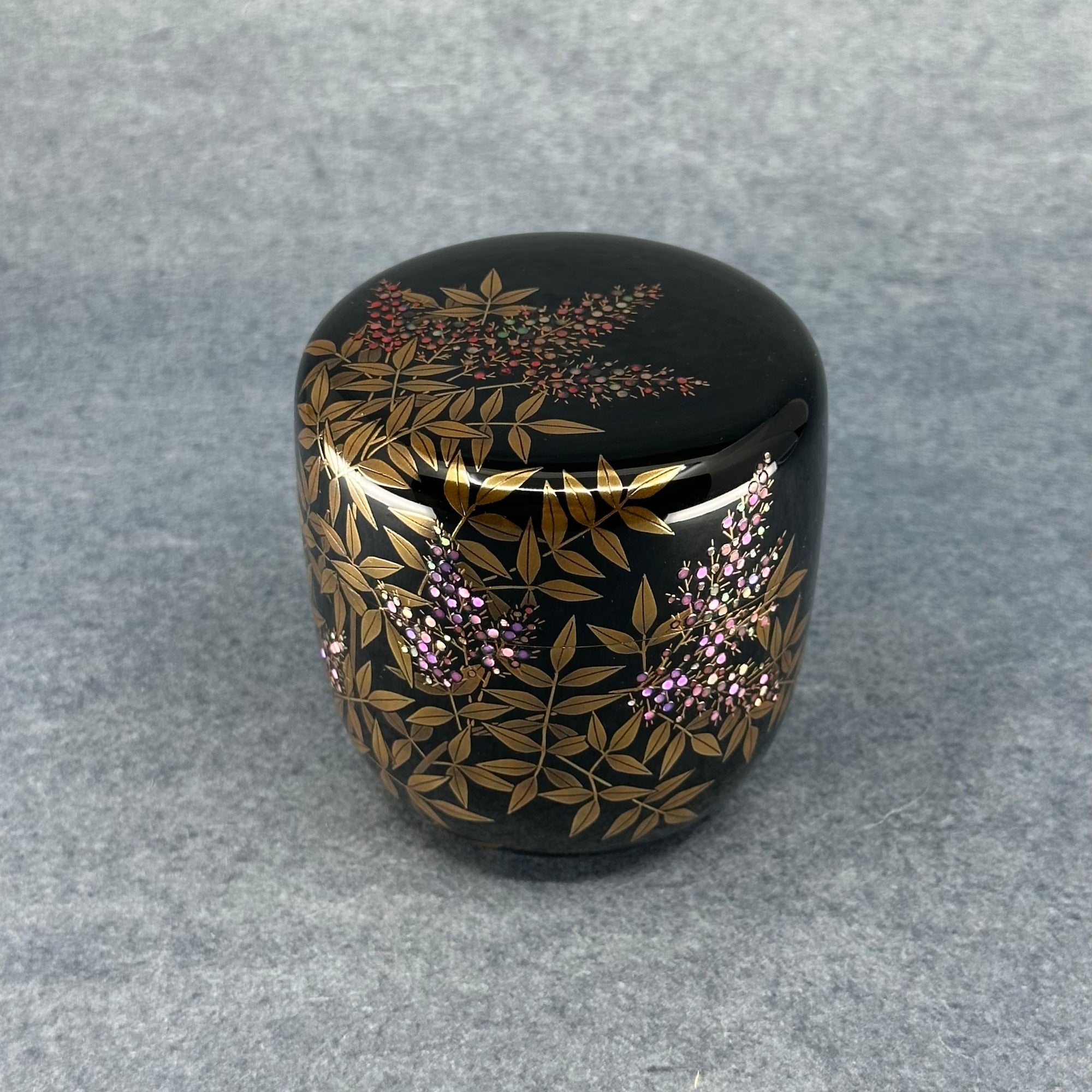
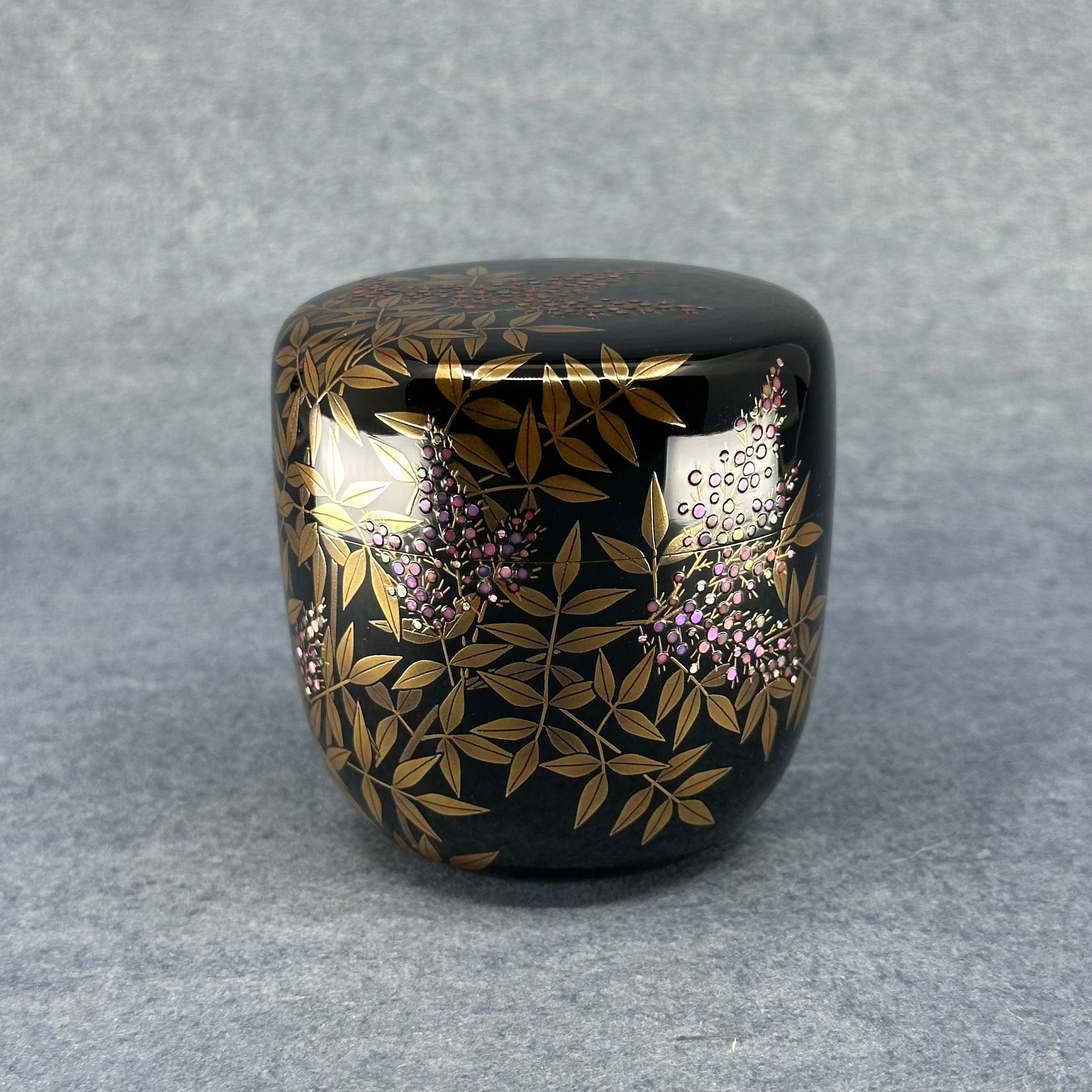

Natsume (Japanese tea caddy) in lacquer and gold, decorated with nanten (nandina) motifs by Sadaharu Higashino
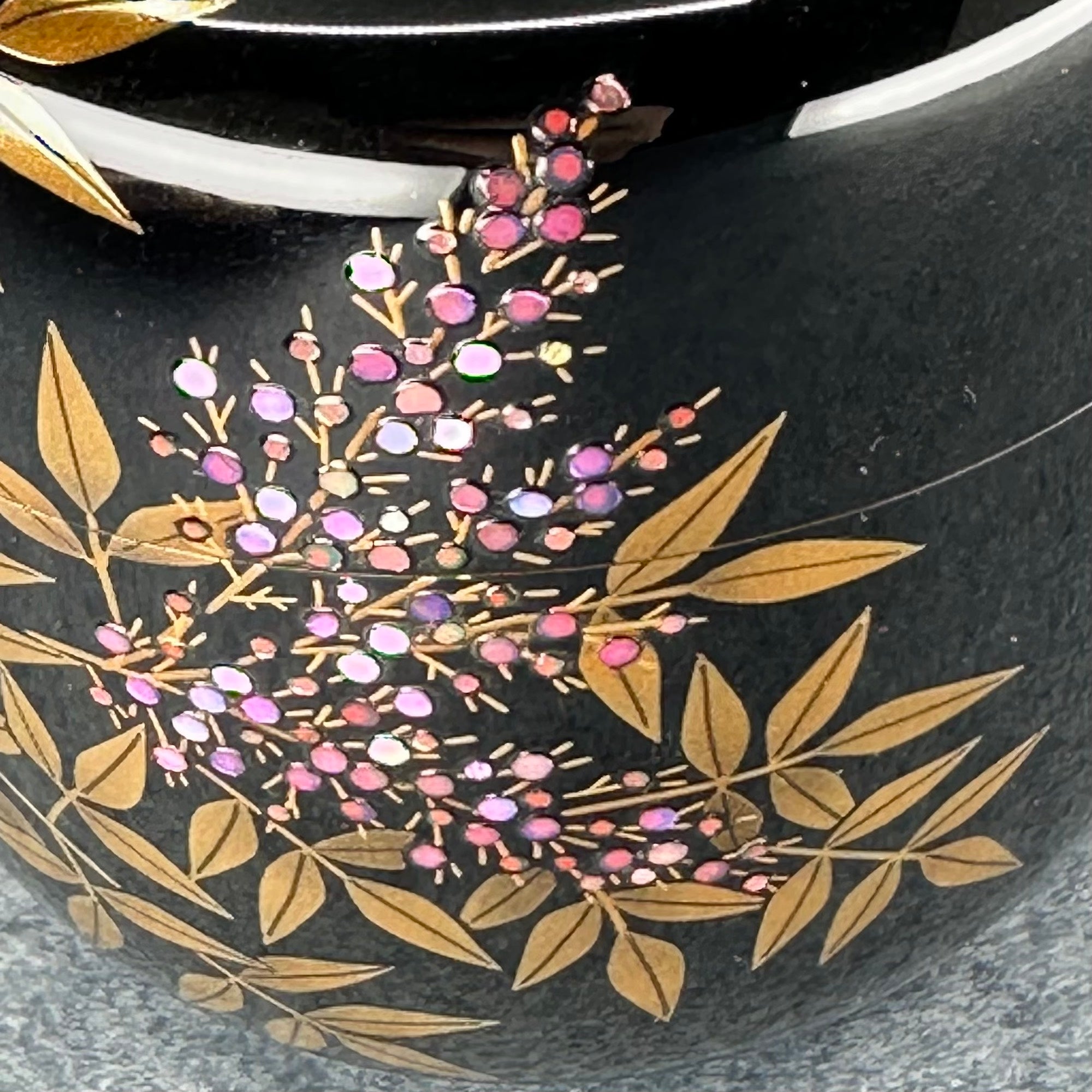
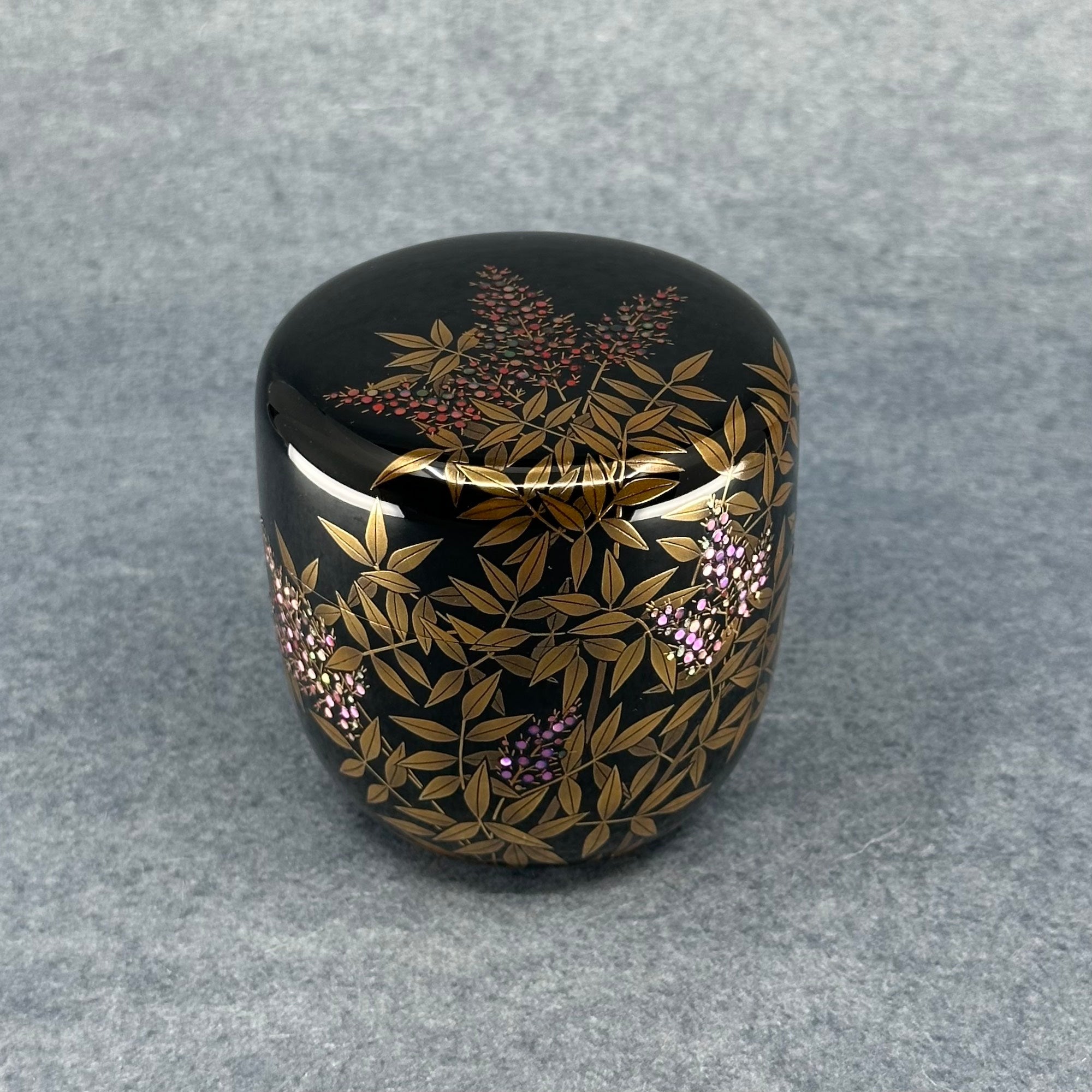
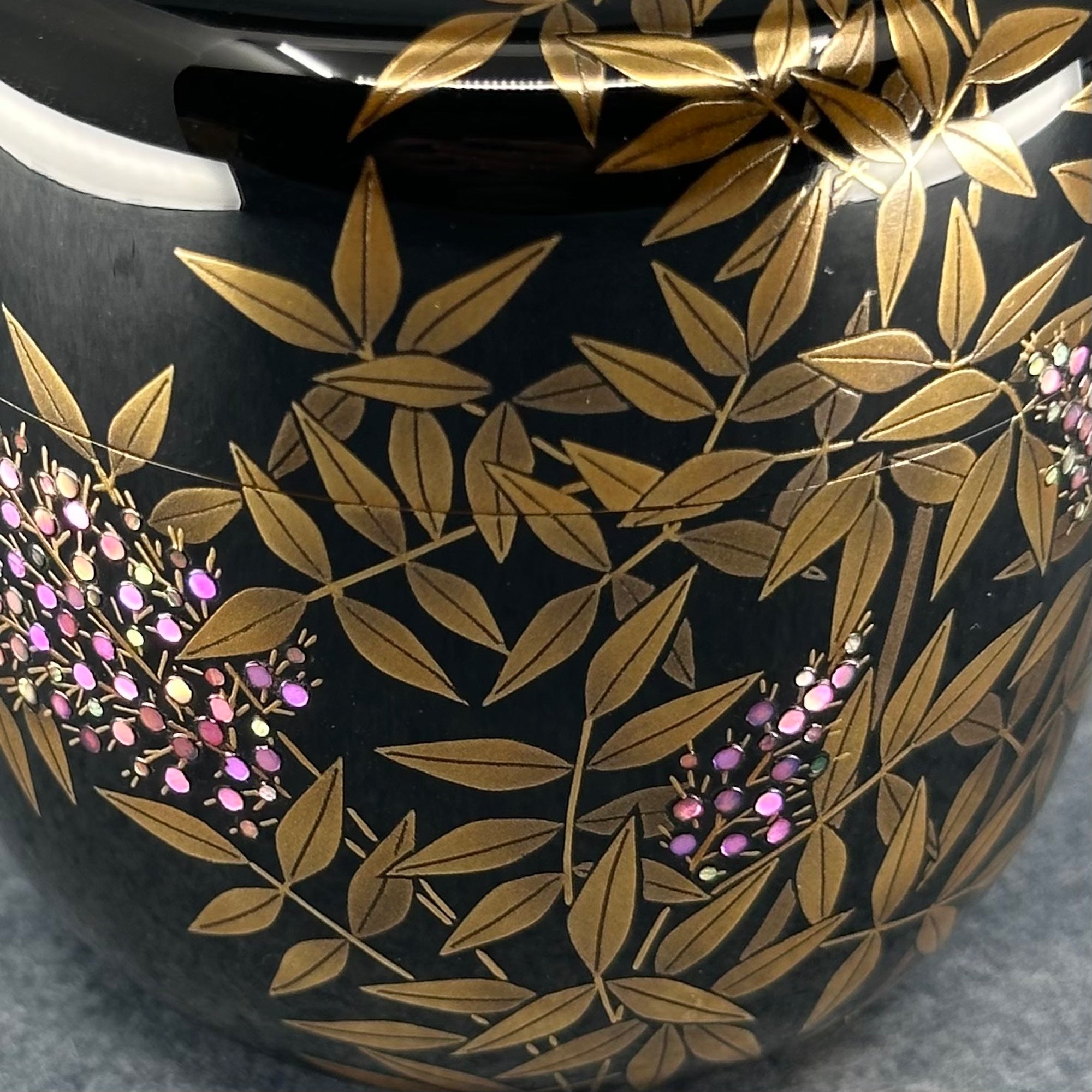
This natsume (the box in which matcha powder is placed during the Japanese tea ceremony) by Sadaharu Higashino is a superbly crafted piece. On a light wooden container covered with a deep, polished black urushi lacquer, unfolds a decoration of nandina (nanten) with gold powder leaves and small berries represented by delicate mother-of-pearl (raden) inlays whose iridescent reflections animate the surface depending on the light.
Decor and techniques
The nandina leaves are made using the hiramaki-e (flat) technique, in which the design is first drawn with slightly thickened urushi lacquer, then sprinkled with gold powder. After drying, the excess is removed and the surface is polished, resulting in even, flat areas of gold that blend seamlessly into the black background. On this natsume, the precise control of the lacquer thickness is evident, giving the leaves sharp outlines and remarkable uniformity.
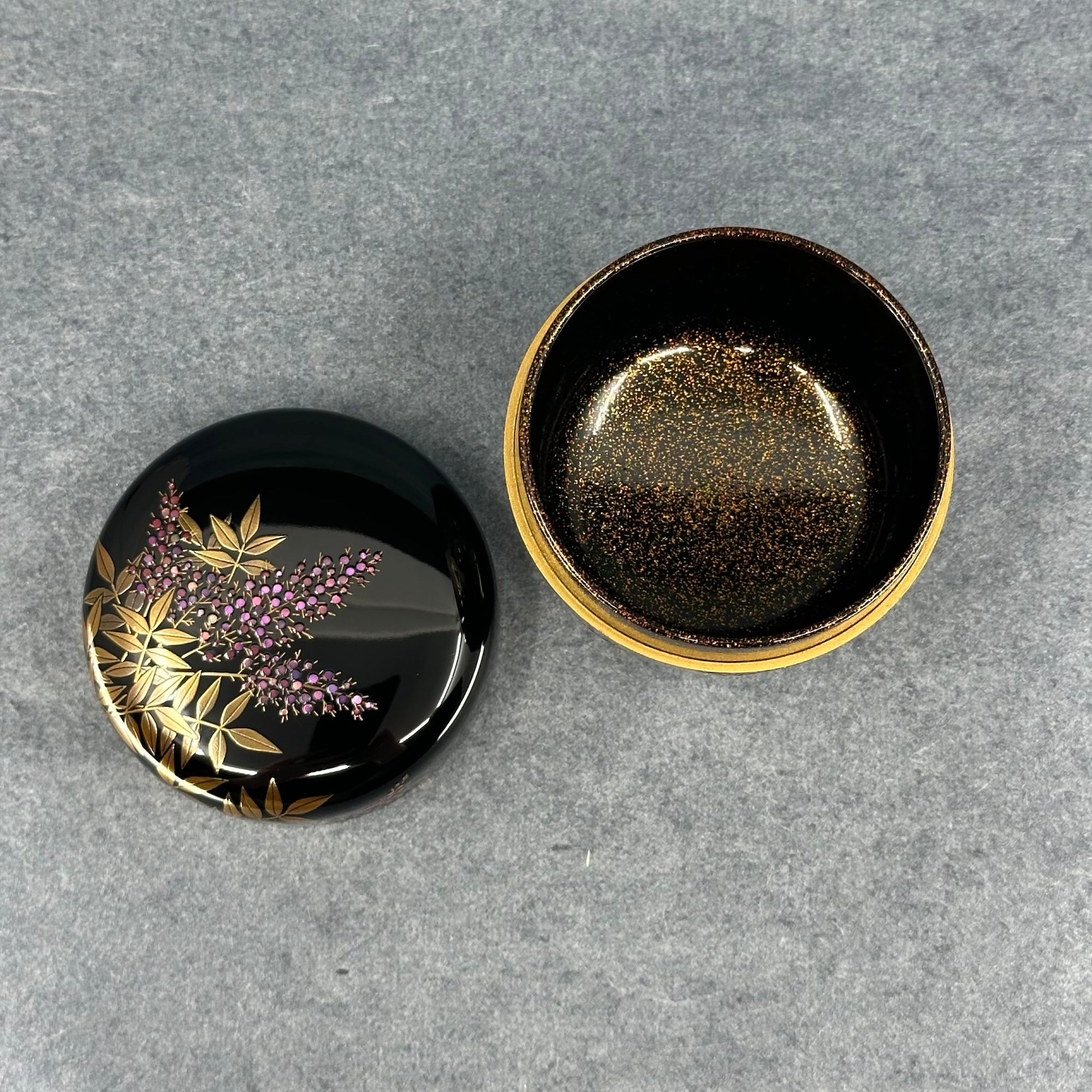
The berry clusters are crafted from raden (mother-of-pearl). For this technique, very thin slices of shell are cut, placed in the still-fresh lacquer, then covered with additional layers before polishing. The result is a surface that seems to dance, where each mother-of-pearl flecks the surface and catches the light in an iridescent way.
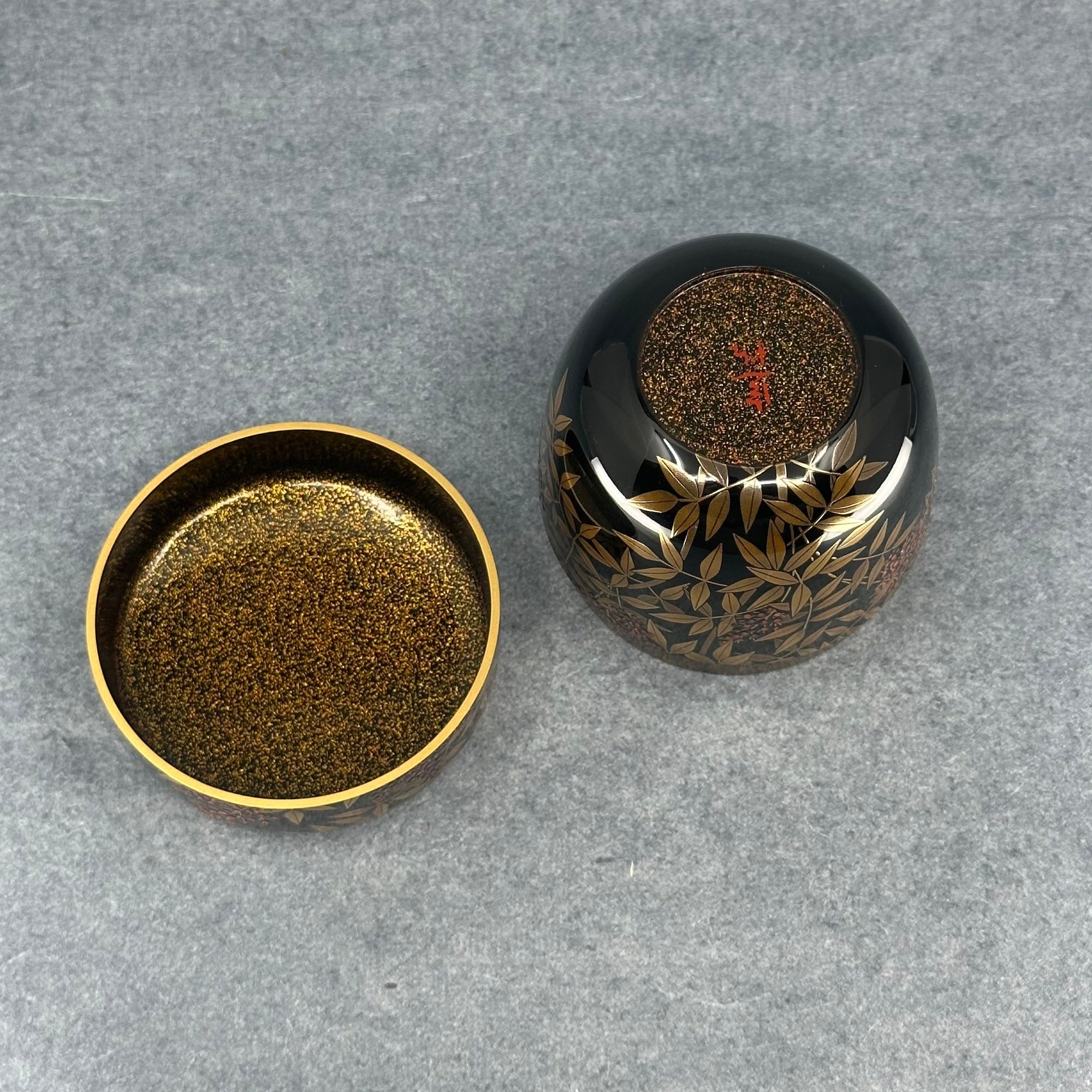
The interior of the lid and cup is finished with nashiji (gold dusting), a technique involving scattering tiny gold flakes within a layer of lacquer, then layering several transparent coats before final polishing. The dense scattering produces a soft, even sheen that subtly contrasts with the glossy black exterior. The nandina (nanten), an auspicious motif associated with protection in Japan, finds a luminous expression here.
Form and use
This natsume is a chū-natsume (medium size), used for preparing light whipped tea (usucha) during the tea ceremony.
The craftsman
Sadaharu Higashino, born in 1947 in Ishikawa Prefecture, is a renowned lacquer artist from Wajima, where he has dedicated himself for several decades to the production of maki-e pieces and the transmission of traditional Wajima-nuri techniques. His works have been featured in several prestigious national exhibitions, where the finesse of his craftsmanship and the quality of his finishes have been consistently praised.
Presentation
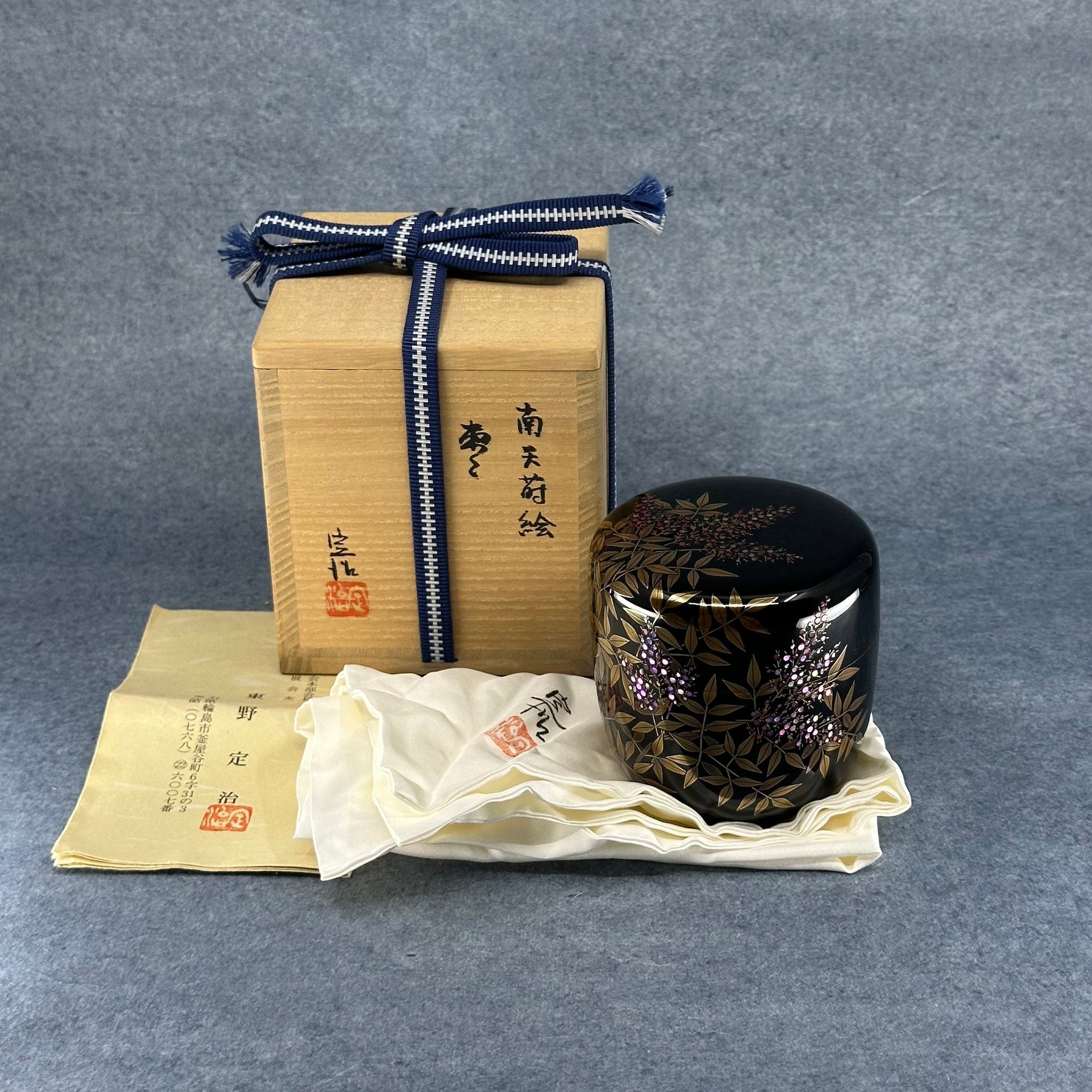
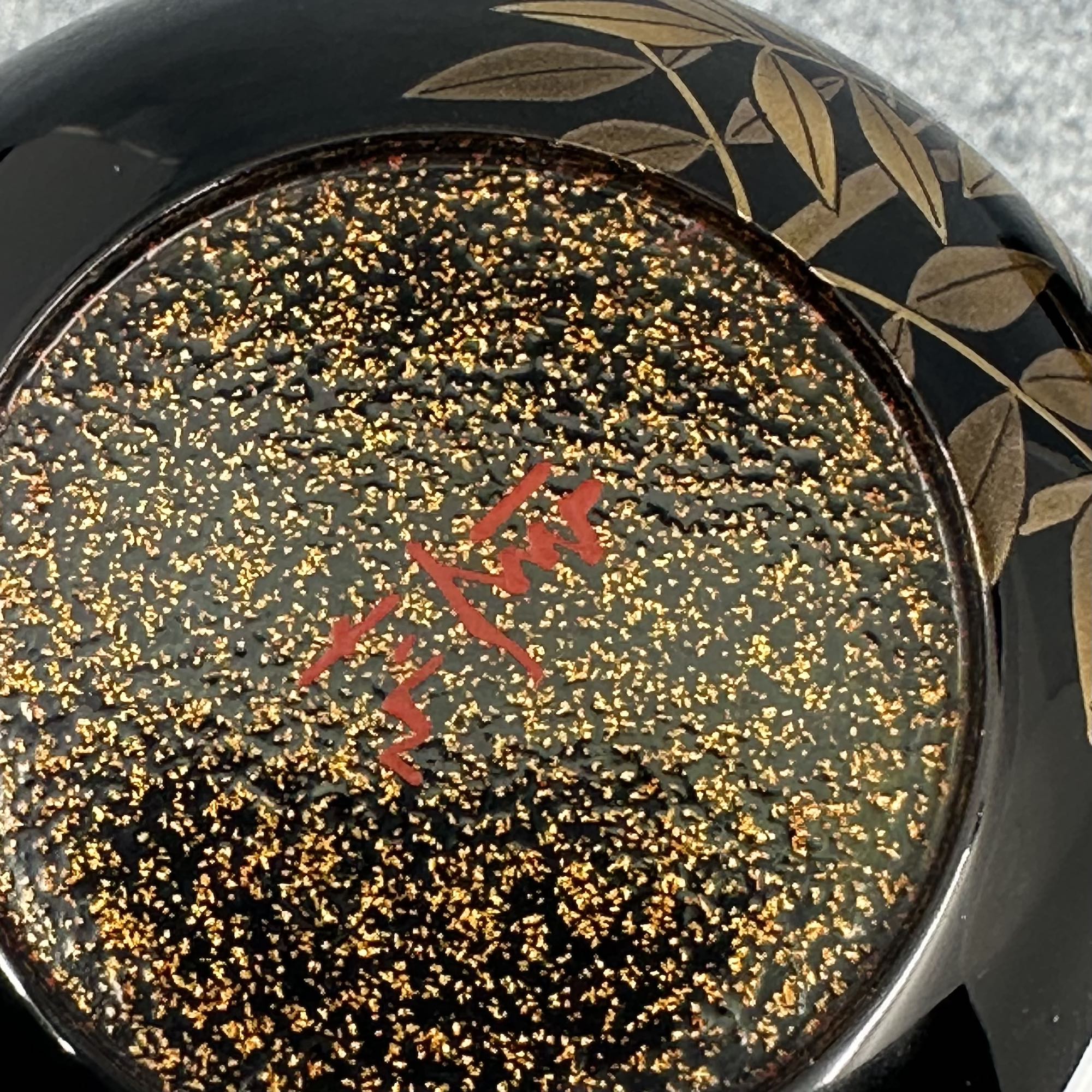
This piece, dating from the Heisei era (1989-2019), comes with a protective paulownia wood (kiribako) box tied with a cord (sanadahimo), bearing the artist's name, official seal, and the title of the work, as well as a protective cloth (tomonuno) with the artist's seal and an informational document (shiori). The natsume is signed by the artist at its base.
Place of manufacture
Japan, Wajima, Ishikawa Prefecture.
Dimensions
Diameter 7.3 cm - Height 7.3 cm
Weight
Natsume alone: 59 g
Natsume with box: 183 g
Materials
Wood, Japanese urushi lacquer, gold powder, mother-of-pearl (raden)
Condition
Very good condition.
© Atelier Ikiwa – Laurence Corteggiani. All photographs and text are protected. Reproduction without permission is prohibited.
KNOW-HOW
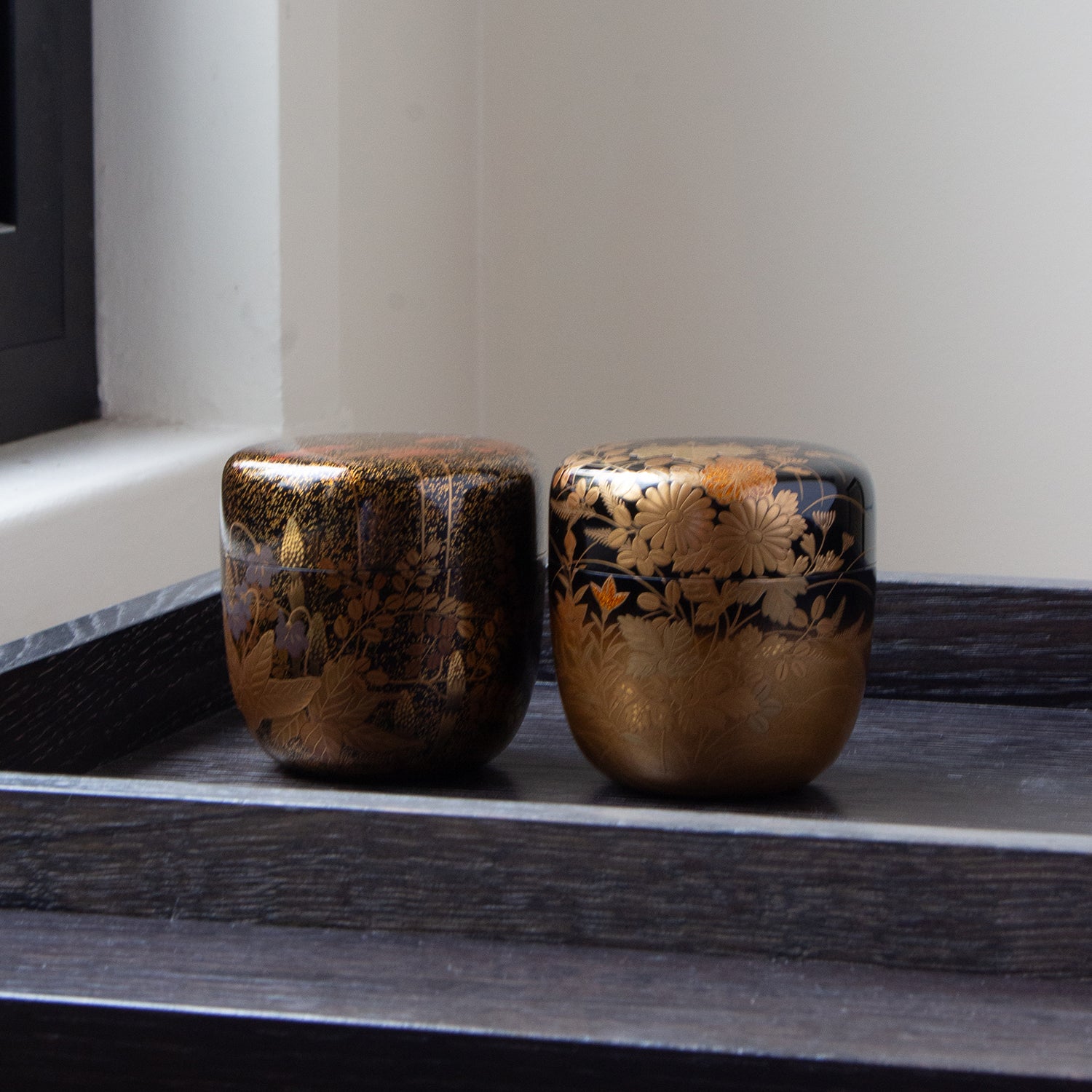
Natsume (棗) are small boxes with few variations in shape and dimensions (which are codified), and which are made of Japanese urushi lacquer, welcoming the matcha tea powder during the traditional Japanese tea ceremony (chanoyu and sadō). They are magnificent objects that can be used for tea or superb decorative pieces to collect and to position individually or grouped on a pretty tray or in a display case. Modern productions are more often made of resin and not lacquer, and of molded wood powder or plastic. We only offer authentic traditional natsume in real Japanese urushi lacquer made according to the rules of the art. These objects are rare and precious, they are likely to increase in value. Read our article on natsume >
Traditional Japanese lacquer, urushi, comes from the sap of the lacquer tree (Rhus Verniciflua), which flows after incision of the bark. It is a very precious material, a tree will give a maximum of 200ml of sap in its life, which is worked by specialized craftsmen. It takes many operations, slow and meticulous, and several months of work to bring real lacquer objects to life. It is the oldest craft in Japan! Initially used to protect and waterproof objects, this immutable craft has become an art of extreme sophistication. If you want to know more about the art of Japanese lacquer, you can read our dedicated article > .
DELIVERY AND PAYMENT OPTIONS
Shipping
Free shipping in metropolitan France for purchases over €200. Shipping with Colissimo, choice of home delivery or relay point, parcel delivered against signature or unique code for valuable items. Orders are generally dispatched within 2 business days, except for fine art photographs, which are printed on demand, and special cases which will be announced in the banner at the top of the site (e.g., in case of absence). Learn more >
Payment options
Secure card payment with Shopify Payments and 3D Secure technology.
Visa, MasterCard, American Express, Bank Cards, PayPal, Apple Pay, Shop Pay, and Klarna.
Klarna: Pay in 3 interest-free installments or within 30 days for purchases up to €1,500, subject to Klarna's approval. You will be redirected to Klarna to log in or create an account and confirm your payment.
PayPal: You will be redirected to PayPal to log in and confirm payment. New users can create an account during checkout.
Your invoice will be sent with your order.
Returns and exchanges
14 days to change your mind. Learn more >
CARE INSTRUCTIONS
Clean with a very soft cloth to avoid scratches, soaked in a little warm water if necessary (never soak your lacquer objects). No microwave, dishwasher, dryer. Do not expose to direct sunlight for a long time (risk of discoloration). If the atmosphere is very dry and very hot, and to avoid the risk of cracking, you can place a glass filled with water next to your lacquer object.
Choose options
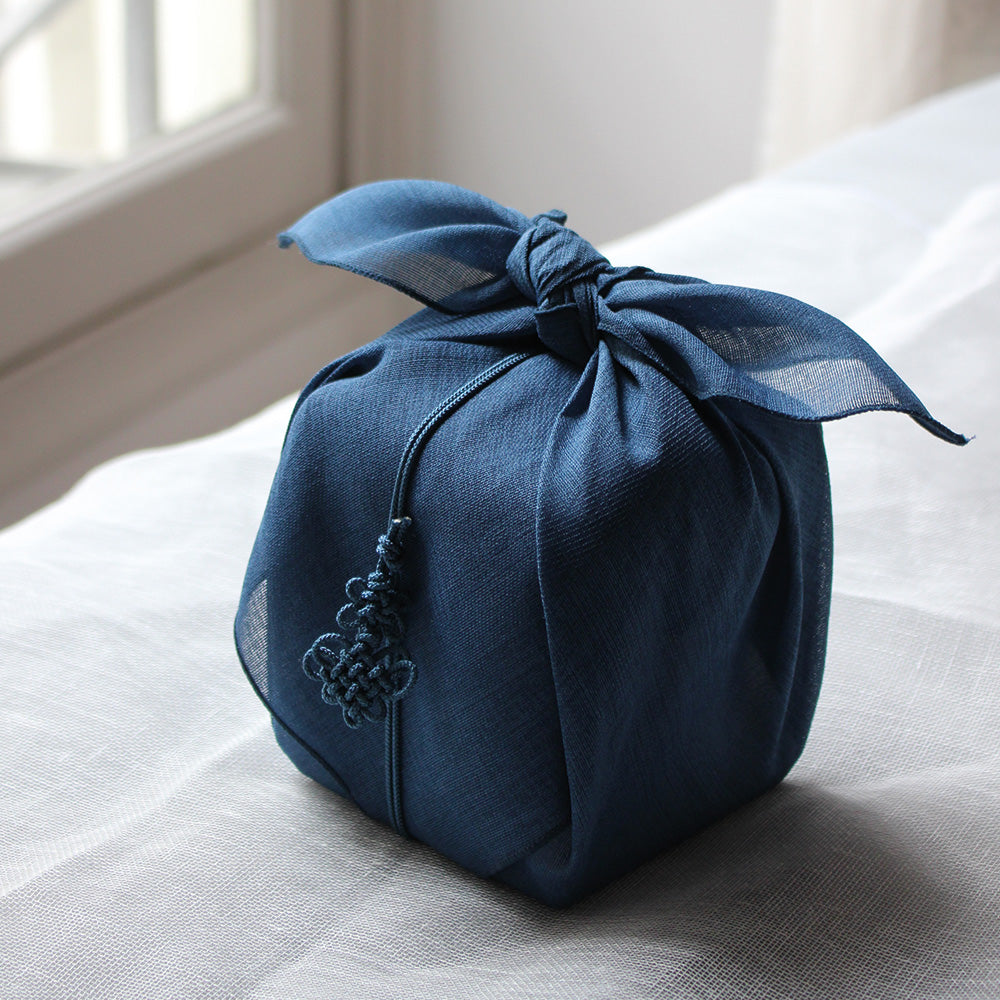
The art of wrapping
The exceptional items are wrapped in a beautiful fabric beautifully knotted using the little-known art of Korean pojagi and decorated with a delightful maedup (Korean ornamental knot). Details and conditions >
WRAPPING
Exceptional items are wrapped in textiles tied according to the Korean pojagi art