

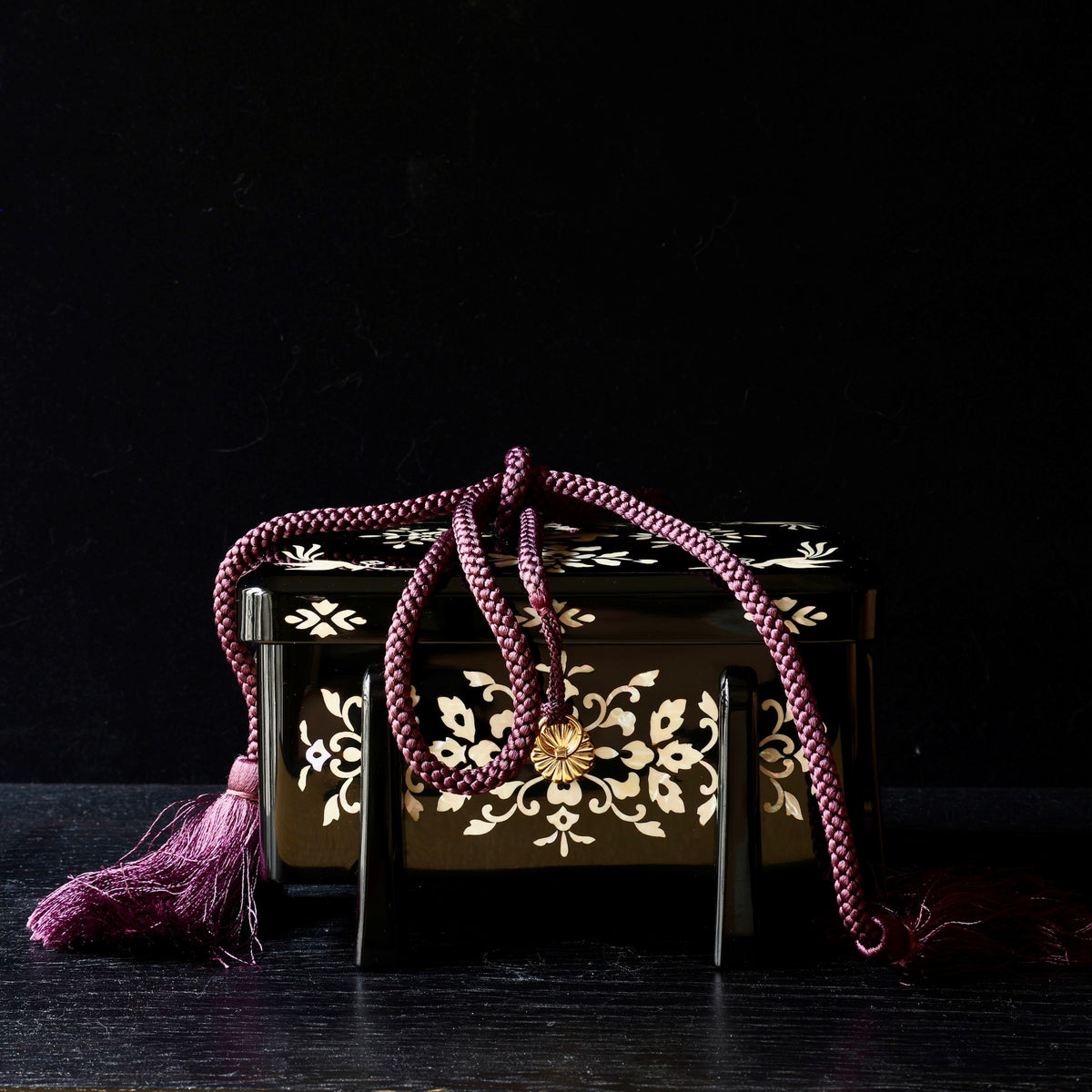
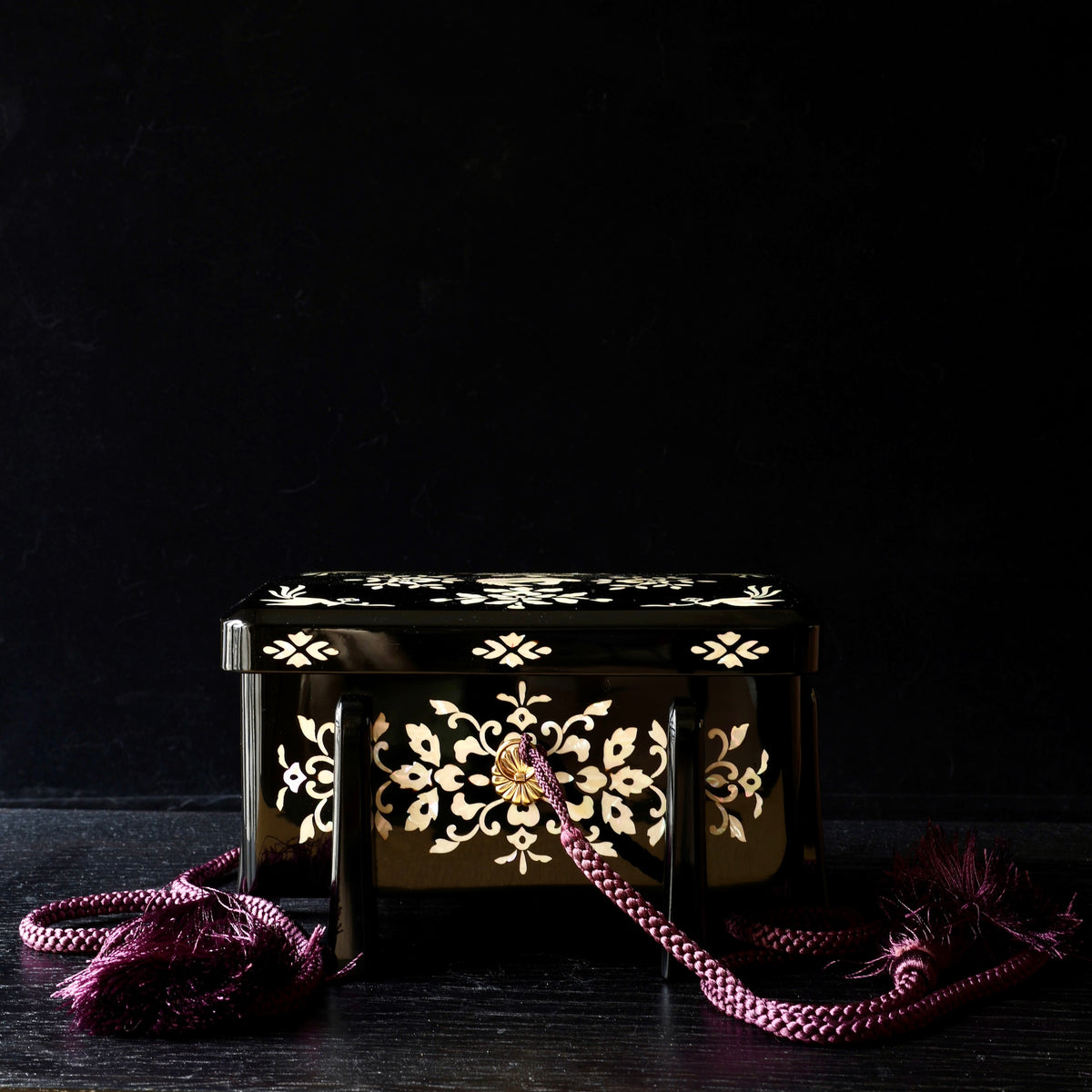
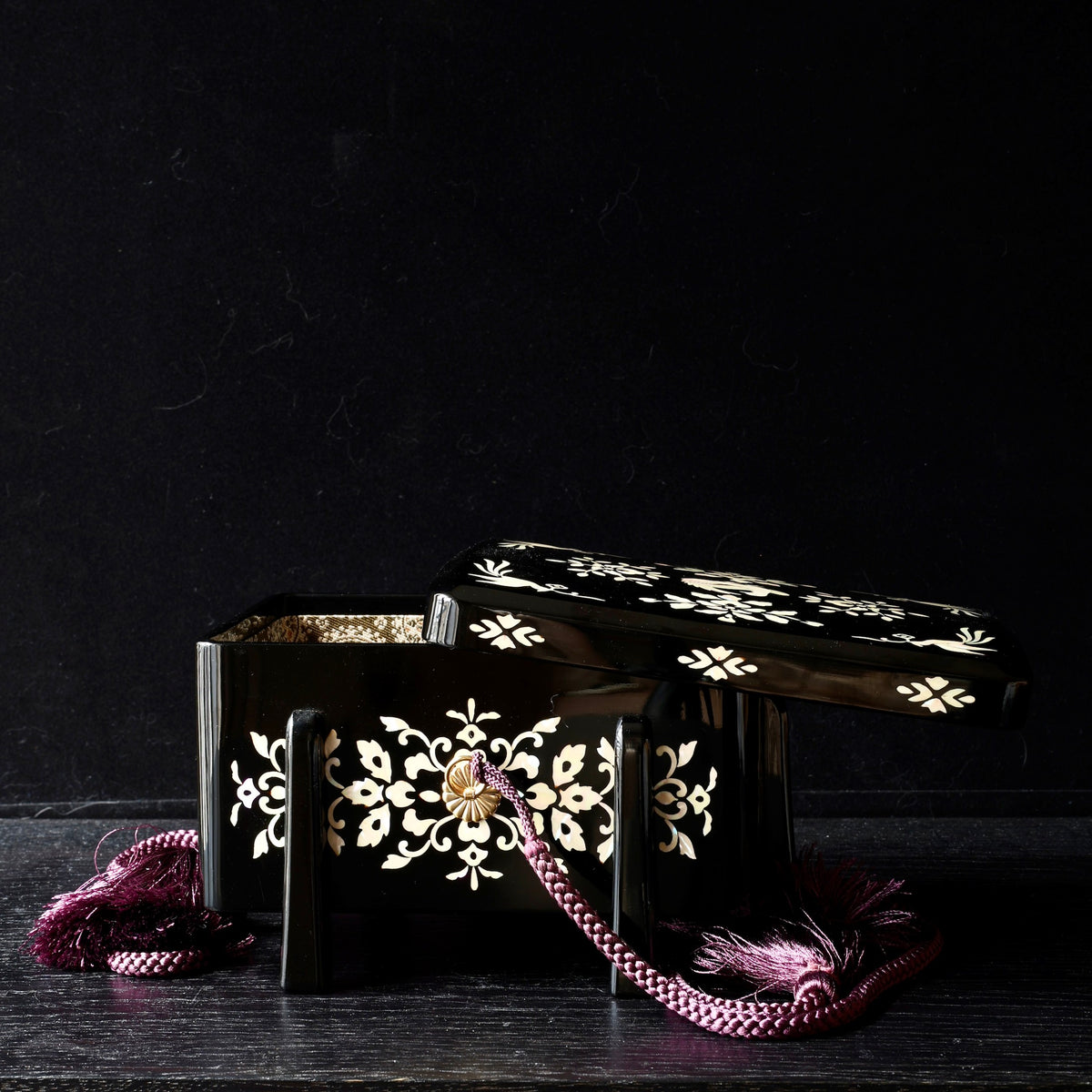


Tebako (Japanese box for precious objects) in black urushi lacquer and mother-of-pearl, Shōsō-in moyō design by Ishida Shinonome-dō
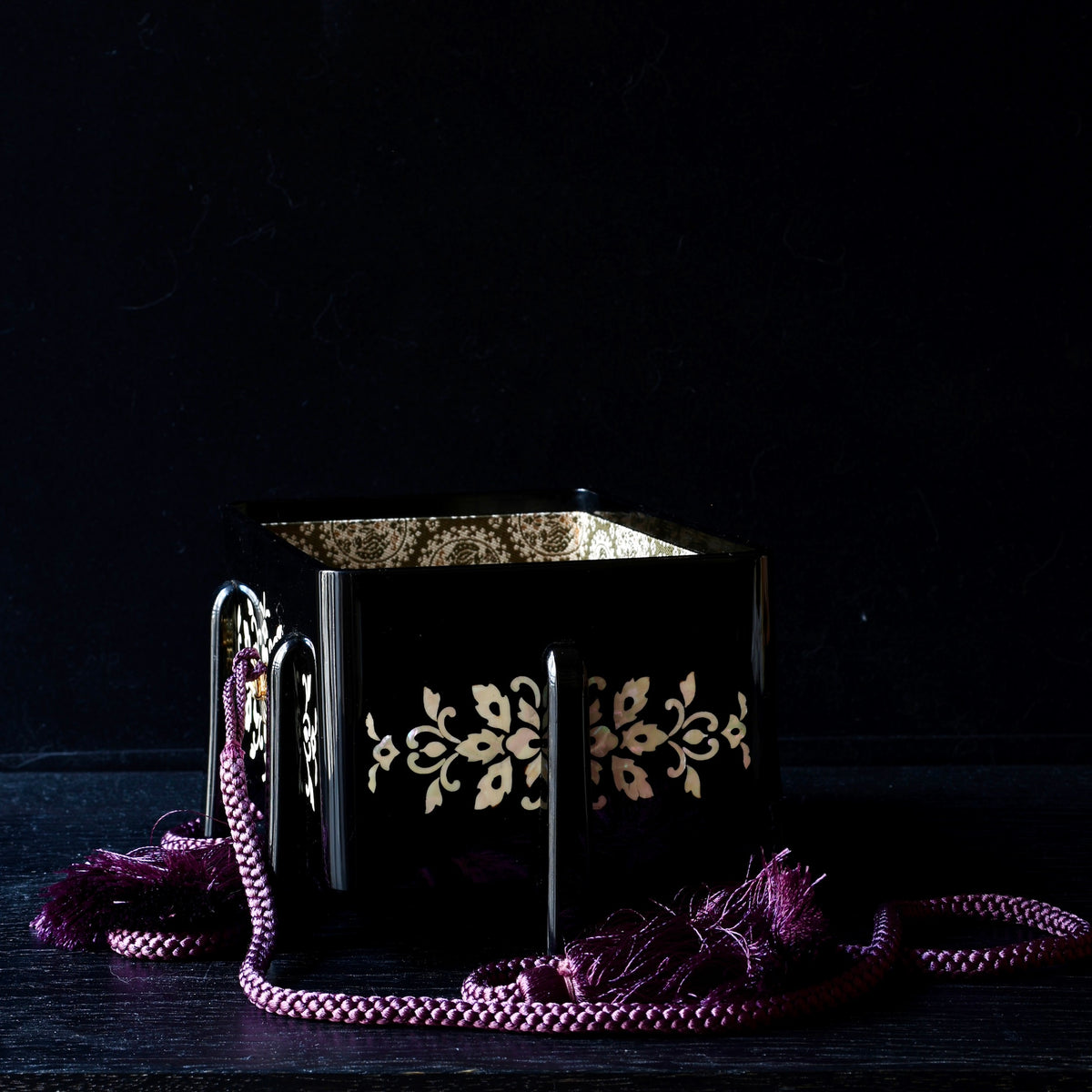
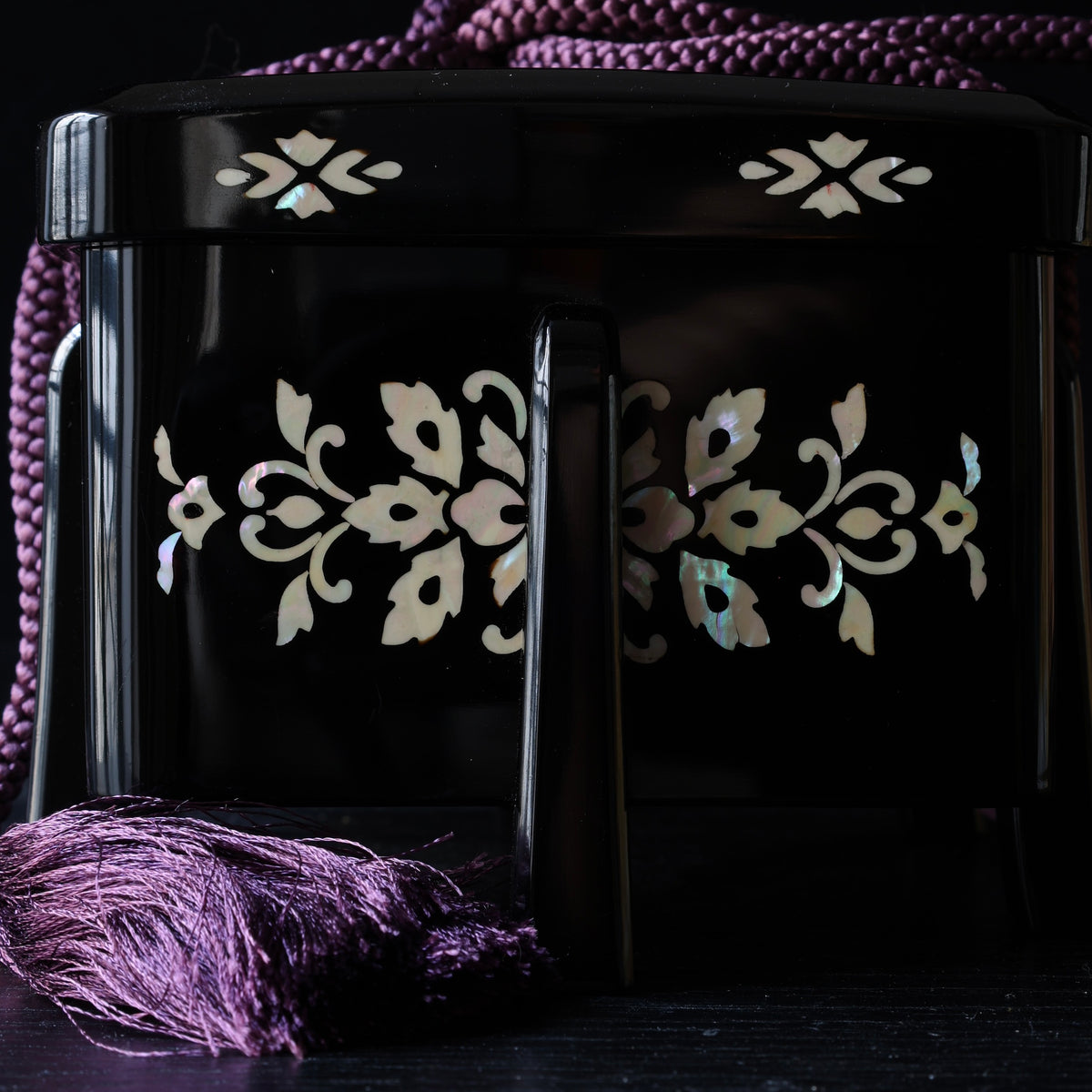
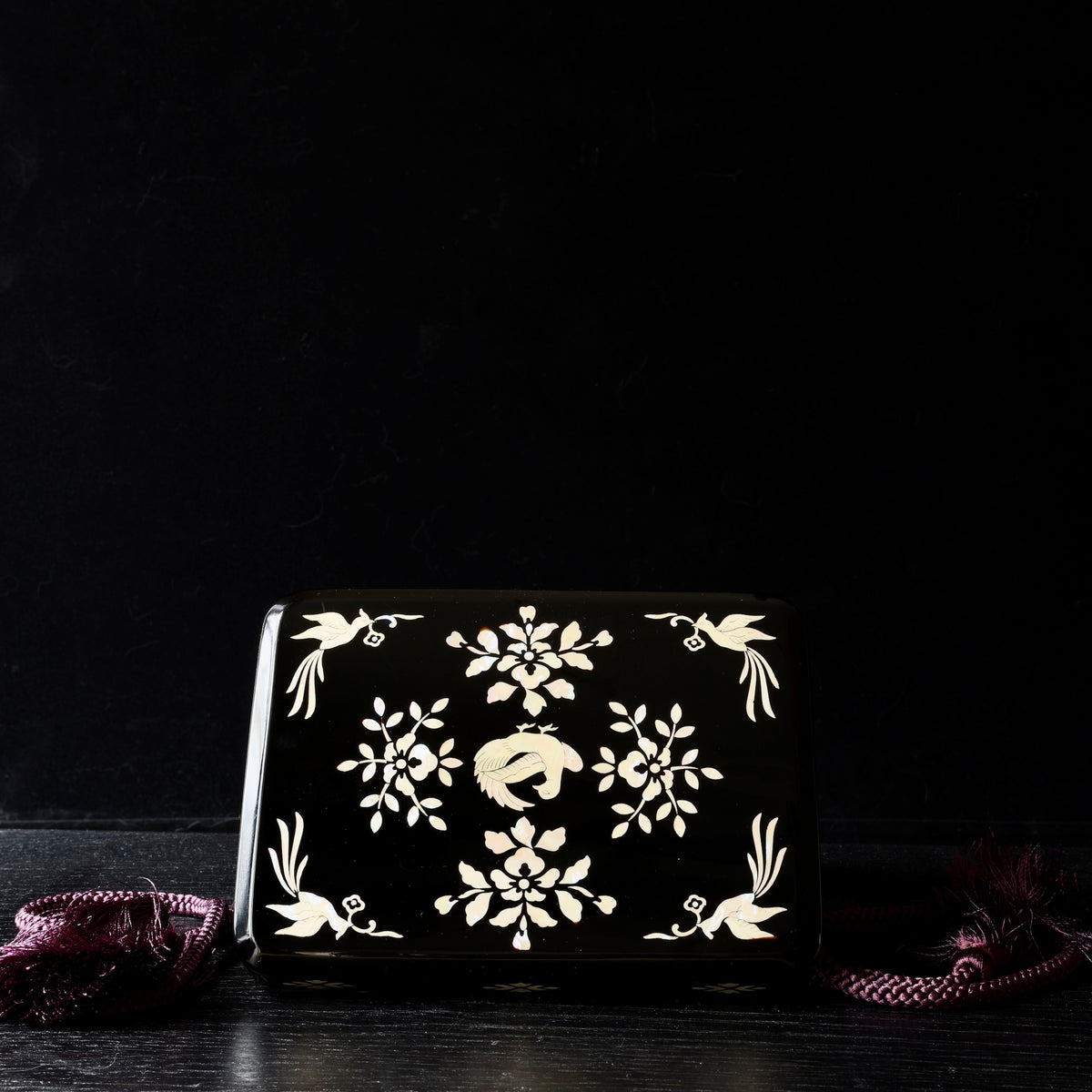
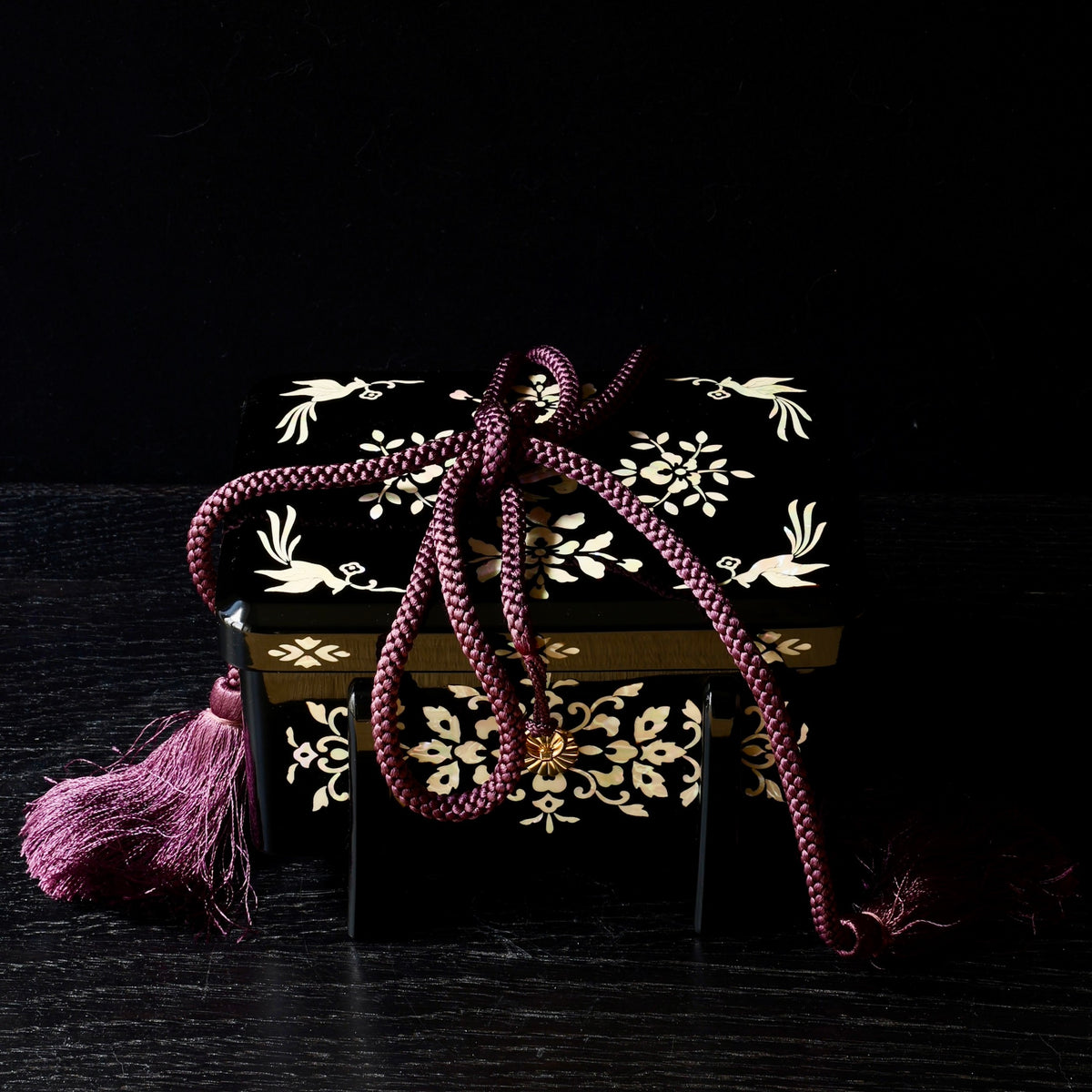
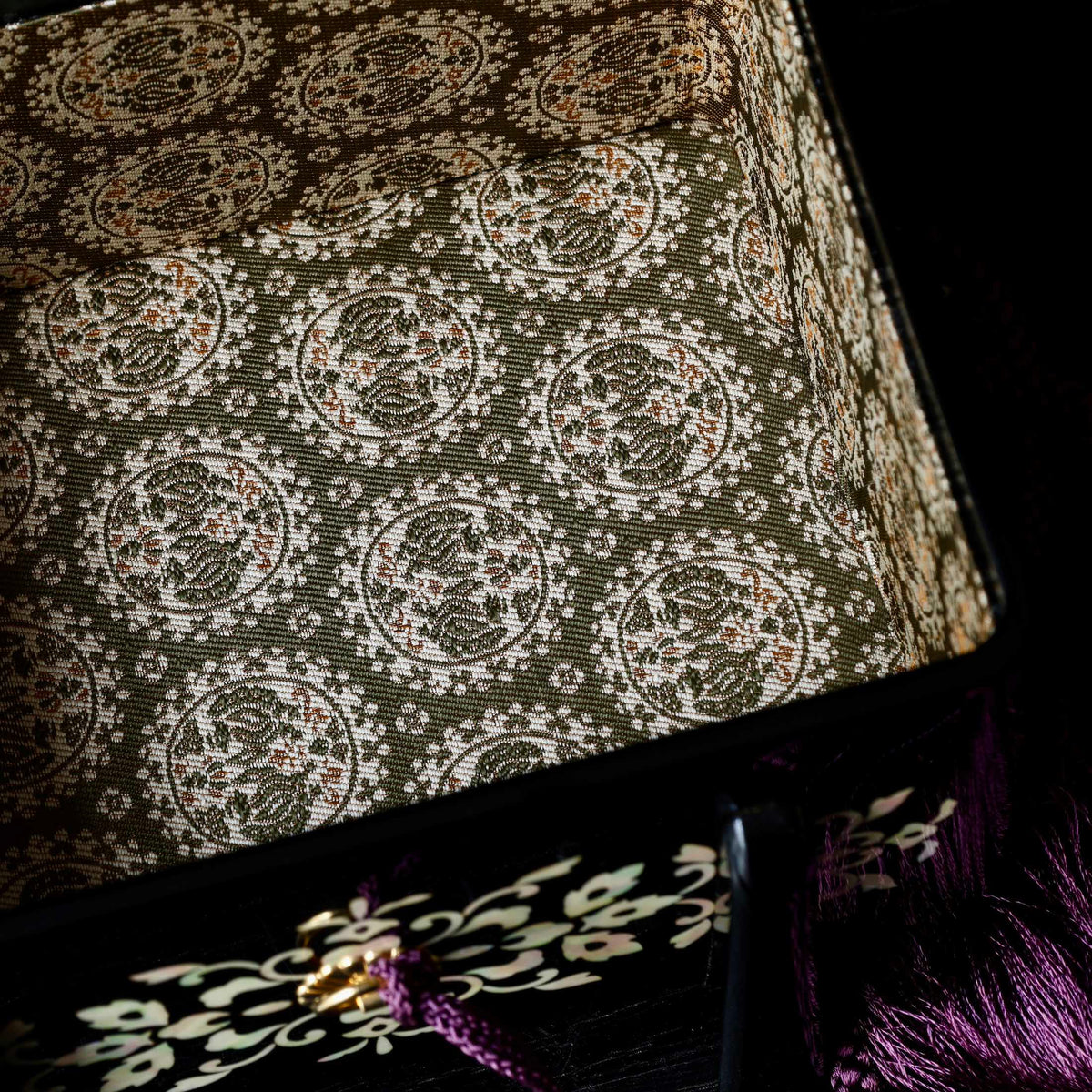
This tebako (a Japanese box intended to hold personal effects or precious objects) was made by Ishida Shinonome-dō, a former lacquerware workshop established in Nara. Entirely coated in a beautiful black urushi lacquer, it is adorned with iridescent mother-of-pearl inlays in an ornamental repertoire inspired by the treasures of the Shōsō-in, the famous imperial repository in Nara. Its form, inherited from ancient Japanese chests, and its interior, fully lined with brocade, bear witness to the care given to this superb piece, which combines the tradition of Nara lacquerware with the artistic heritage of the former imperial capital.
The artisan
Ishida Shinonome-dō is a former lacquerware workshop from Nara whose work is closely linked to the artistic heritage of the former imperial capital, particularly to the reinterpretation of the forms and decorations preserved at the Shōsō-in.
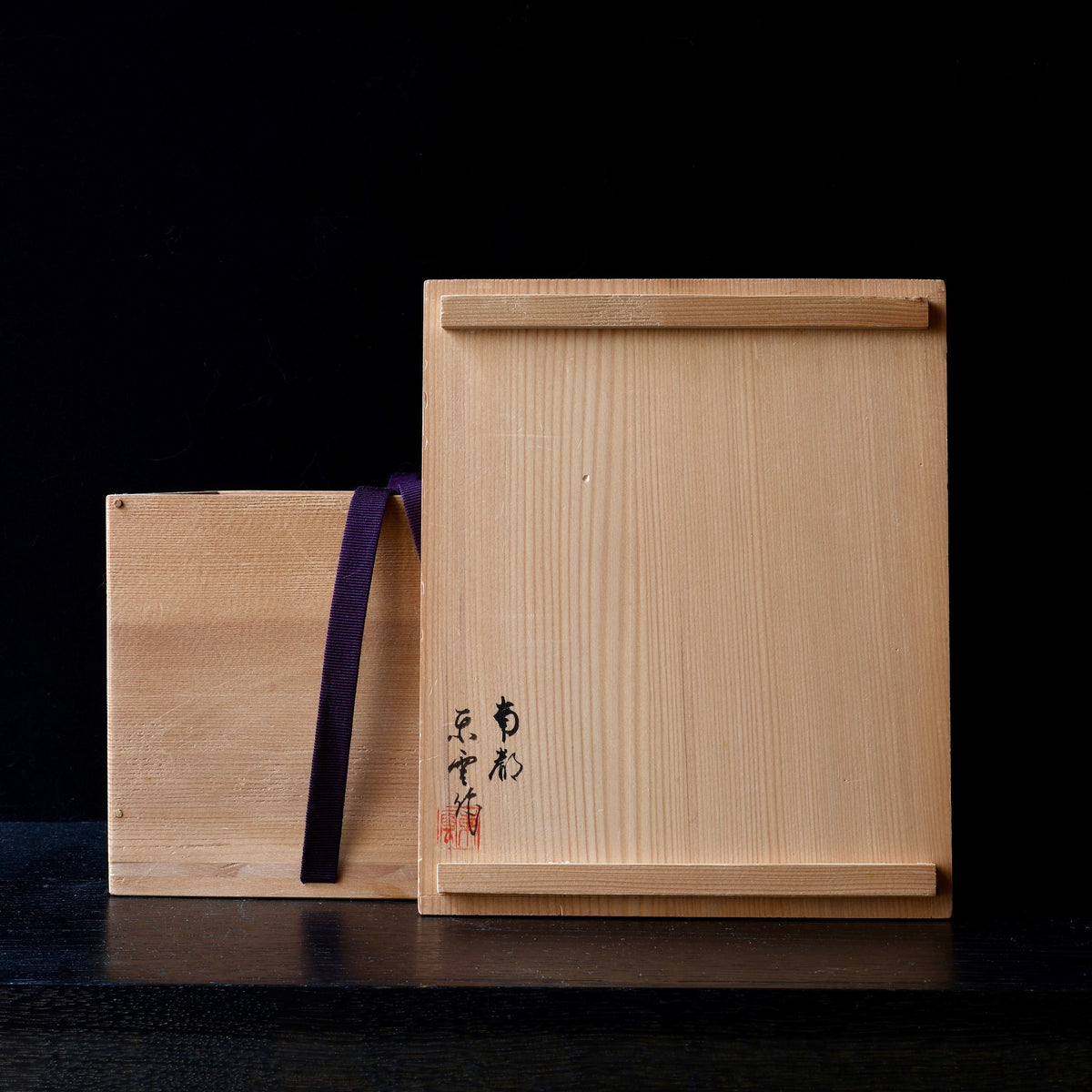
This connection to Nara helps explain the great coherence of this piece: the form inspired by the karabitsu, the raden decoration, and the Shōsō-in motifs all draw from the city's artistic heritage. The inscription Nanto Shinonome on the work reinforces this link: Nanto, "Southern Capital," is an old name for Nara, while Shinonome designates the workshop.
Ishida Shinonome-dō has now ceased operations due to a lack of a successor to continue the workshop and pass on its expertise. This tebako thus bears witness to a production that has now ceased and to a lacquer tradition unique to Nara, deeply nourished by the artistic heritage of the former imperial capital.
Decoration and techniques
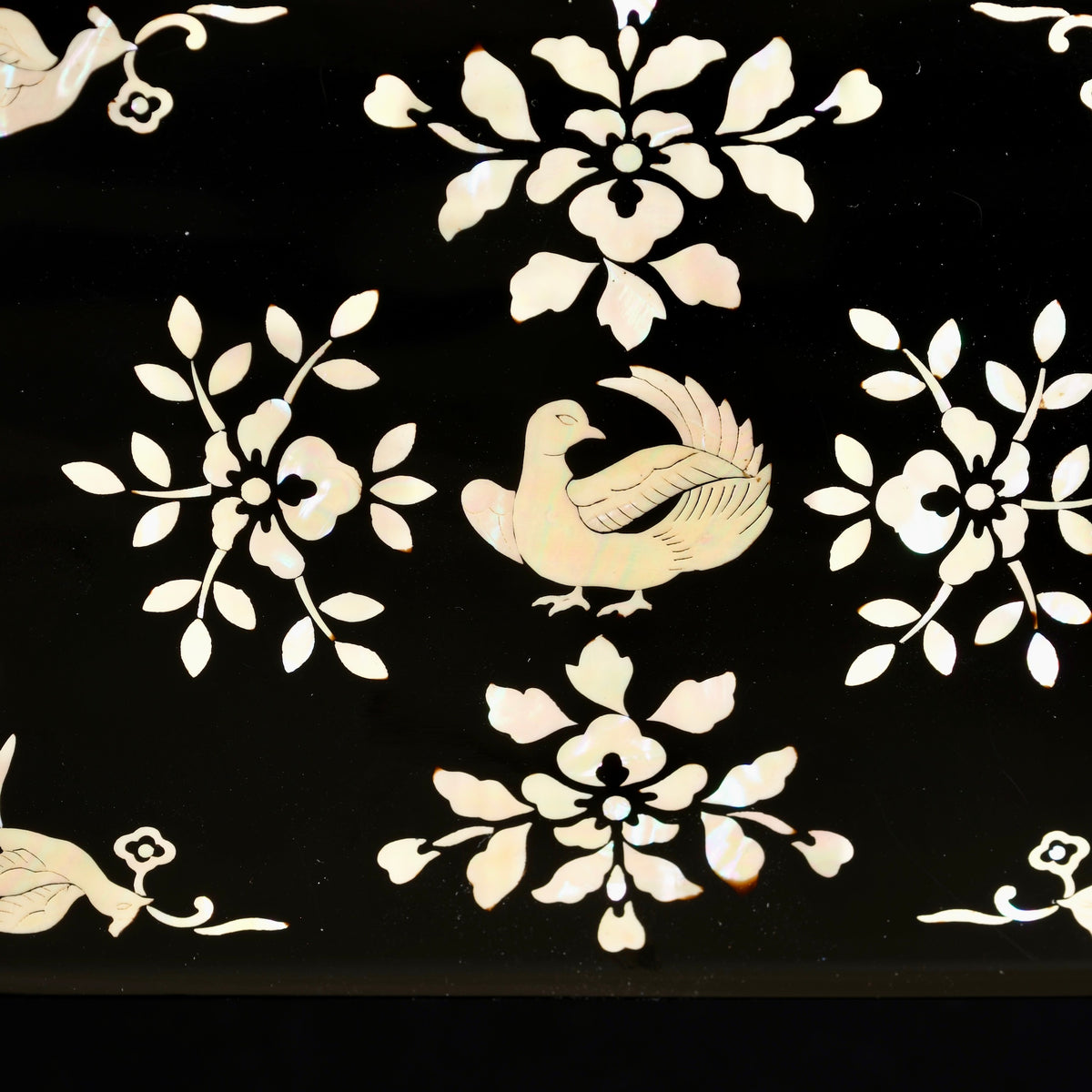
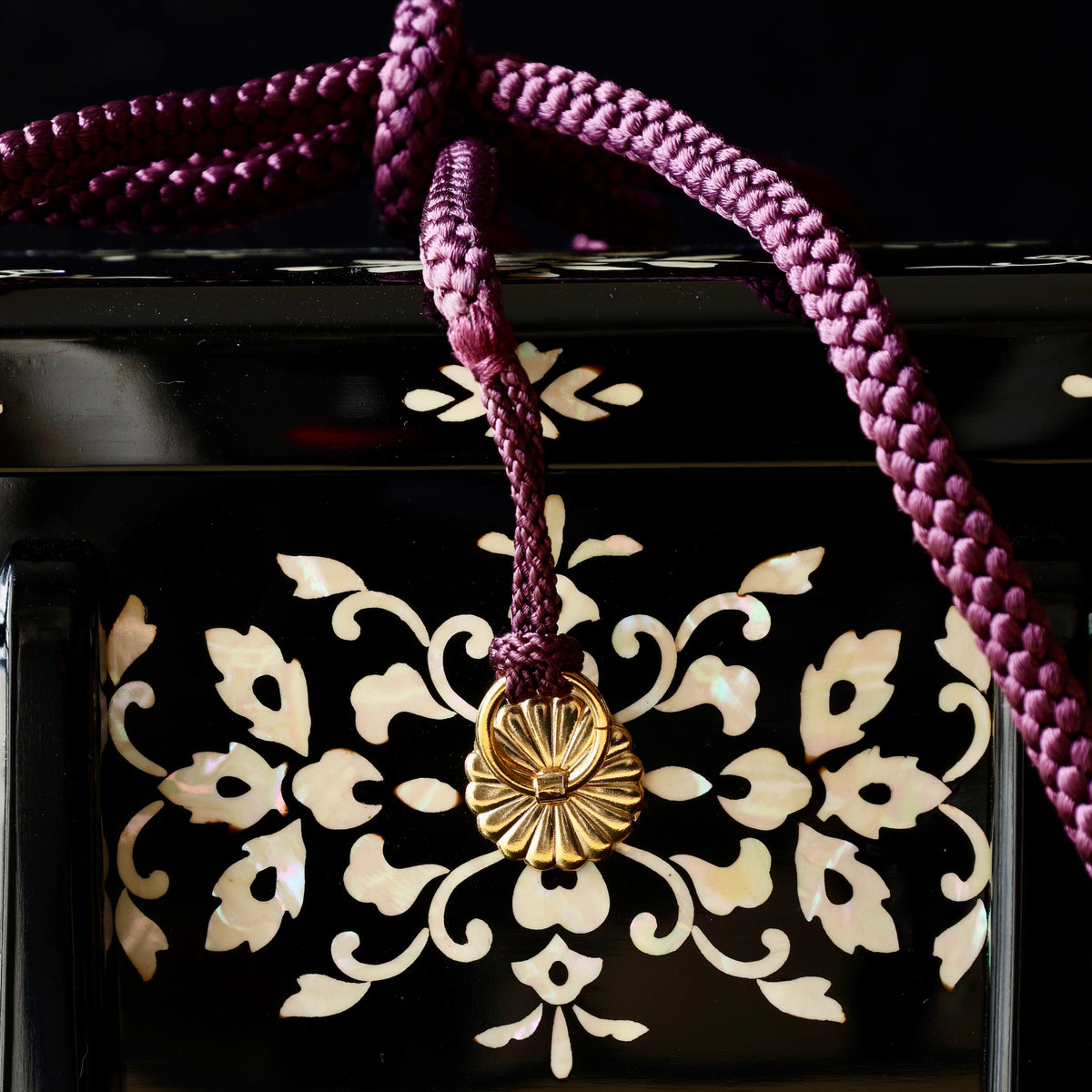
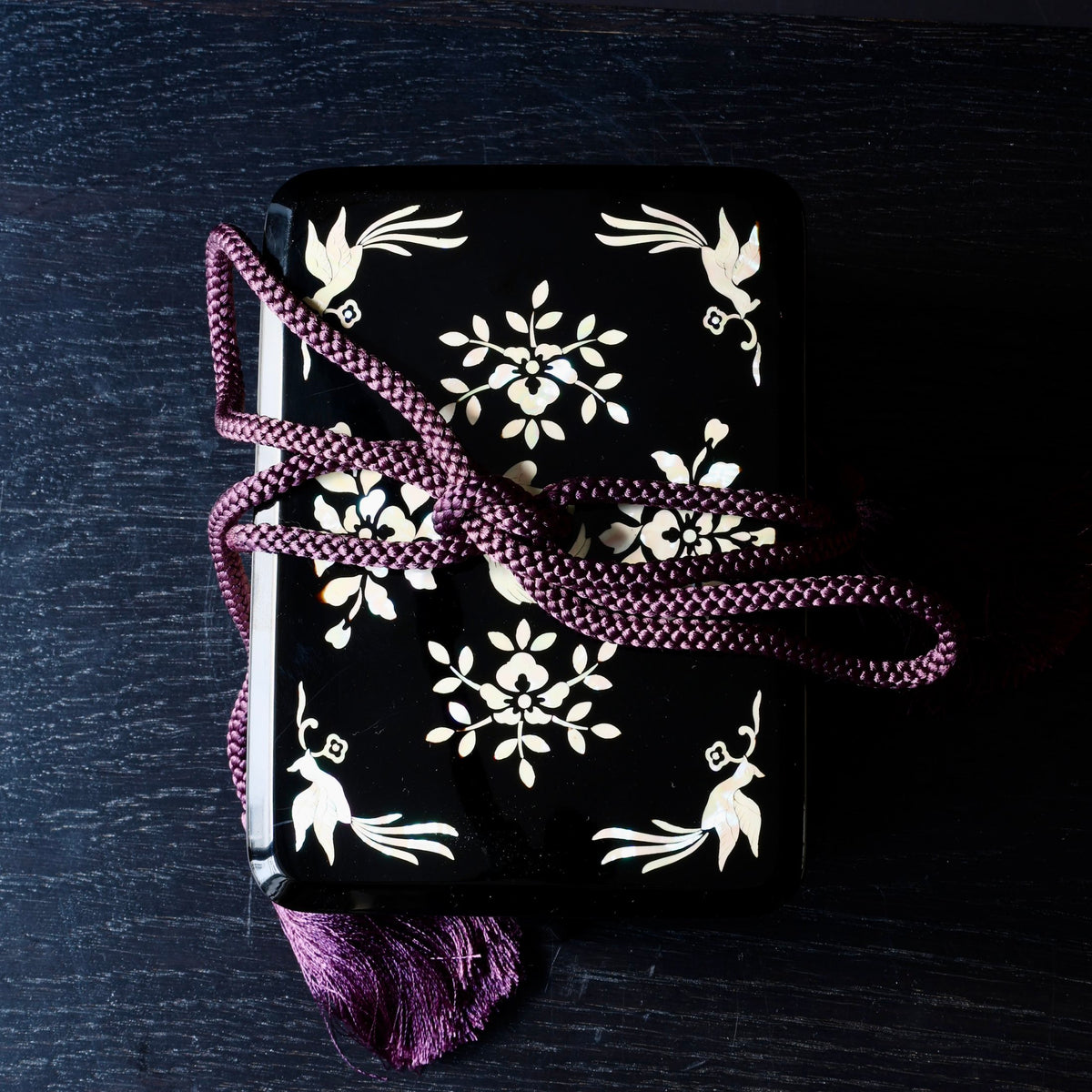
On the black urushi lacquer is a decoration created in raden (mother-of-pearl inlay), a complex artistic technique consisting of cutting out thin pieces of mother-of-pearl before inlaying them into the lacquered surface. The iridescence of the mother-of-pearl reveals birds amid floral, botanical, and arabesque motifs.
The decoration is directly inspired by the treasures of the Shōsō-in, the famous imperial repository located in Nara. It houses several thousand objects dating mainly from the 8th century, a large part of which is related to Emperor Shōmu and the imperial court of the Nara period. Textiles, furniture, musical instruments, Buddhist objects, and precious objects notably bear witness to the artistic and cultural exchanges that then linked Japan to China, Central Asia, and, more broadly, to the civilizations traversed by the Silk Roads.
These treasures gave rise to a decorative vocabulary today referred to in Japan as Shōsō-in moyō, or "Shōsō-in motifs." Birds arranged among flowers and botanical arabesques, symmetrical compositions, and motifs of continental origin are characteristic of it. The decoration of this tebako fits into this tradition, as does the choice of raden, a technique of which remarkable 8th-century examples are themselves preserved at the Shōsō-in.
Form and use
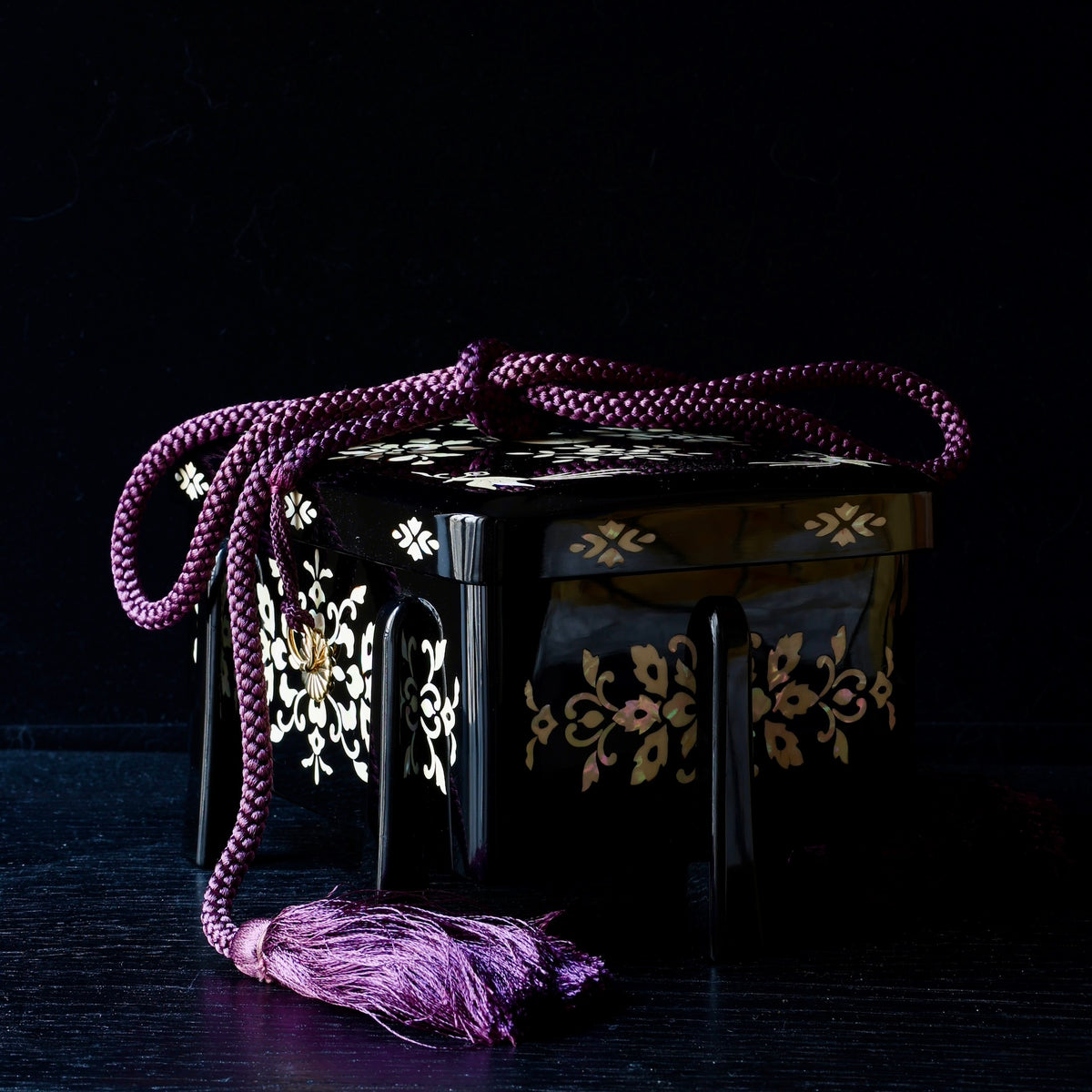
By its dimensions and function, this piece is a tebako, a term designating a box intended for personal effects and precious objects. Its form is inspired by the karabitsu (raised Japanese chest), however, a very ancient type of chest characterized by a rectangular box resting on feet, a fully removable lid, and cords allowing it to be kept closed.
Karabitsu were notably used to store textiles, documents, ritual objects, or precious goods. Shinonome-dō here offers a small-scale interpretation, adapted for a more intimate use, such as a jewelry box or for storing small precious objects.
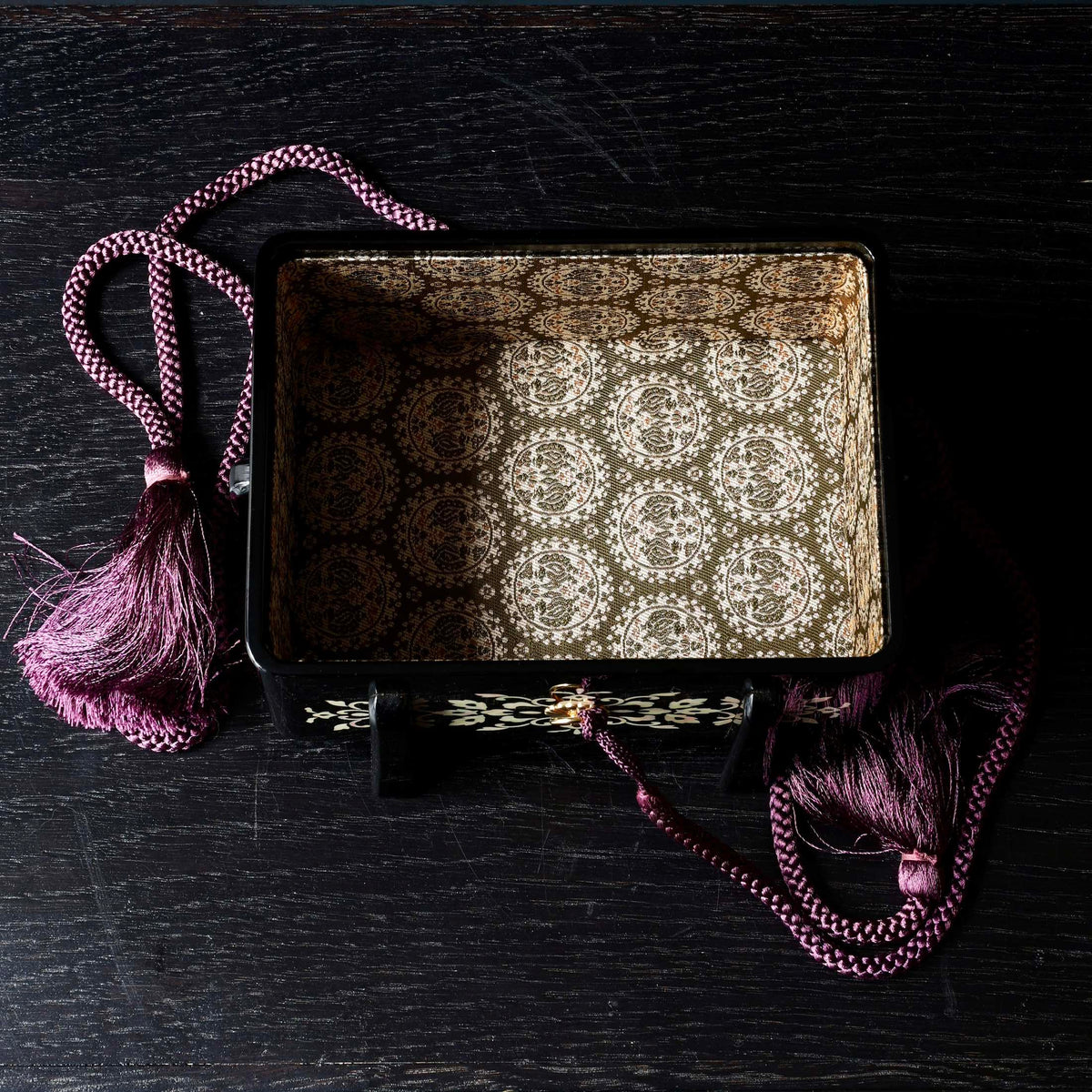
The care given to the interior fully contributes to the refinement of the whole. Both the bottom and the walls are lined with nishiki (Japanese brocade) featuring a decoration of two birds, which continues the piece's ornamental vocabulary inside.
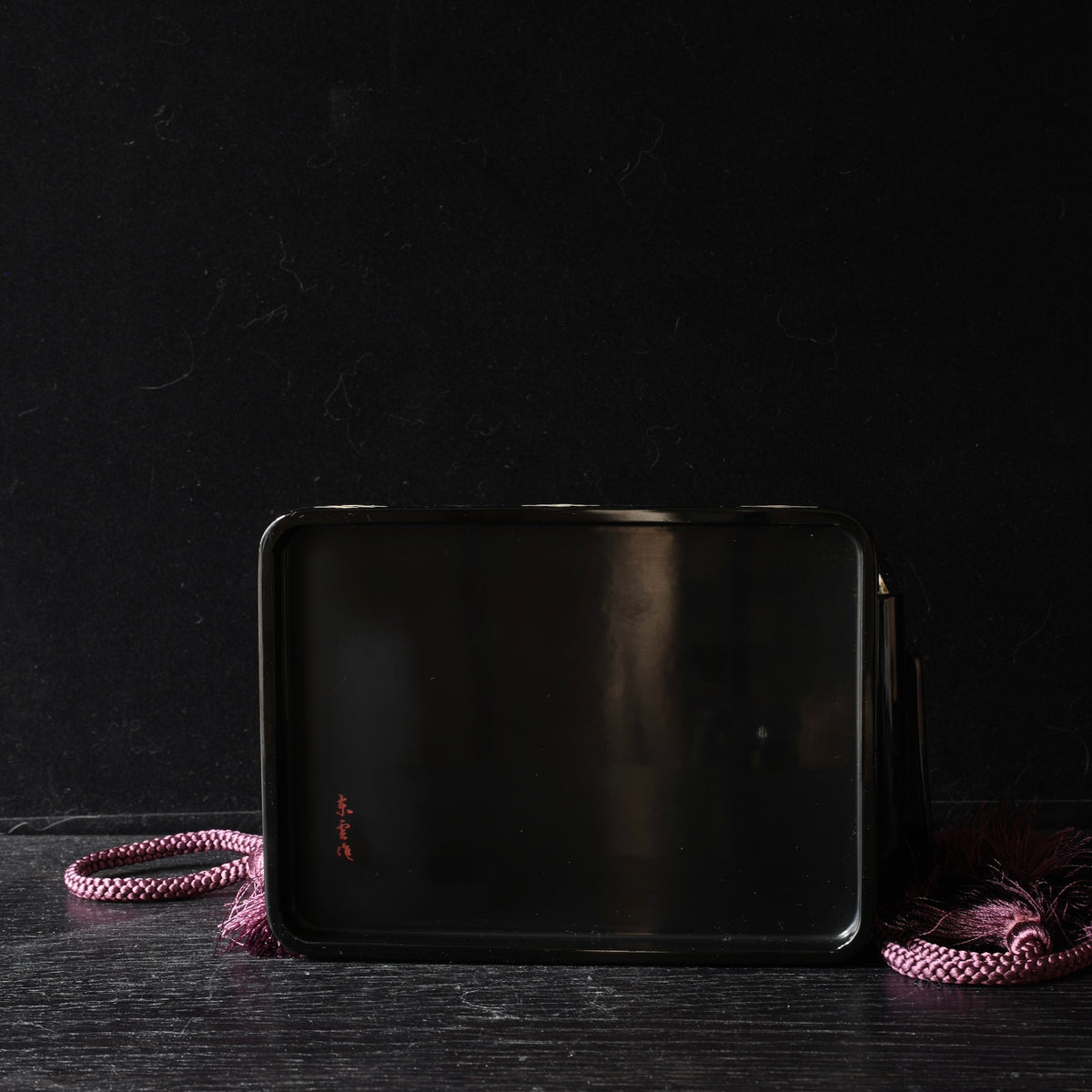
The box rests on six small feet. A long braided purple cord, finished with two tassels, allows its removable lid to be kept in place.
Presentation
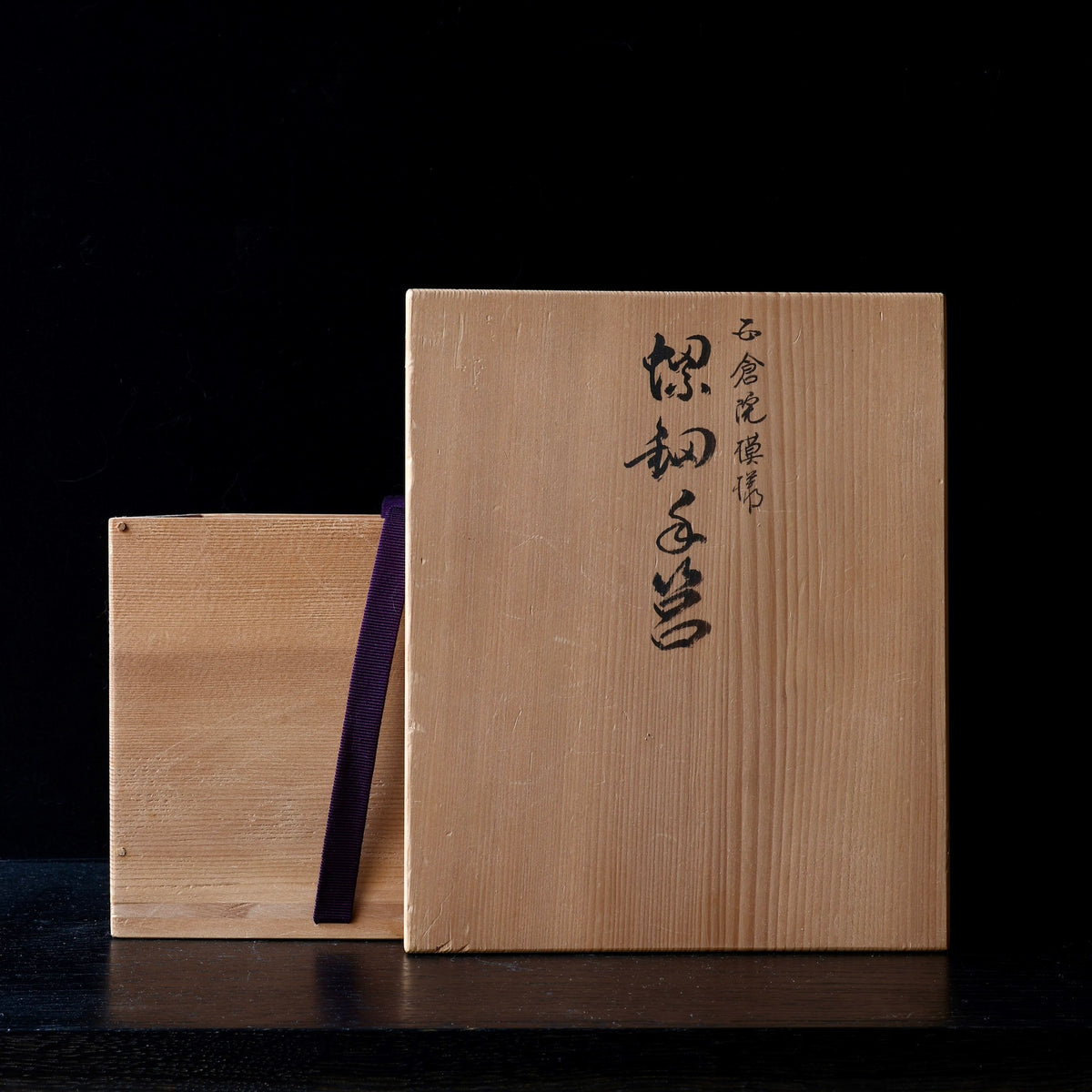
This piece is accompanied by its original tomobako (wooden protective box), bearing the seal, signature, and name of the work. The tebako is signed by the artisan inside the lid.
Place of manufacture
Japan, Nara
Period
Shōwa era (1926-1989)
Dimensions
Length 19.9 cm - Width 15 cm - Height 11.1 cm
Weight
Tebako + protective box: 1350 gr
Materials
Urushi lacquer, mother-of-pearl, textile brocade
Condition
Very good condition.
The reflections of the lacquer and decoration can create misleading visual effects in photographs. Any actual defect, if it exists, is systematically reported in the product sheet (under the "Condition" section) so that you can make your decision with complete confidence.
© Atelier Ikiwa – Laurence Corteggiani. Photos and texts protected. All reproduction forbidden without authorization.
KNOW-HOW
Traditional Japanese lacquer, urushi, comes from the sap of the lacquer tree (Rhus Verniciflua), which flows after incision of the bark. It is a very precious material, a tree will give a maximum of 200ml of sap in its life, which is worked by specialized craftsmen. It takes many operations, slow and meticulous, and several months of work to bring real lacquer objects to life. It is the oldest craft in Japan! Initially used to protect and waterproof objects, this immutable craft has become an art of extreme sophistication. If you want to know more about the art of Japanese lacquer, you can read our dedicated article > .
SHIPPING AND PAYMENT OPTIONS
Shipping
Free shipping in mainland France for purchases over €200. Shipping with Colissimo, delivery to your home or a pick-up point, package delivered against signature or unique code for valuable items. Orders are generally dispatched within 2 business days, except for fine art photographs, which are printed on demand, and special cases that will be announced in the banner at the top of the site (e.g., in case of absence). Learn more >
Payment options
Secure card payment with Shopify Payments and 3D Secure technology.
Visa, MasterCard, American Express, Cartes Bancaires, PayPal, Apple Pay, Shop Pay, and Klarna.
Klarna: Pay in 3 interest-free installments or within 30 days, for purchases up to €1,500, subject to Klarna's approval. You will be redirected to Klarna to log in or create an account and confirm your payment.
PayPal: You will be redirected to PayPal to log in and confirm payment. New users can create an account during checkout.
Your invoice will be sent with your order.
Returns and exchanges
14 days to change your mind. Learn more >
CARE INSTRUCTIONS
Clean with a very soft cloth to avoid scratches, soaked in a little warm water if necessary (never soak your lacquer objects). No microwave, dishwasher, dryer. Do not expose to direct sunlight for a long time (risk of discoloration). If the atmosphere is very dry and very hot, and to avoid the risk of cracking, you can place a glass filled with water next to your lacquer object.
Choose options
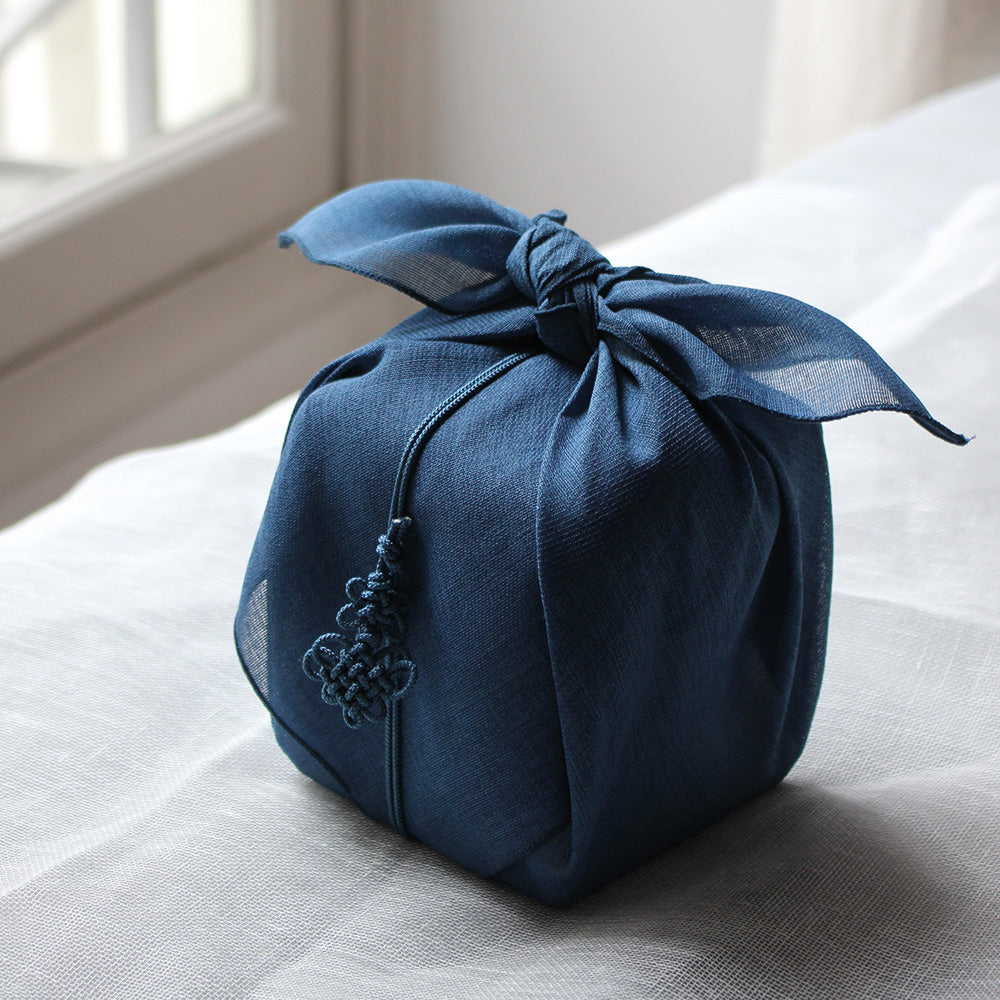
The art of wrapping
The exceptional items are wrapped in a beautiful fabric beautifully knotted using the little-known art of Korean pojagi and decorated with a delightful maedup (Korean ornamental knot). Details and conditions >
WRAPPING
Exceptional items are wrapped in textiles tied according to the Korean pojagi art