

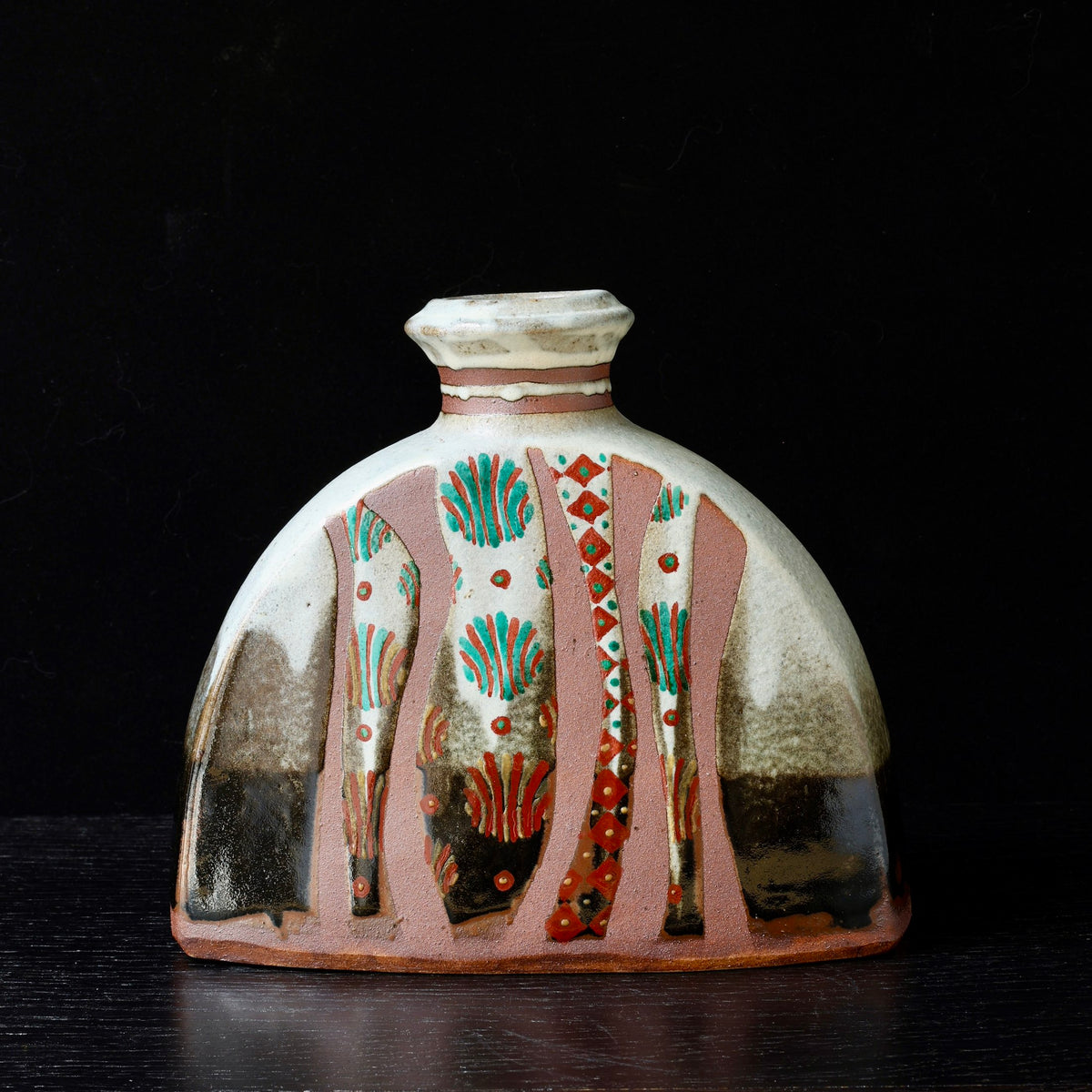
Henko ceramic kakeai yakishime akae vase by Tomoo Hamada
This vase by master ceramicist Tomoo Hamada is rooted in the tradition of Mashiko yaki (Mashiko pottery), which was profoundly shaped by the Mingei movement. Descendant of three generations of ceramicists, Tomoo Hamada continues the work of his grandfather Shōji Hamada, a Living National Treasure and co-founder of the Mingei movement, while developing a distinctive artistic language recognized both in Japan and internationally.
With its slender silhouette, contrasting textures, and polychrome graphic decoration, this vase embodies a resolutely contemporary aesthetic in which functional pottery meets sculptural creation.
The Ceramicist
Tomoo Hamada (born in 1967 in Mashiko, Tochigi Prefecture) belongs to one of the most prestigious lineages in Japanese ceramics. The grandson of Shōji Hamada (1894–1978), a Living National Treasure and co-founder of the Mingei movement alongside Sōetsu Yanagi and Kanjirō Kawai, he is also the son of ceramicist Shinsaku Hamada.
After studying sculpture at the Tama Art University, from which he graduated in 1989, he completed a research course in fine arts in 1991 before joining his family’s studio in Mashiko. He has developed a distinctive body of work that combines traditional techniques with research into form, glazes, and decoration. Since 2008, he has led the third generation of the Hamada studio, and since 2012, he has also directed the Shōji Hamada Memorial Mashiko Sankokan Museum, dedicated to his grandfather’s legacy.
His international reputation is reflected in numerous exhibitions in Japan, the United States, and the United Kingdom, notably at the Leach Pottery in St Ives and the Pucker Gallery in Boston. His works are held in the permanent collections of major institutions, including the Victoria and Albert Museum in London, the Museum of Fine Arts in Boston, and the Asian Art Museum in San Francisco. He also plays a major role in passing on the traditional skills of Mashiko and in fostering artistic exchange between Japan and the West.
Technique and Decoration
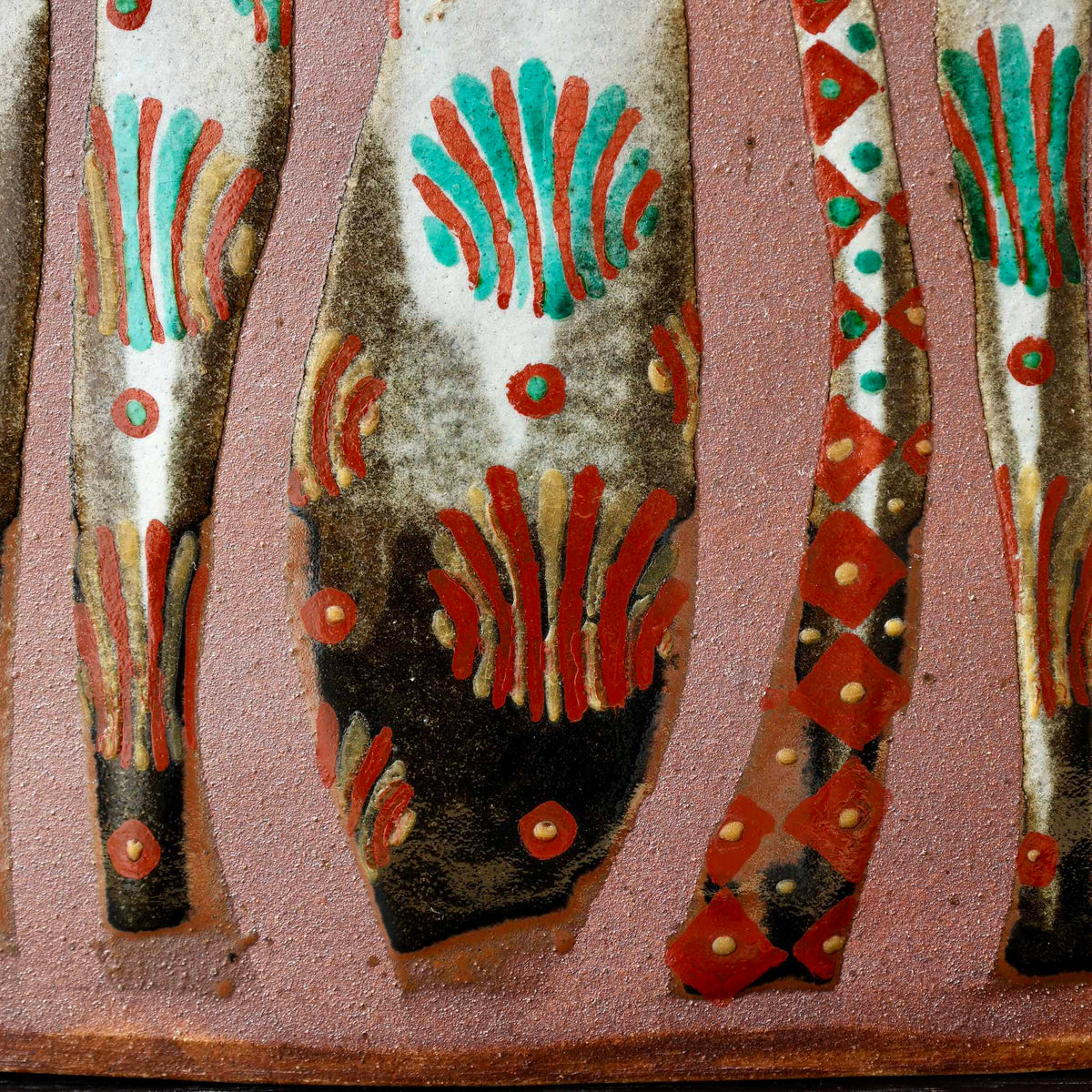
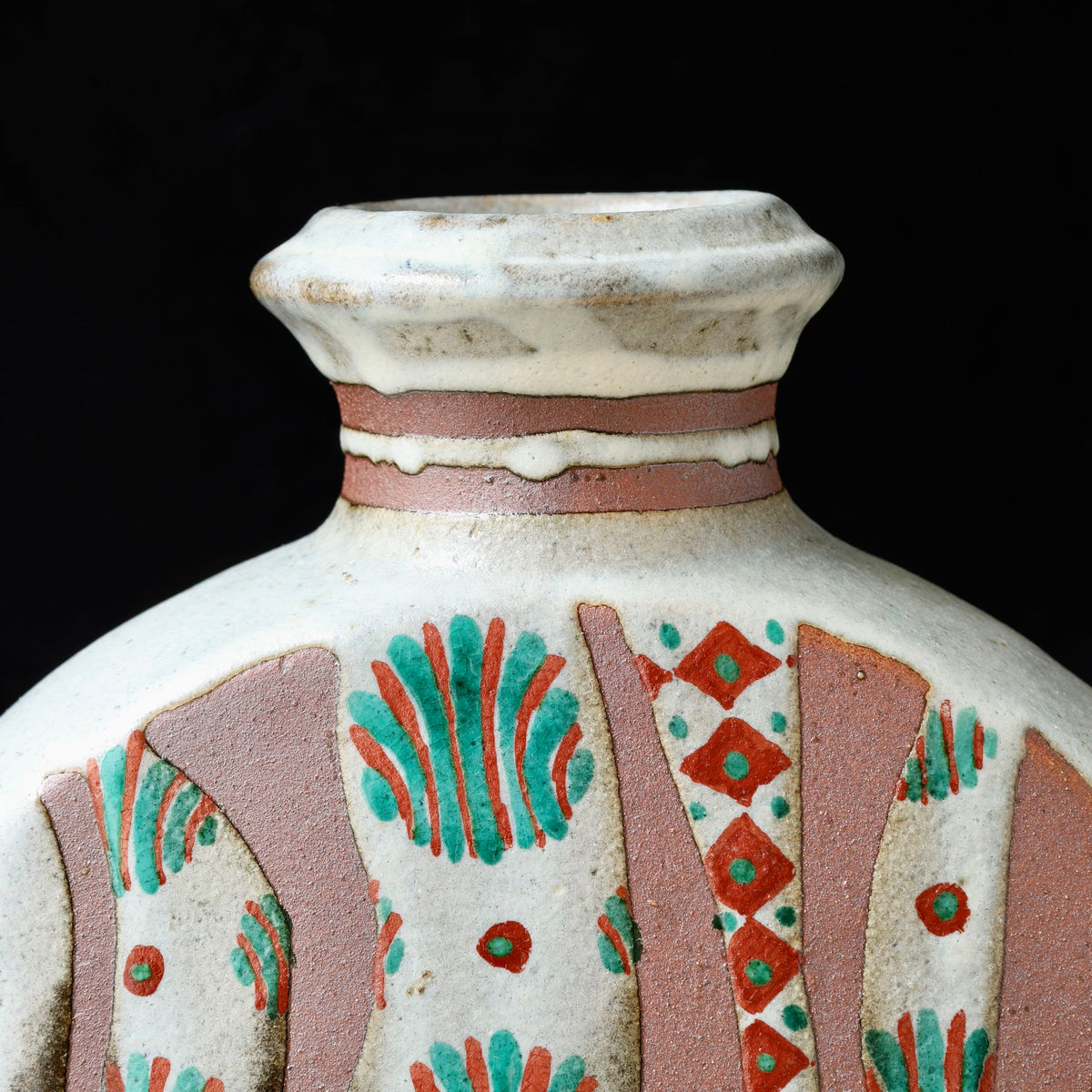
Tomoo Hamada continues the traditional techniques of Mashiko while conducting personal research into form, glaze combinations, and polychrome decoration. He notably uses layered iron-based glazes, contrasts between glazed surfaces and exposed clay, and akae decoration (polychrome decoration with a predominantly red color scheme), created by applying colored glazes to a previously fired surface. This technique produces reds, greens, and yellows with bold tones, whose vibrancy contrasts with the more mineral colors of the base glazes.
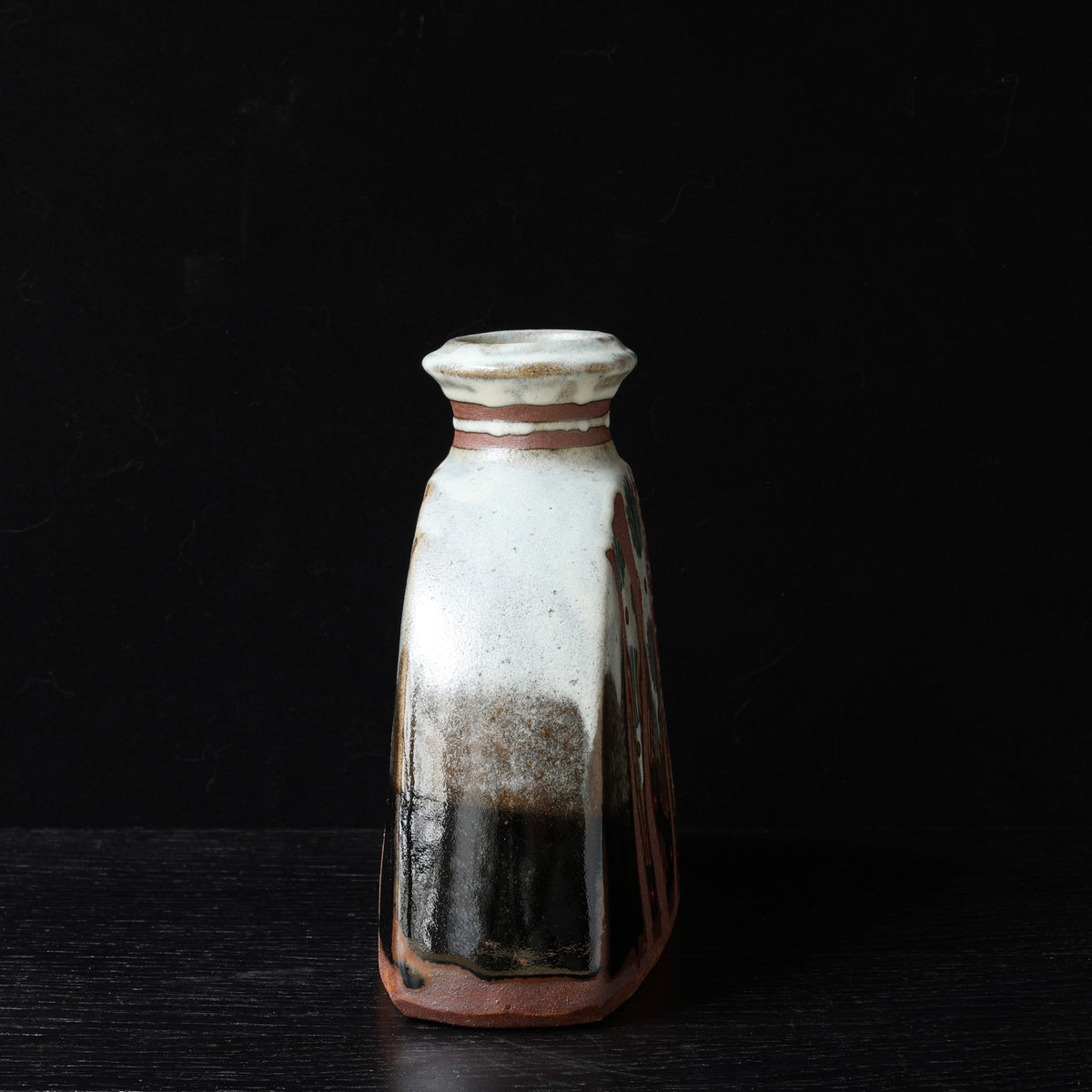
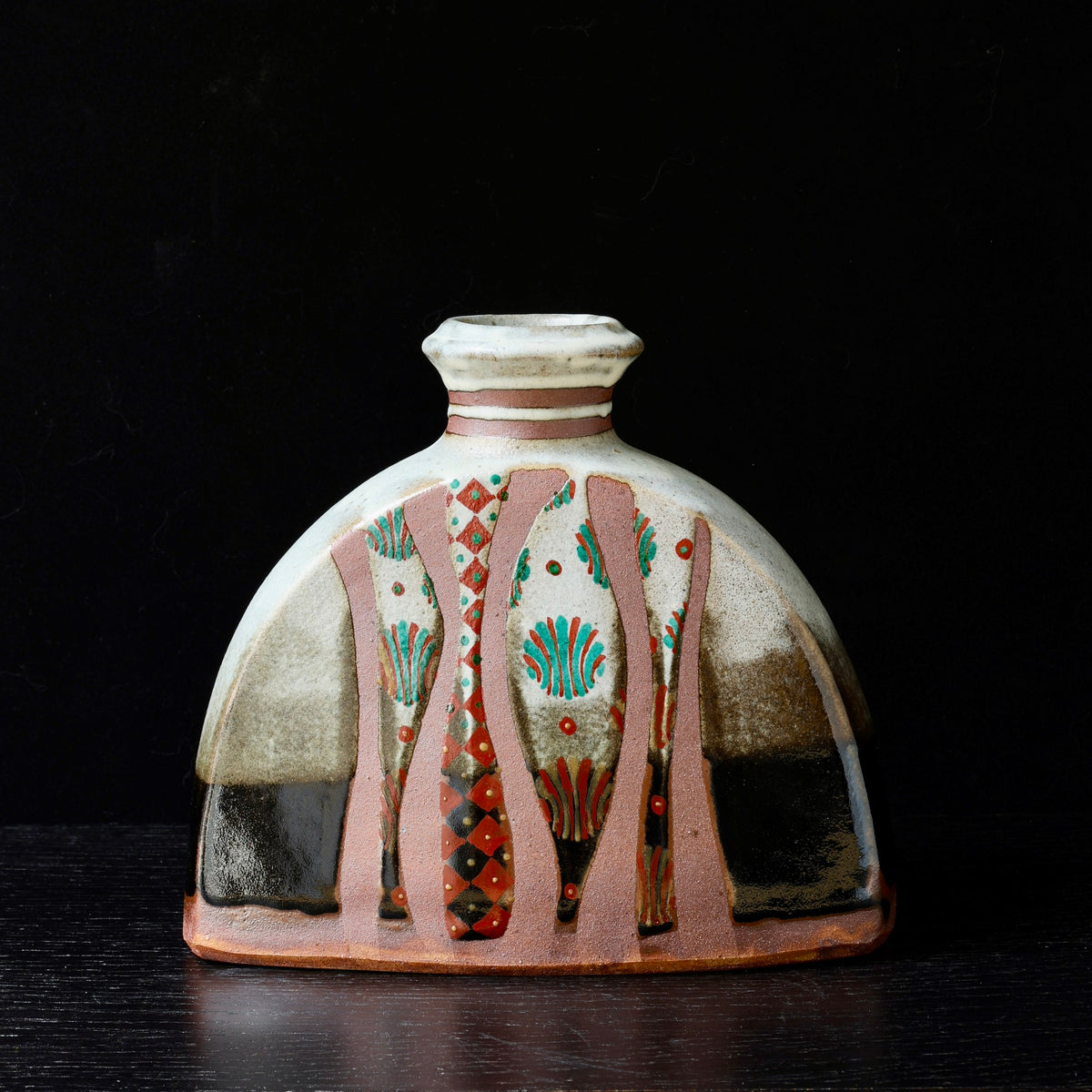
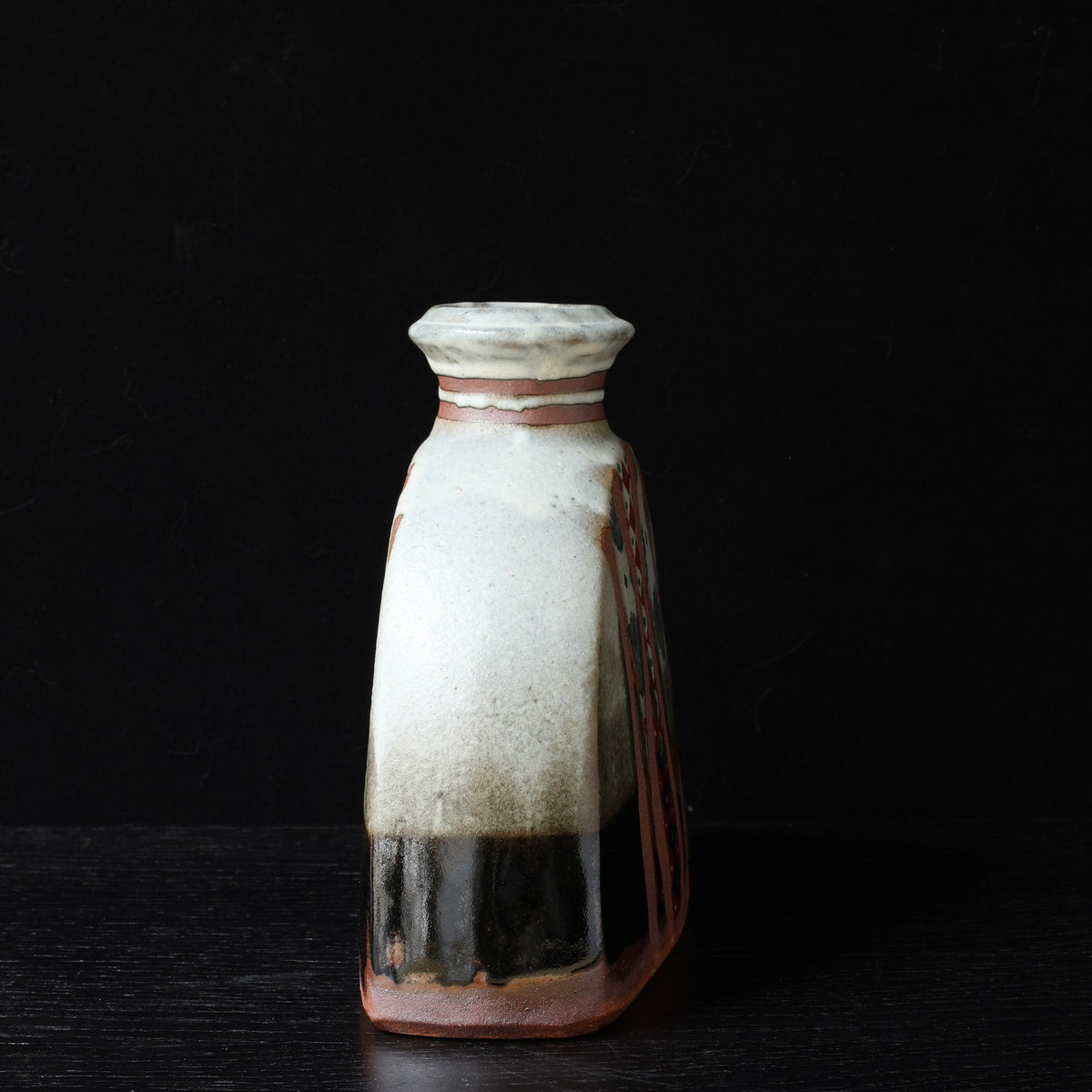
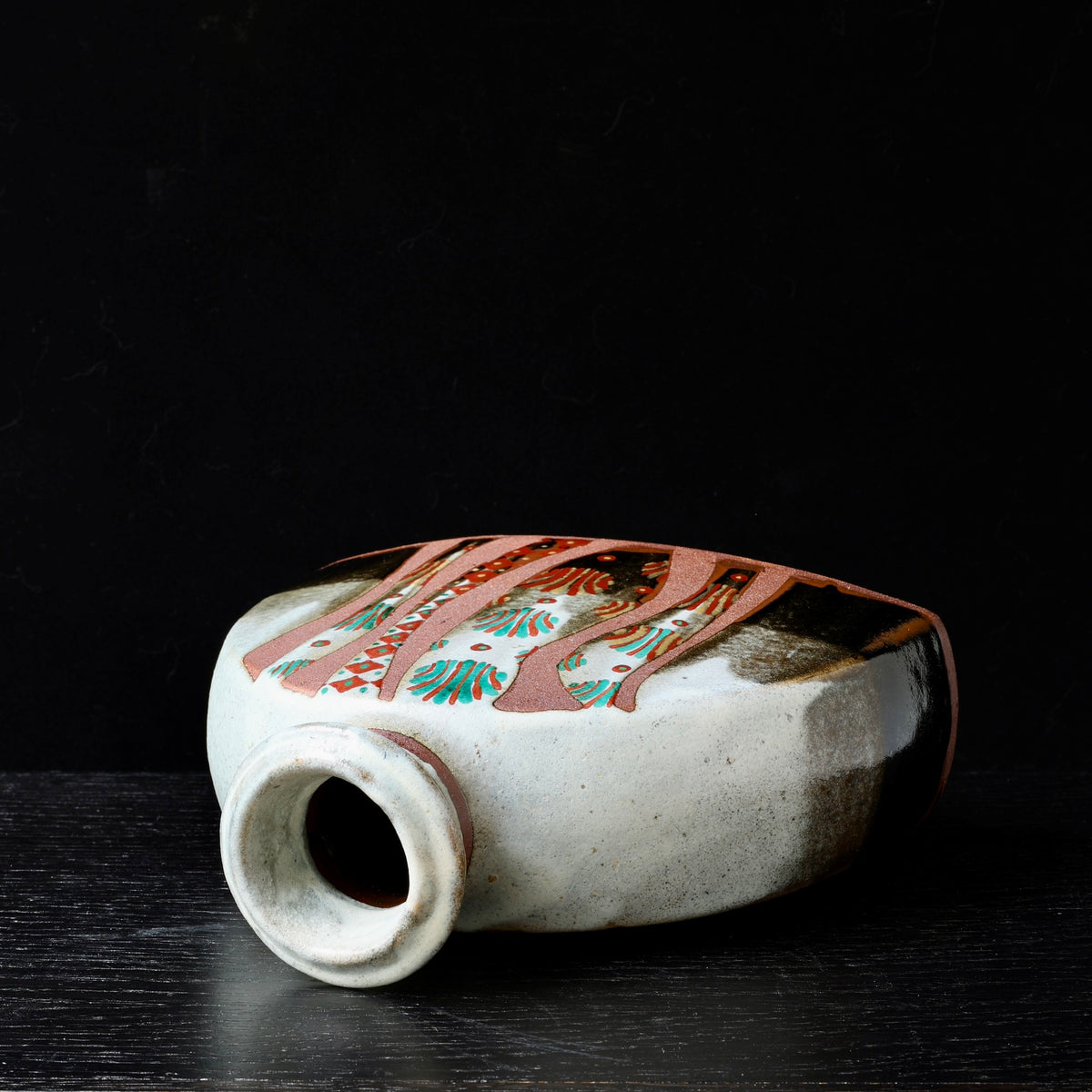
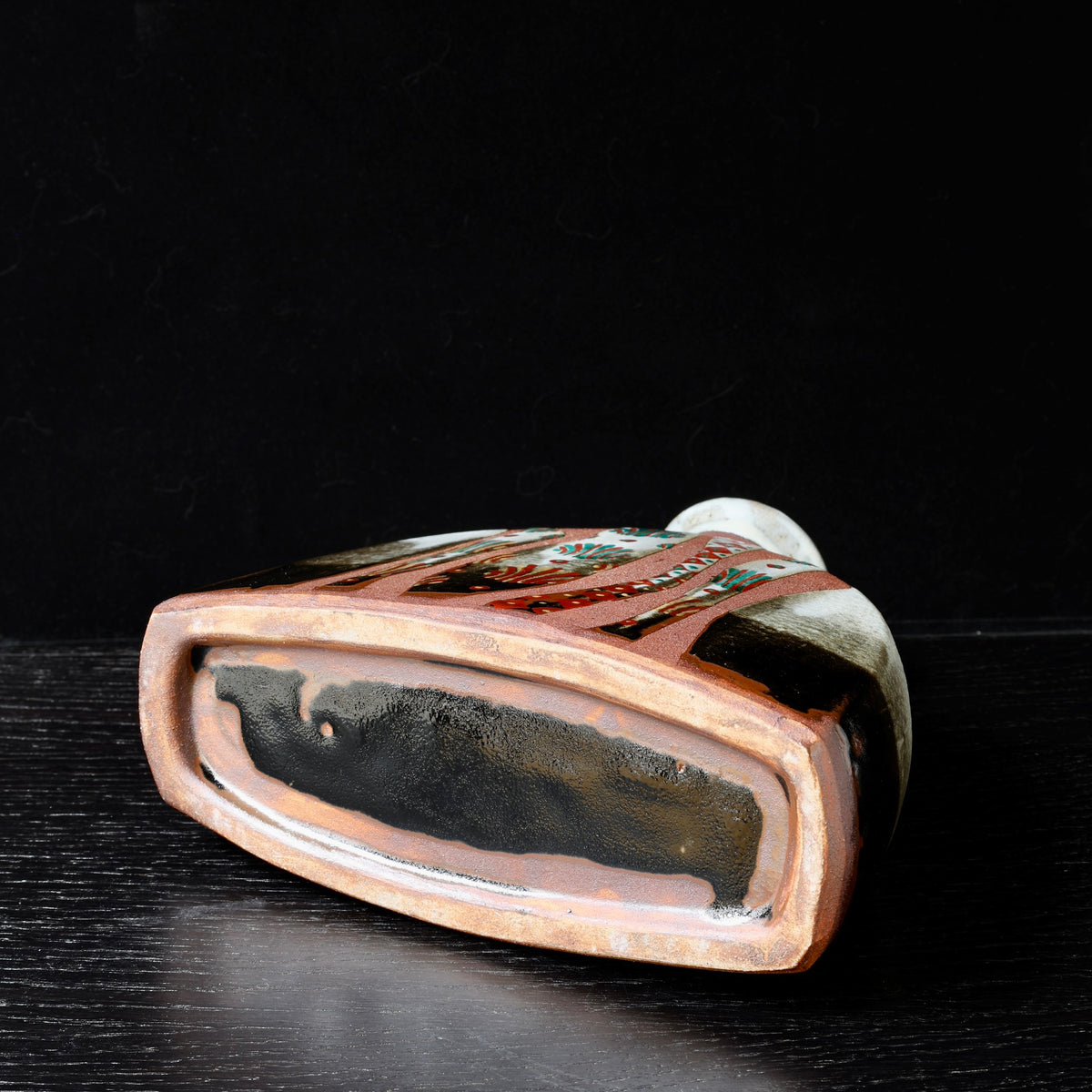
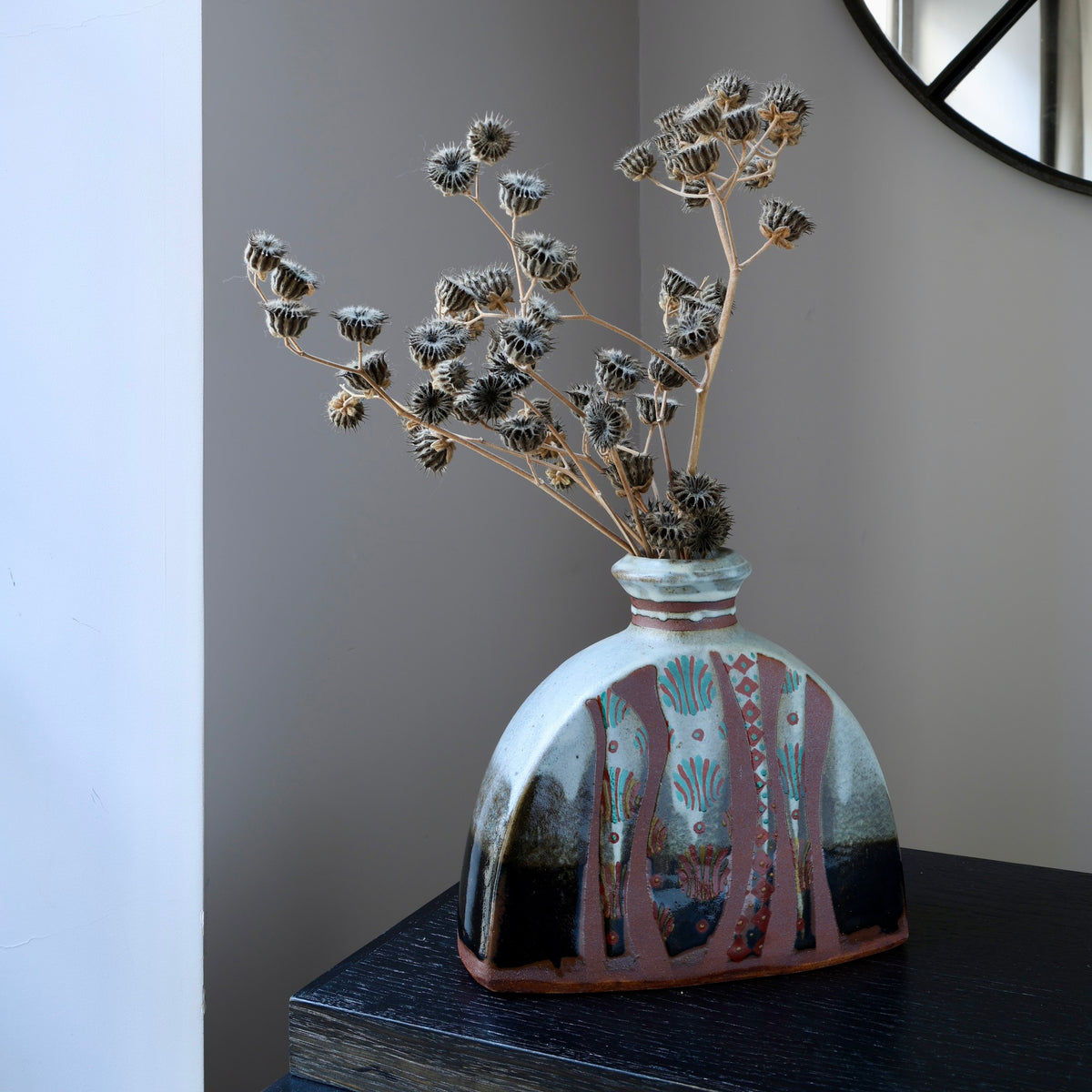
This henko vase (flattened vase) combines a light glaze in shades of cream and gray with large dark, almost black areas, whose variations reveal the richness of the glaze work. The composition is based on alternating bands of exposed red clay and glazed surfaces animated by stylized geometric and botanical motifs. The red, green, and ochre decorations are applied in successive lines and strokes, forming repetitive compositions whose colors and rhythms sometimes evoke textile patterns. The layering of surface treatments and the reserved areas that define the different zones contribute to the visual depth of the decoration.
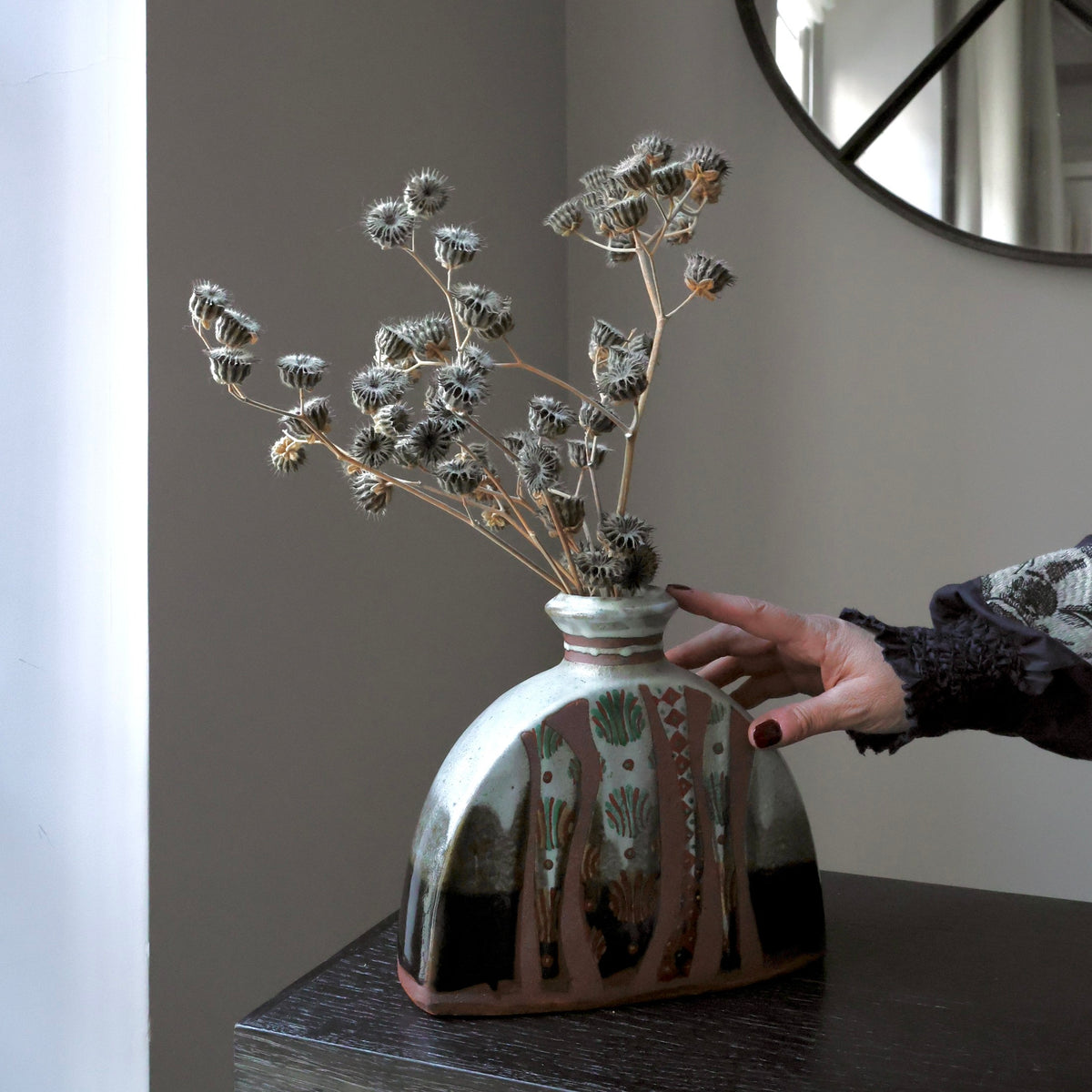
Through this combination of materials, colors, and textures, Tomoo Hamada renews the aesthetic of Mashiko yaki (Mashiko pottery) while maintaining a close relationship with the materials and skills passed down by his family. His resolutely contemporary language here transcends the vase’s purely functional role: its architectural silhouette, powerful contrasts, and rhythmic motifs give it a truly sculptural dimension. Designed to hold flowers as well as to be admired, this vase stands as a work of art in its own right, its visual presence transforming the space in which it is placed.
Presentation
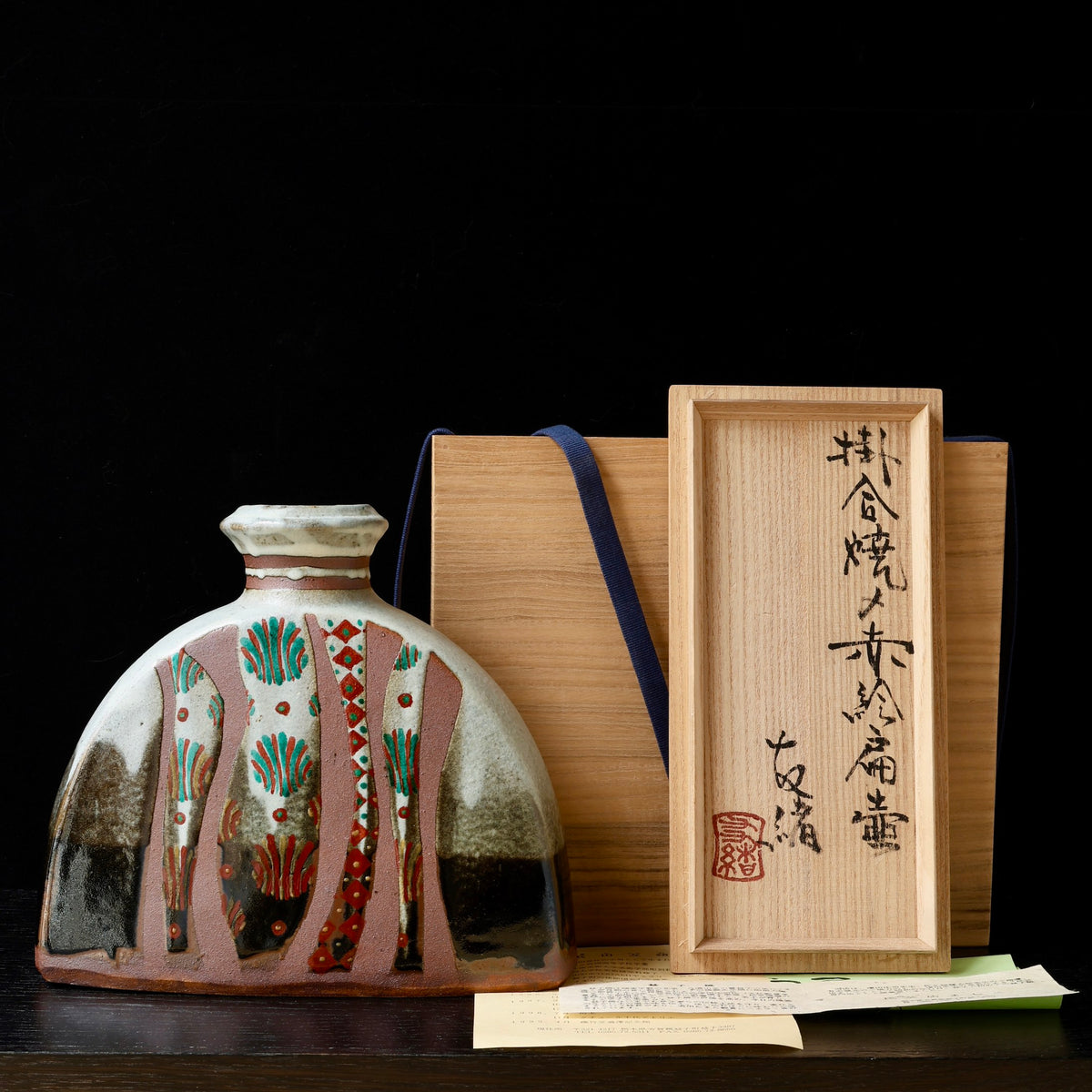
This vase is accompanied by its tomobako (signed wooden box), bearing the name of the work, the ceramicist’s signature and seal, as well as a shiori (information document) detailing the ceramicist’s profile.
Place of Manufacture
Japan, Mashiko, Tochigi Prefecture
Dimensions
Height 21 cm - Width 23.5 cm - Depth 9.8 cm
Weight
2.6 kg with box
Materials
Ceramic
Period
Heisei Era (1989–2019)
Condition
In very good condition
© Atelier Ikiwa – Laurence Corteggiani. Photos and text protected. All reproduction prohibited without authorization.
KNOW-HOW
Japanese ceramics, born more than 10,000 years ago, are a dialogue between earth and fire, a quest for harmony through imperfection.
With a wide variety of high-quality raw materials, such as rich clays and natural glazes, each region has developed its own techniques, reflecting the identity of its terroir.
Hand-crafted, these vases, made using the most precious Japanese ceramic techniques, bear the imprint of a master craftsman who is the heir to a thousand-year-old tradition. This living art embodies the essence of Japan, where history and nature unite in beauty.
Although deeply rooted in tradition, these exceptional Japanese ceramic vases, signed by very big names, have a resolutely contemporary spirit while preserving their authenticity, incredibly decorative and wonderfully timeless sculptural pieces.
DELIVERY AND PAYMENT OPTIONS
Shipping
Free shipping in mainland France for purchases over €200. Shipping with Colissimo, choice of Home delivery or Relay Point, package delivered against signature or unique code for valuable items. Orders are generally sent within 2 business days, except for art photographs which are printed on demand and special cases which will be announced in the banner at the top of the site (e.g., in case of absence). Learn more >
Payment Options
Secure card payment with Shopify Payments and 3D Secure technology.
Visa, MasterCard, American Express, Cartes Bancaires, PayPal, Apple Pay, Shop Pay and Klarna.
Klarna: pay in 3 interest-free installments or within 30 days, for purchases up to €1,500, subject to Klarna's approval. You will be redirected to Klarna to log in or create an account and confirm your payment.
PayPal: You will be redirected to PayPal to log in and confirm the payment. New users can create an account during checkout.
Your invoice will be sent with your order
Returns and Exchanges
14 days to change your mind. Learn more >
CARE INSTRUCTIONS
Handle with care. Rub gently with a soft cloth. Do not place near a heat source.
Choose options
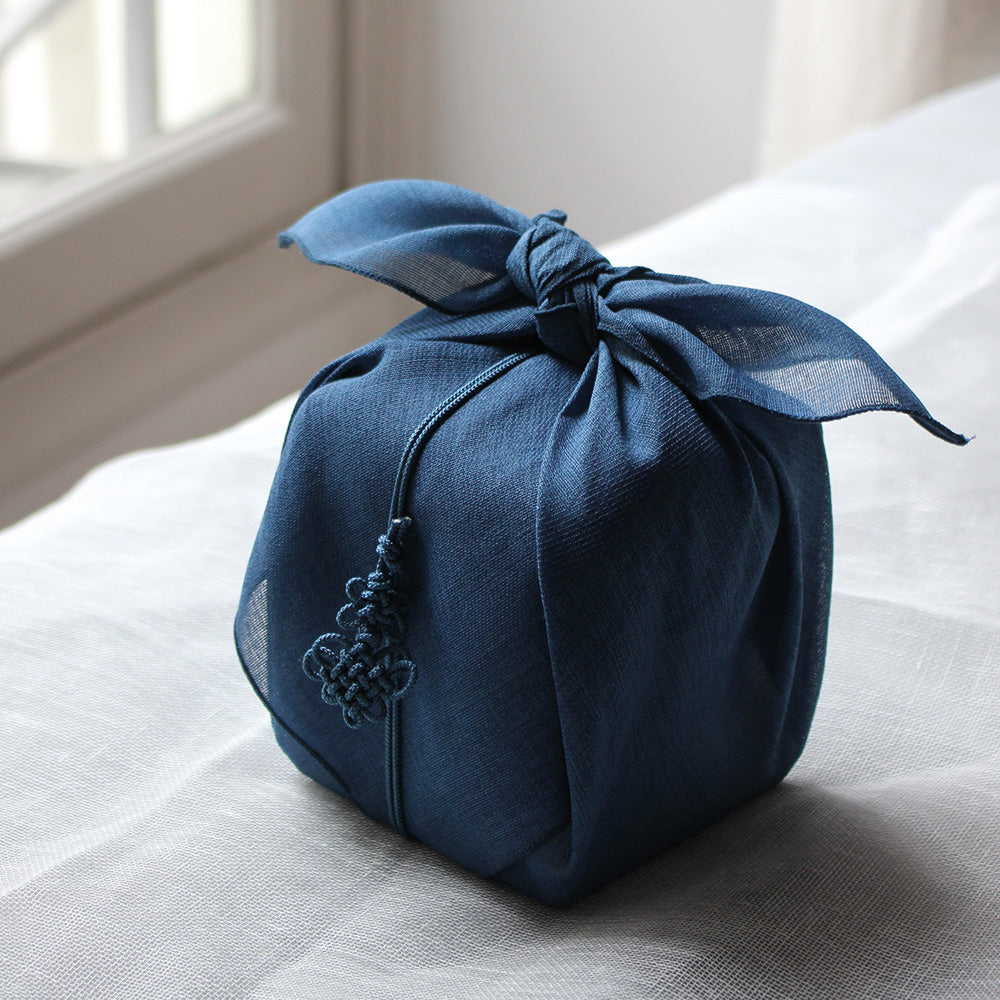
The art of wrapping
The exceptional items are wrapped in a beautiful fabric beautifully knotted using the little-known art of Korean pojagi and decorated with a delightful maedup (Korean ornamental knot). Details and conditions >

WRAPPING
Exceptional items are wrapped in textiles tied according to the Korean pojagi art