
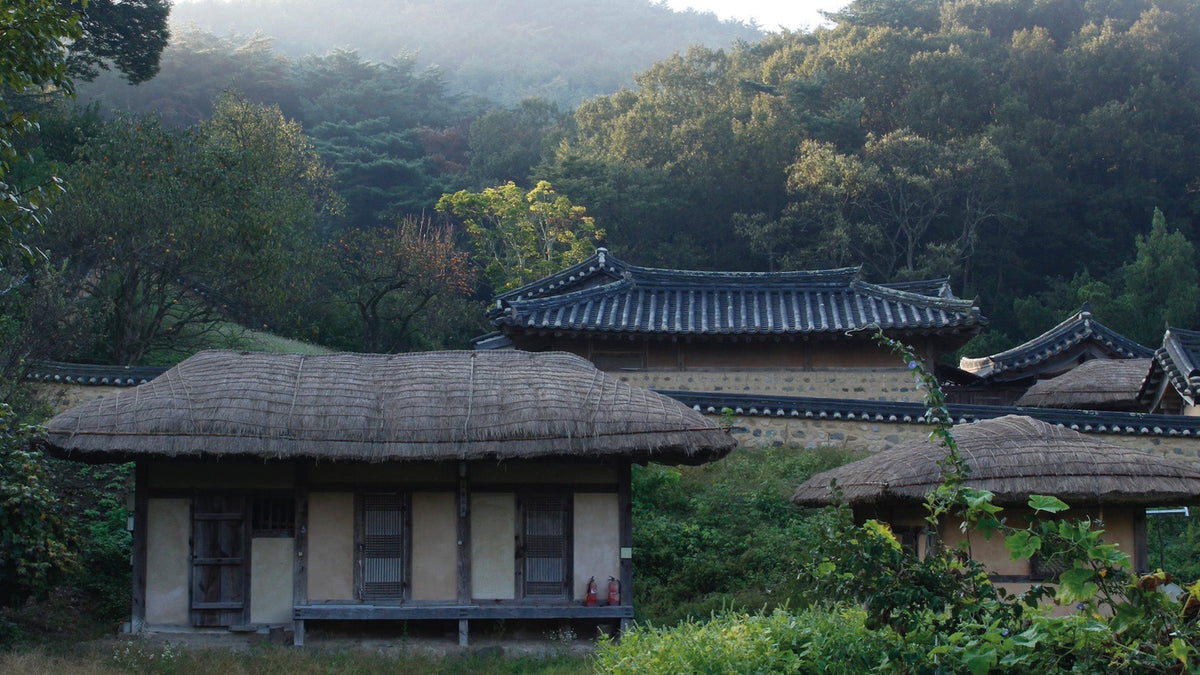
YANGDONG, ANOTHER KOREA
In Korea, there are a few places designated as "folk villages." This label, which sounds a bit like "Disneyland," hides very well-preserved traditional villages that, because they are few in number, have become major tourist attractions. Yangdong is one of them. Located about thirty kilometers north of Gyeongju, it belongs to that more discreet, less immediately spectacular Korea, but profoundly striking when one takes the time to linger there.
During the day, the village is very busy, and the perception of its charm can be altered. Groups pass by, cameras click. One must be willing to shift one's pace for the place to truly reveal itself.

A VILLAGE CONCEIVED AS A WORLD ORDER
Yangdong was founded in the 15th century, during the Joseon dynasty, by great families of Confucian scholars. This is not an anecdotal historical detail, but an essential interpretative key, because the village did not grow randomly; it was designed according to a very precise vision of society, where the organization of space reflects moral and social order.

The thatched-roof houses spread out below, close to the cultivated lands, while the noble tiled-roof residences occupy the heights, open to the landscape. This hierarchy is not brutal; it is legible, almost gentle, inscribed in the slope of the terrain and in the natural flow of sight. This organization also allows for multiple experiences in one, offering an interesting perspective on village life.

ARCHITECTURE OF EVERYDAY LIFE
The houses of Yangdong are beautiful without necessarily trying to be, and nothing is perfectly smooth in this village; it's even very lively (sometimes quite messy in some courtyards!). Patinated wood, earthen walls, gently curving roofs, inner courtyards protected from the wind. Everything seems to be on the scale of daily life; one feels that these dwellings were designed to be lived in, to last, to grow old with their inhabitants.

Nature is very present, everything is harmonious. Vegetable gardens adjoin the houses, trees bend under their fruit, and gentle hills envelop the village. Whether it's the thatched-roof houses below or the nobler ones situated higher up, the whole forms a landscape of great coherence, where nothing seems out of place.

TIME AS AN ALLY
The most exceptional experience to truly enjoy it is to arrive in the late afternoon, once all the tour buses have left, spend the night there, and depart before late morning. The village then returns to its residents. Yangdong is not a museum-village. It is small, but lively and inhabited, mainly by elderly people, who busy themselves in their cultivated gardens. And there's little more than a telephone booth overgrown with tall grass to suggest that the village hasn't yet entered modernity; for the rest, mobile phones are very much present.

There is a terribly moving gentleness in this village. A gentleness without sentimentality, made of slow rhythms, presences, greetings that transcend language barriers. One no longer truly visits; one observes, one walks, one stops for no specific reason.

With luck, you visit a village that changes with the hours and the light, unfolding infinite variations that create very different atmospheres depending on the time of your stroll. In the low, golden light of evening, or the misty and mysterious light of morning, Yangdong is never quite the same.

AN INNER KOREA
Yangdong doesn't try to seduce, doesn't tell anything spectacular, but shows something else: an inner and calm Korea, structured, shaped by centuries of ordinary life and Confucian thought. A place where history is not told on signs, but inscribed in the volumes, distances, customs, encounters, and surprises.
You leave with a lasting impression, that of having encountered a different temporality, slower, quieter, yet profoundly alive. A true favorite, for sure!

PRACTICAL INFORMATION
Yangdong is located about thirty kilometers north of Gyeongju (which can be reached in about 2 hours by KTX train from Seoul, with several daily connections). To get to Yangdong from Gyeongju, you can take a bus (irregular schedules) or, more simply, a taxi, for about €20.

Please note, I did not see any place to have lunch or dinner in Yangdong, so you should bring some provisions for a small picnic in your room in the evening. The only exception to this is the welcome in some guesthouses, which may include a snack upon arrival. In mine, where I arrived at 3:30 PM, the hostess had prepared a wonderful "afternoon tea" for me that was more like a late lunch or early dinner, and it was largely sufficient until the next morning when breakfast was provided. But to be safe, it's better to bring what you'll need.

My guesthouse, Hyangdan House, was spectacular, in a "noble" house on top of a small hill, overlooking the village. 500 years old, it has a very rich history that the owner, Nan-hee, enjoys recounting (a translation app is essential here for communication!). This house is the largest in the village; it once had up to 99 rooms (but unfortunately part of it was destroyed during the Korean War), all in dark wood, hanji paper partitions, small nooks. It has an incredible charm! Here, you sleep in the Korean style, without modern comfort improvements, directly on the hard floor (no tatami mats in Korea!), on a simple, very thin mattress. The bathroom is outside the house and very spartan. All of this is, of course, part of the experience, but it won't be for everyone's taste, so take it into consideration to avoid disappointment.

This house is on Airbnb, but the random translation from Korean makes selecting the room and booking a bit complicated. Arm yourself with patience; it's really worth it!

© Atelier Ikiwa – Laurence Corteggiani. Photographs and texts protected. All reproduction prohibited without authorization.