

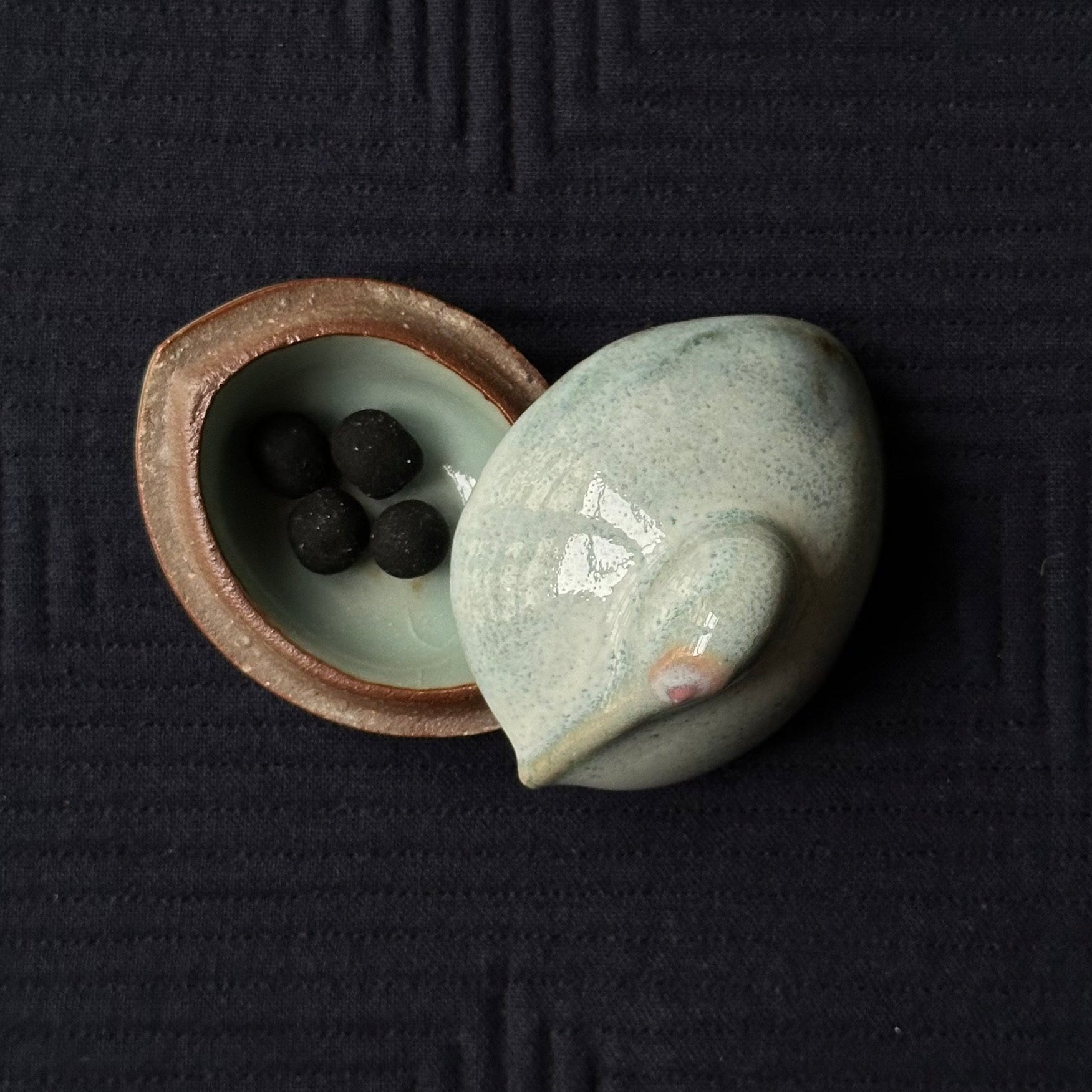


Uno Soyo ceramic kōgō and Japanese nerikō (incense balls)
In the art of Japanese incense, the kōgō is a small, precious box that preserves and showcases the nerikō, refined incense tablets made from precious woods and spices. Together, they embody a sensory tradition rooted in the elegance of gestures and the subtlety of fragrances, which Atelier Ikiwa was keen to celebrate by offering a carefully curated selection of superb kōgō, here crafted by ceramicist Uno Soyo, accompanied by their nerikō boxes to introduce this little-known art.
The craftsman
This kōgō was created by Uno Soyo (1888-1973), an eminent Kyoto ceramist specializing in kun glazes, celadon and purple glazes inherited from research on jun firing techniques during the Song dynasty. Trained at the Kyoto Municipal School of Arts and Crafts and later at the Kyoto Municipal Ceramics Laboratory, he dedicated his career to the in-depth study of high-temperature glazes, mastering their delicate nuances and characteristic gradations. Recognized by Japanese cultural authorities for the importance of his technique and the need to document it to ensure its transmission, he contributed to the redefinition of Kyoto celadons in the 20th century. His works, frequently awarded prizes at international exhibitions and distinguished with national decorations, have entered various public collections, testifying to his demanding exploration of color and light.
The technique and the decor
This kōgō depicts a small, stylized crane, a lucky motif associated with longevity and good wishes. Its rounded body and slightly raised head evoke the bird in a calm posture, typical of the gentle forms favored in chanoyu ware to create a discreet yet expressive presence. The glaze belongs to the kun glaze family, a technique inspired by high-temperature celadons, where a base rich in iron oxides and controlled firing in a reducing atmosphere result in a milky celadon blue with subtle variations. The bluish hues arise from the glaze's reaction in the kiln, creating the subtle color transitions characteristic of kun glazes. The piece is signed (with a seal) by the potter at its base.
The nerikō
To enjoy the kōgō as intended, a box of nerikō is also included. This box contains thirty-six nerikō beads, each composed of a delicately fragrant blend based on sandalwood, crafted by one of Kyoto's oldest incense houses. To use them, place two or three in the kōgō and leave the lid slightly ajar. To stop the fragrance, simply close the lid. The nerikō beads should be replaced when they become dry. It is important to store unused nerikō in the tightly sealed plastic bag to prevent them from drying out.
To discover the art of Japanese kōgō and nerikō, we invite you to read the article we wrote on the subject, available via this link . Other kōgō are available on the site; feel free to browse our selection.
Practical information
Place of manufacture
Japan
Dimensions
Length 6.5cm - Width 5cm - Height 4.5cm
Weight
158 g with the wooden box
Materials
Ceramic
Period
Shōwa era (1926-1989)
Accessories
For the kōgō: a protective box made of paulownia wood tomobako bearing the inscription of the work, the signature and the official seal of the craftsman, a protective cloth tomonuno bearing the seal of the craftsman, as well as an information document shiori.
For the nerikō: box containing thirty-six nerikō marbles.
The kōgō and nerikō will be packed together in a white cardboard box wrapped in a beautiful, skillfully knotted textile, making it an original, unique and very elegant ready-to-give gift.
Usage tips
Place two or three nerikō beads in the kōgō, leave the lid slightly ajar to diffuse the fragrance or closed to stop diffusion. Replace the beads when they become dry and store any unused beads in their airtight bag. Keep out of reach of children and pets. Do not ingest. Avoid prolonged skin contact. If you experience discomfort or sensitivity to the scent, discontinue use. Store away from heat, humidity, and direct sunlight.
© Atelier Ikiwa – Laurence Corteggiani. Photos and texts protected. All reproduction prohibited without permission.
DELIVERY AND PAYMENT OPTIONS
Shipping
Free shipping in mainland France for purchases of €200 or more. Shipped with Colissimo, you can choose home delivery or a pickup point. Parcels are delivered against signature or a unique code for valuable items. Orders are generally dispatched within 2 business days, except for fine art photographs, which are printed on demand, and special cases, which will be announced in the banner at the top of the website (e.g., in case of absence). Learn more >
Payment Options
Secure card payment with Shopify Payments and 3D Secure technology.
Visa, MasterCard, American Express, Cartes Bancaires, PayPal, Apple Pay, Shop Pay, and Klarna.
Klarna: Pay in 3 interest-free installments or within 30 days, for purchases up to €1,500, subject to Klarna's acceptance. You will be redirected to Klarna to log in or create an account and confirm your payment.
PayPal: You will be redirected to PayPal to log in and confirm payment. New users can create an account during checkout.
Your invoice will be sent with your order.
Returns and Exchanges
14 days to change your mind. Learn more >
Choose options
WRAPPING
Exceptional items are wrapped in textiles tied according to the Korean pojagi art