

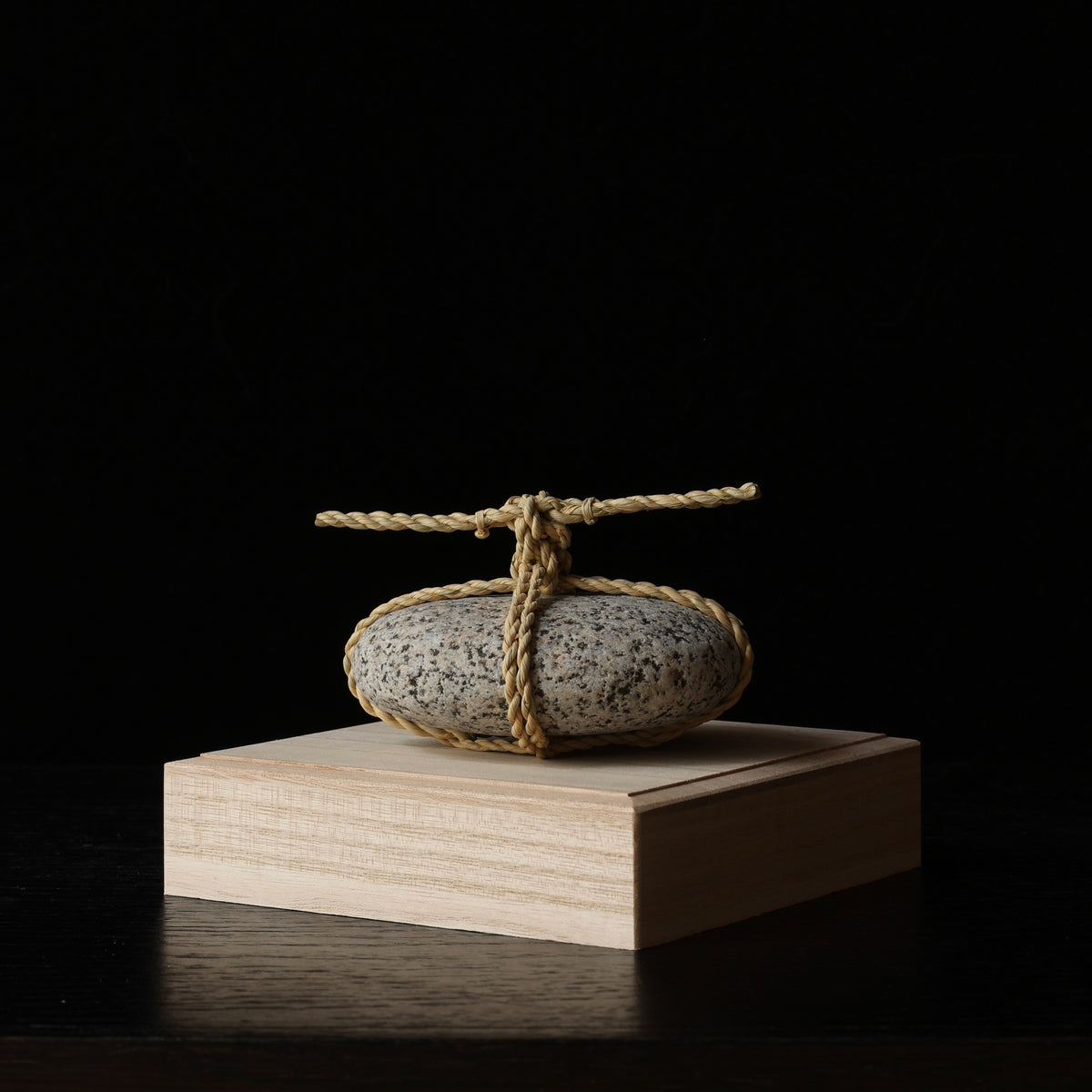
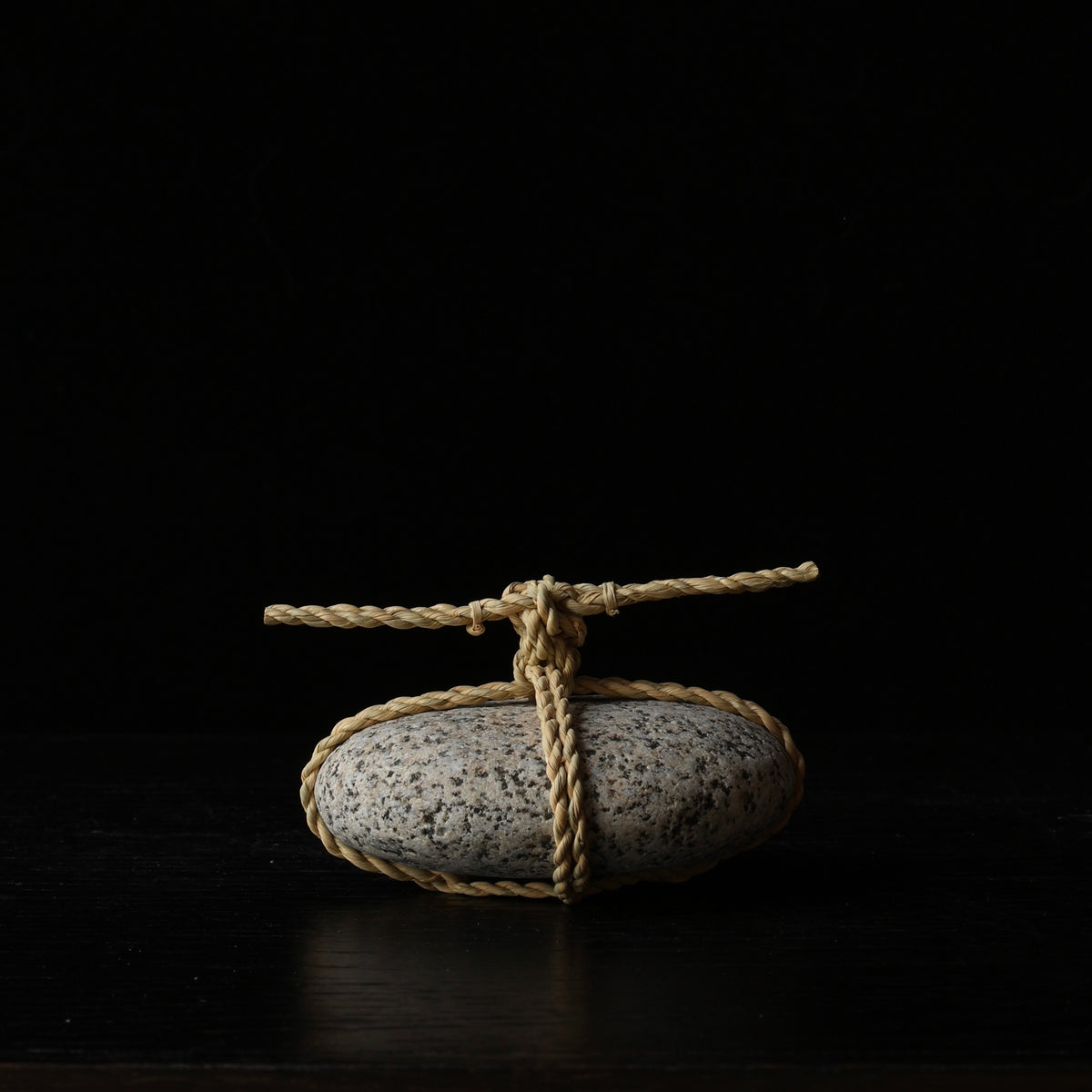
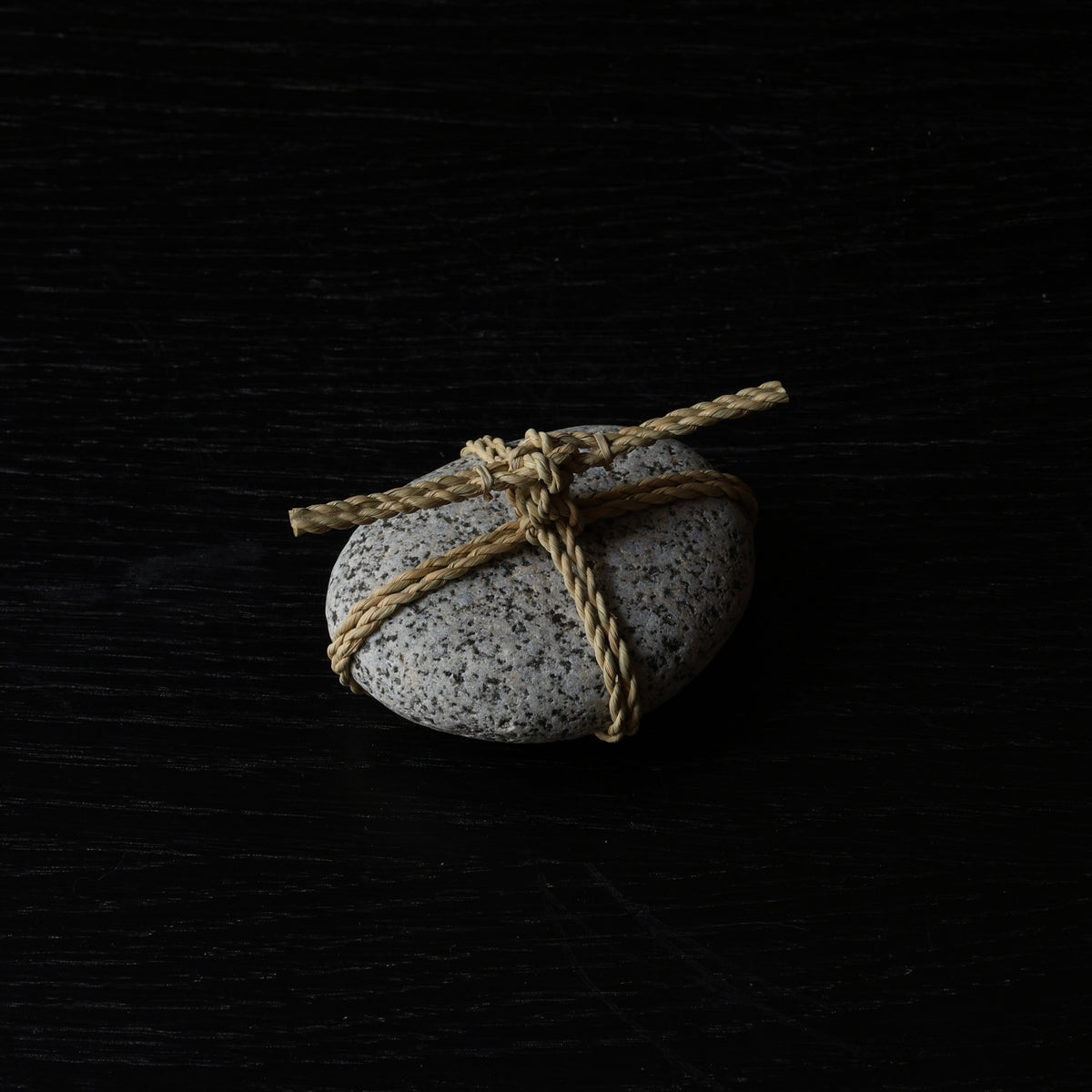
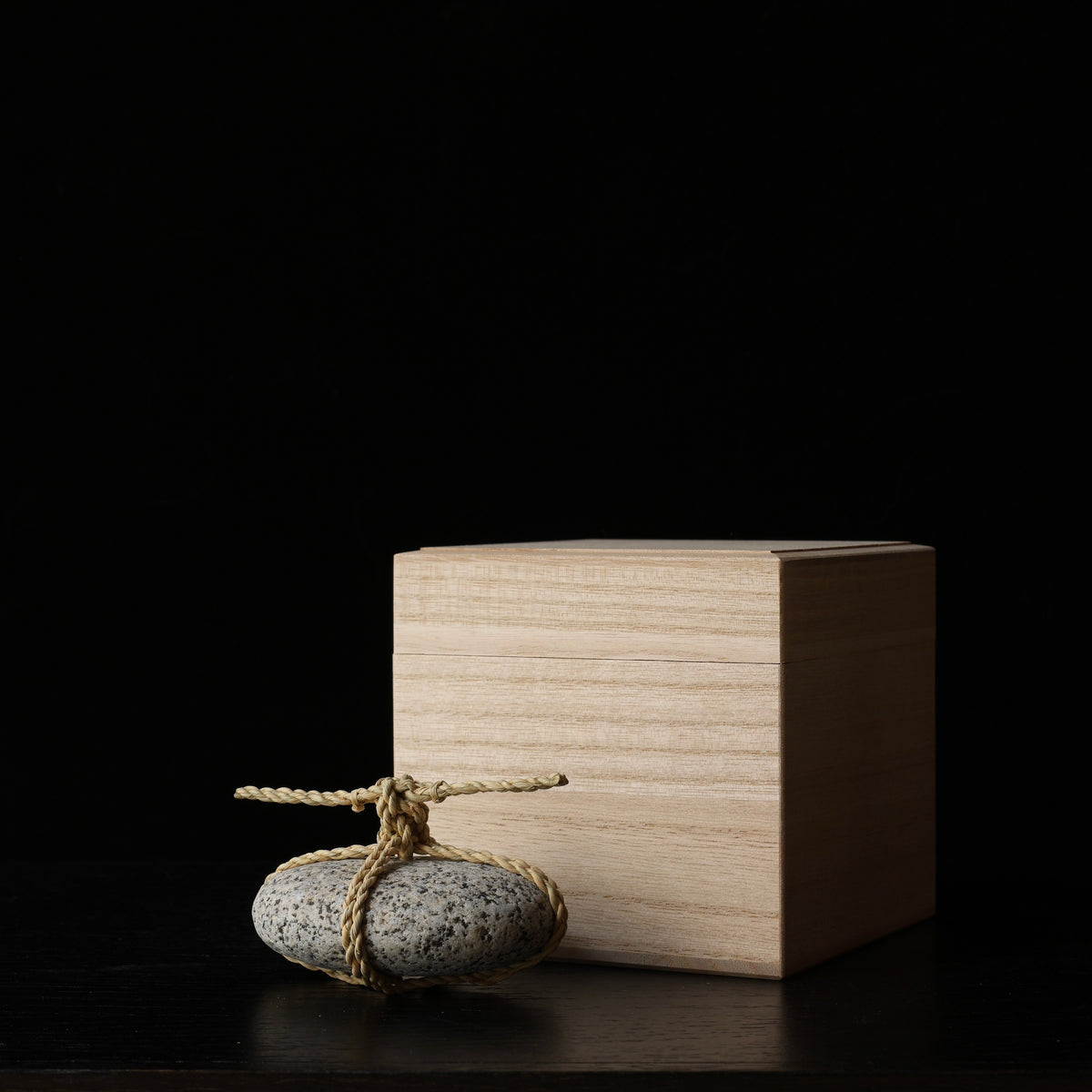

Sekimori #19, stone and rice straw (wara) rope
The sekimori-ishi, or guardian stone, finds its origins in the Japanese tea gardens of the era of Sen no Rikyū, the founding master of the tea ceremony, in the 16th century. Placed at the entrance to a space, it serves as an invitation to pause before crossing the threshold—a gesture of restraint and respect. This sekimori by Eri (WARA), with its polished stone and rice straw (wara) rope, embodies ma (interval) and yohaku (the beauty of emptiness), two essential notions of Japanese aesthetics that evoke the space between things, the silence that gives meaning to presence. In a space one holds dear, this stone becomes a touchstone of calm, a moment of breath in daily life.
The Artist
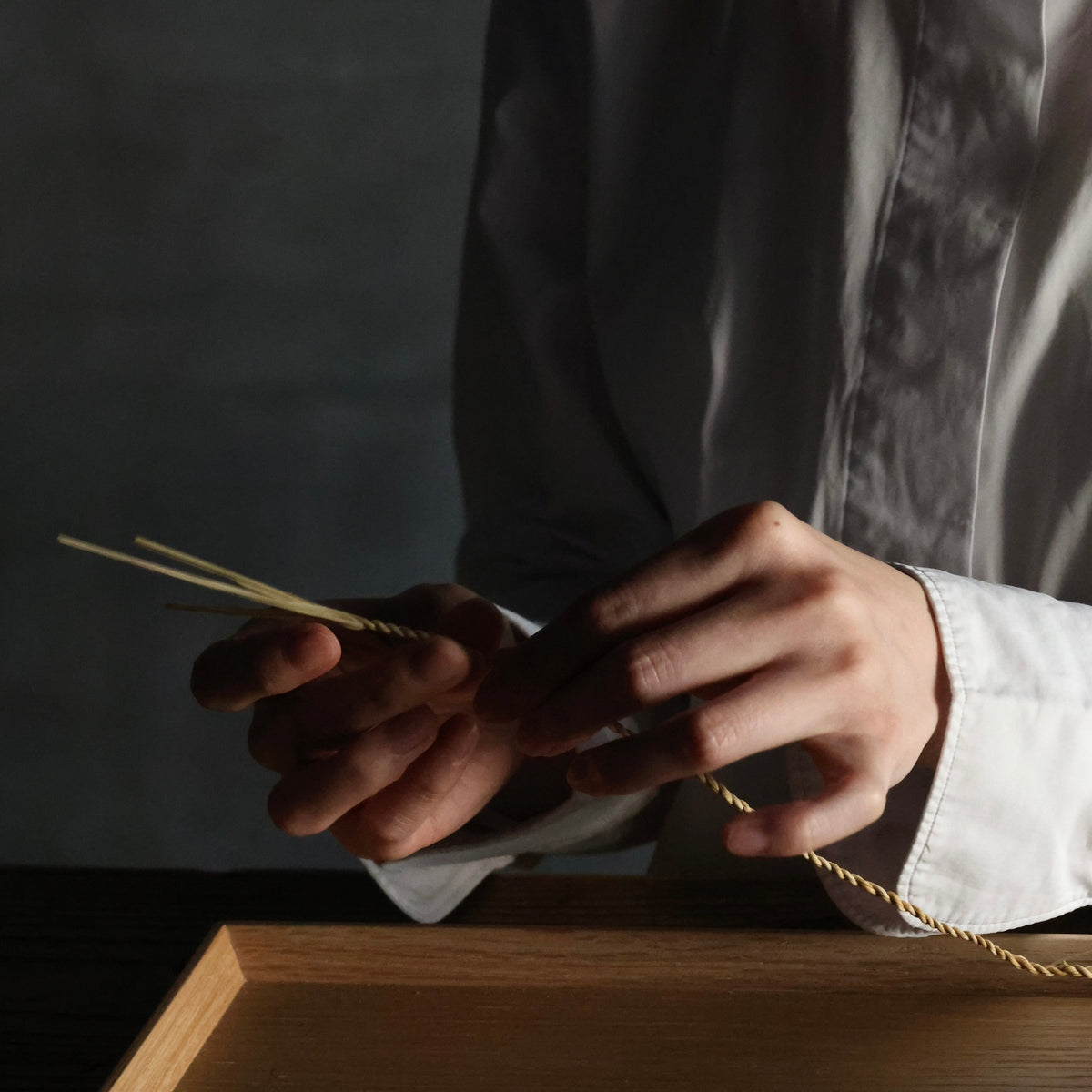
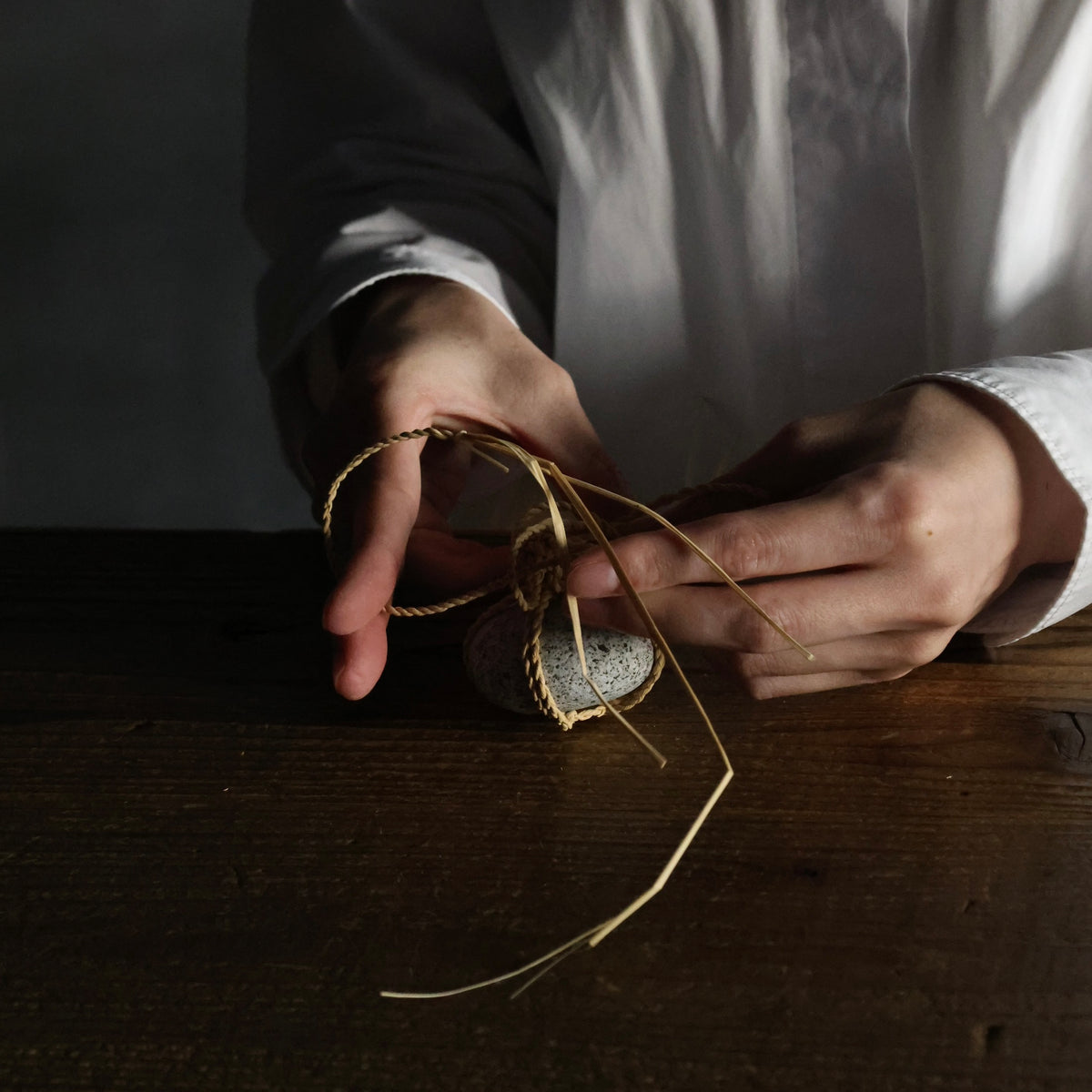
Eri lives and works in Shizuoka Prefecture. In 2020, moved by the meditative dimension of working with rice straw, she began braiding ropes inspired by shimenawa—the sacred ropes of Shinto shrines that mark the boundary between the sacred and the ordinary—and founded her brand, WARA. Her work explores the connection between material, ritual, and inner life, in an approach where every movement becomes an act of consciousness. Through the braiding of shimenawa and the creation of sekimori, she weaves a dialogue between past and present, extending an aesthetic of ma and yohaku, where beauty is born from silence, emptiness, and the precision of the gesture.
The Technique and Decor
The stone, chosen by Eri on the Shizuoka coast, was selected for the balance of its shape and the smoothness of its surface, naturally polished by the sea. It is wrapped in a wara (rice straw) rope, braided entirely by hand using the same technique as that of the shimenawa in Shinto shrines. The wara, derived from rice straw that has been carefully dried, beaten, and then combed, features a fiber that is both structured and soft, with a natural, warm feel; it has been used since antiquity in Shinto rituals and seasonal practices. Its matte texture and golden hue, which evoke the warmth of daily life and the rhythm of the seasons, lend the object a peaceful presence, imbued with balance and simplicity.
This sekimori is a unique piece, the stone having been chosen for its individuality and the braiding bearing the mark of the artist’s hand.
Practical Information
Place of creation: Shizuoka Prefecture, Japan
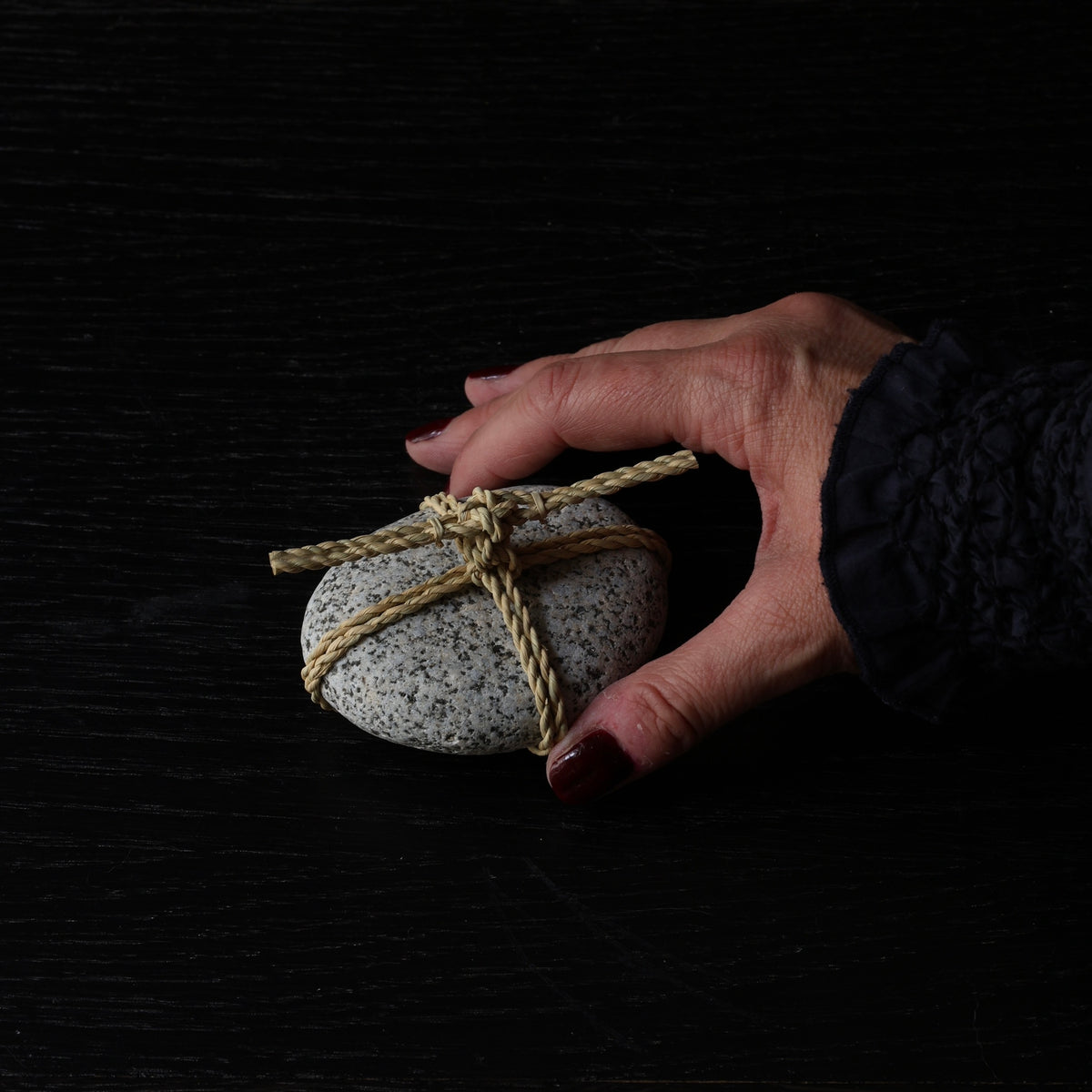
Format: Medium (see the image with the hand for scale)
Dimensions (including rope): Length 9.5cm - Width 6.9cm - Height 4.8cm
Weight (without box): 232g
Materials: natural stone, wara (rice straw) rope
Period: contemporary
This Sekimori is presented in a protective paulownia wood box, the lid of which can serve as a display stand, accompanied by a booklet in Japanese describing the artist’s intent (a translation of which will be provided).
© Atelier Ikiwa – Laurence Corteggiani. Photos and texts protected. All reproduction prohibited without permission.
Origin and symbolism
The sekimori-ishi, or tome-ishi, is a stone in Japanese gardens surrounded by a braided rope that invites one to go no further. Neither barrier nor obstacle, it marks the boundary of a space to be preserved. This highly subtle gesture extends the tradition of shimenawa, sacred Shinto ropes demarcating places inhabited by the divine: the stone thus becomes a spiritual threshold, a point of attention in the landscape.
The use of sekimori-ishi dates back to the 16th century, during the time of Sen no Rikyū, in tea gardens called roji ("dew path"). Placed at certain junctions, the stone surrounded by a braided rope gently and restrainedly indicated the boundary of an area not to be crossed. The tome-ishi, its close relative, was used in temples to indicate a closed or reserved area.
These stones express the Japanese philosophy of the threshold: marking the limit without constraining, preserving the tranquility of a place by the mere presence of a sign. If you would like to know more about sekimori and the work of Eri / WARA, you can read our dedicated article > .
DELIVERY
Delivery
Free delivery in mainland France for purchases over €200. Shipping with Colissimo, delivered to your home or a pick-up point, with parcels requiring a signature or unique code for valuable items. Orders are generally dispatched within 2 working days, except for art photographs which are printed on demand and special cases that will be announced in the banner at the very top of the site (e.g., in case of absence). Learn more >
Payment options
Secure card payment with Shopify Payments and 3D Secure technology.
Visa, MasterCard, American Express, Cartes Bancaires, PayPal, Apple Pay, Shop Pay and Klarna.
Klarna: Pay in 3 interest-free installments or within 30 days, for your purchases up to €1,500, subject to Klarna's approval. You will be redirected to Klarna to log in or create an account and confirm your payment.
PayPal: You will be redirected to PayPal to log in and confirm payment. New users can create an account during checkout.
Your invoice will be sent with your order
Returns and exchanges
14 days to change your mind. Learn more >
CARE INSTRUCTIONS
Sekimori stone: Remove dust with a very soft cloth to avoid scratches. Always handle the stone by the stone and not by the rope, never pull on the knot, let it air dry if the rope is wet. For hemp models, the fibers can sometimes shift: simply realign them by gently rolling the rope between your fingers to realign them.
Paulownia wood box: Avoid contact with water. Since the box is unvarnished, it will stain if wet. Do not store it in a hot or humid place. Sudden temperature changes may cause the wood to discolor to brown tones. Store it in stable conditions.
Choose options

WRAPPING
Exceptional items are wrapped in textiles tied according to the Korean pojagi art